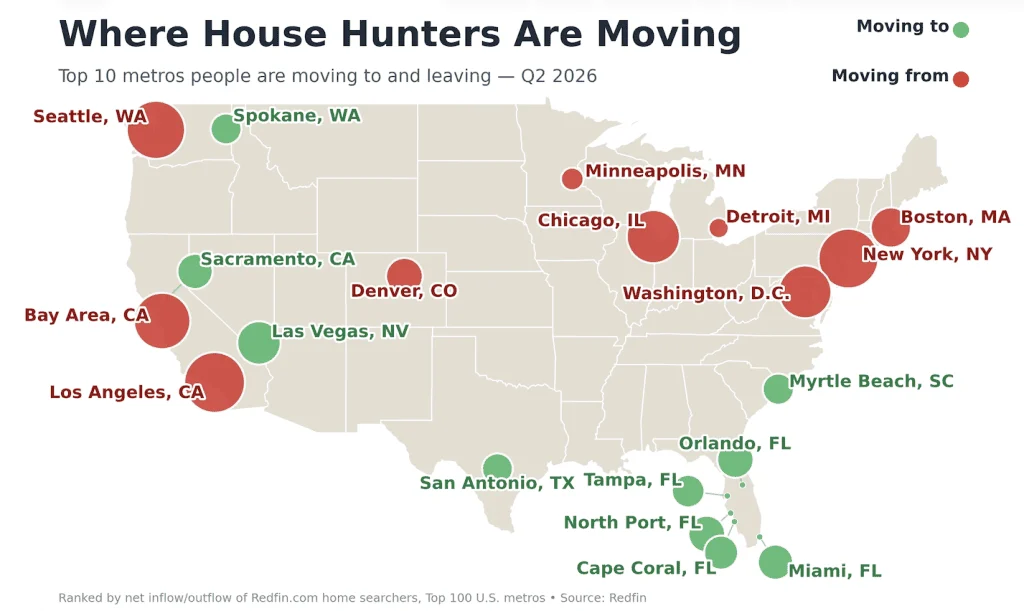
The landscape of the American housing market is undergoing a profound geographic shift, as home searchers increasingly abandon high-cost coastal powerhouses in favor of more affordable, warmer climates. According to the latest migration data from Redfin for the second quarter of 2026, Las Vegas has emerged as the most sought-after destination for Americans looking to relocate. This trend represents a broader, structural movement that has been building momentum since the onset of the pandemic, driven by a combination of remote work flexibility, the pursuit of lifestyle improvements, and a desperate search for affordability in an era of elevated interest rates and home prices.
The data, which tracks the net inflow and outflow of Redfin.com users searching for homes outside their current metropolitan area, reveals that nine of the top 10 most popular destination metros are located in the Sun Belt. Following Las Vegas, which recorded a net inflow of 9,581 users, the Florida markets of North Port, Orlando, and Miami round out the top tier of preferred destinations. This influx into the southern and western regions of the United States underscores a fundamental recalibration of where the American workforce—and retirees—are choosing to plant their roots.
The Economic Engine Behind the Migration
The primary catalyst for this migration pattern is the stark disparity in housing costs between origin and destination cities. For many households, moving is no longer merely a lifestyle choice; it is a financial necessity. For instance, the typical home in Las Vegas currently lists for approximately $447,000. In contrast, the top origin city for those moving to the Nevada gambling hub—Los Angeles—features a median home price of $922,000. By relocating to a market like Las Vegas, a family can effectively double their purchasing power or significantly reduce their monthly housing overhead, a critical factor in a high-inflation environment.
This phenomenon is not limited to Nevada. The same economic logic applies to those leaving the New York metropolitan area for markets like Philadelphia, where the median home price of $309,000 offers a drastic reduction compared to the $832,000 average seen in the Big Apple. As remote and hybrid work models have stabilized into long-term fixtures of the corporate landscape, the necessity of living within commuting distance of a Tier-1 coastal city has diminished, empowering workers to prioritize home ownership and quality of life over proximity to the office.
Chronology of a Shifting Market
The trend toward Sun Belt migration did not appear in a vacuum. The roots of this movement can be traced back to 2021, when the initial shock of the global pandemic forced a total rethink of residential priorities. Throughout 2022 and 2023, the surge in demand for space and affordability transformed secondary cities into primary real estate hotspots.
By 2024, the "Zoom town" phenomenon began to stabilize into a consistent pattern of domestic migration. As of the second quarter of 2026, the data indicates that 18.7% of all house hunters are actively looking to move to a different metro area. This figure represents the highest second-quarter share since records began in 2021. While the raw number of individuals moving may be tempered by the current sluggishness of the overall homebuying market, the share of people choosing to relocate confirms that the appetite for geographic mobility remains higher than it was in the pre-pandemic era.
The Coastal Exodus: A Snapshot of Declining Hubs
While the Sun Belt thrives, the traditional anchors of the American economy—Los Angeles, New York, and Seattle—are experiencing significant net outflows. Los Angeles leads the nation in outbound searches, with a net outflow of 28,652, as residents seek relief from the city’s extreme cost of living and inventory constraints. New York follows closely with a net outflow of 27,143, and Seattle rounds out the top three with 24,728.
These figures illustrate a "hollowing out" effect in high-cost, high-tax jurisdictions. Beyond the primary coastal centers, other major job hubs like San Jose, Chicago, Washington D.C., and Boston are also seeing residents depart in significant numbers. The implications for these cities are profound, ranging from shifts in local tax bases to changing demographics and labor market composition. Urban planners and local policymakers in these regions are increasingly tasked with addressing housing supply crises, as the cost of living continues to push the middle class toward more accessible markets.

State-Level Analysis: Florida Leads the Pack
When aggregating the data to a state-wide level, the dominance of Florida becomes undeniable. The Sunshine State attracted a net inflow of 38,922 house hunters in the second quarter of 2026, a figure that dwarfs its nearest competitors, including South Carolina, Arizona, and Tennessee. In fact, Florida’s intake of new residents is greater than that of those three states combined.
This concentration of growth in Florida is largely attributed to a lack of state income tax, a generally favorable regulatory environment for businesses, and the perceived benefits of a warmer climate. Conversely, California stands as the clear leader in outbound migration, with a net outflow of 56,548—a number nearly double that of New York, the state with the second-highest outflow. This trajectory suggests that California’s housing market, while exceptionally valuable, is facing a ceiling in terms of affordability that is actively driving a segment of its population to seek stability elsewhere.
Implications for the National Housing Market
The current migration trend has several critical implications for the broader U.S. economy. First, the movement of workers into lower-cost metros is likely to continue exerting upward pressure on home prices in those destination cities. As demand surges in markets like Sacramento, Cape Coral, and Spokane, local inventory is strained, leading to increased competition and faster price appreciation. This can create new affordability challenges for long-term residents of these "receiving" cities, potentially leading to a cycle where the very affordability that attracted new arrivals begins to erode.
Second, the structural nature of this migration suggests that the traditional "hub-and-spoke" model of economic activity is becoming decentralized. Companies are finding that they can tap into talent pools across the country rather than being confined to the talent clusters of the Northeast or Silicon Valley. This distribution of human capital could lead to more balanced regional economic growth over the coming decade, though it places a significant burden on the infrastructure of rapidly growing Sun Belt cities.
Third, the data serves as a warning for policymakers in high-cost states. If the trend of out-migration continues, states like California and New York will need to aggressively address the supply of housing—specifically middle-income and starter-home inventory—to retain their workforce. Without intervention, these states risk losing the essential workers who sustain their service and infrastructure sectors.
Methodology and Data Context
It is important to note that this data reflects the intentions of Redfin.com users rather than completed sales. The analysis tracks individuals searching for homes across more than 100 U.S. metro areas. A user is identified as a potential migrant if they view at least 20 for-sale or for-rent properties in a destination metro during a single month. While this methodology is a robust indicator of intent, it does include those looking for vacation properties or real estate investments, which may slightly inflate the numbers of those seeking permanent relocation.
Furthermore, the data shows that the willingness to relocate is closely tied to the broader economic environment. With mortgage rates remaining elevated and inventory tight, the overall pool of homebuyers has contracted. The fact that the share of people looking to move is at a record high suggests that the desire for relocation is a strong, persistent force, even when market conditions are less than ideal.
Conclusion
As the second quarter of 2026 draws to a close, the data presents a clear narrative: the American housing market is in a state of flux, defined by a search for value. The movement from expensive coastal cities to the Sun Belt is not a temporary anomaly but a response to deep-seated economic realities. For the residents, it is a strategic maneuver to improve their standard of living; for the nation, it is a shift that will redefine the economic and demographic map of the United States for years to come. Whether this trend leads to a sustainable growth model or creates new economic bubbles in the Sun Belt remains to be seen, but for now, the path of the American house hunter is undeniably pointed toward the sun.