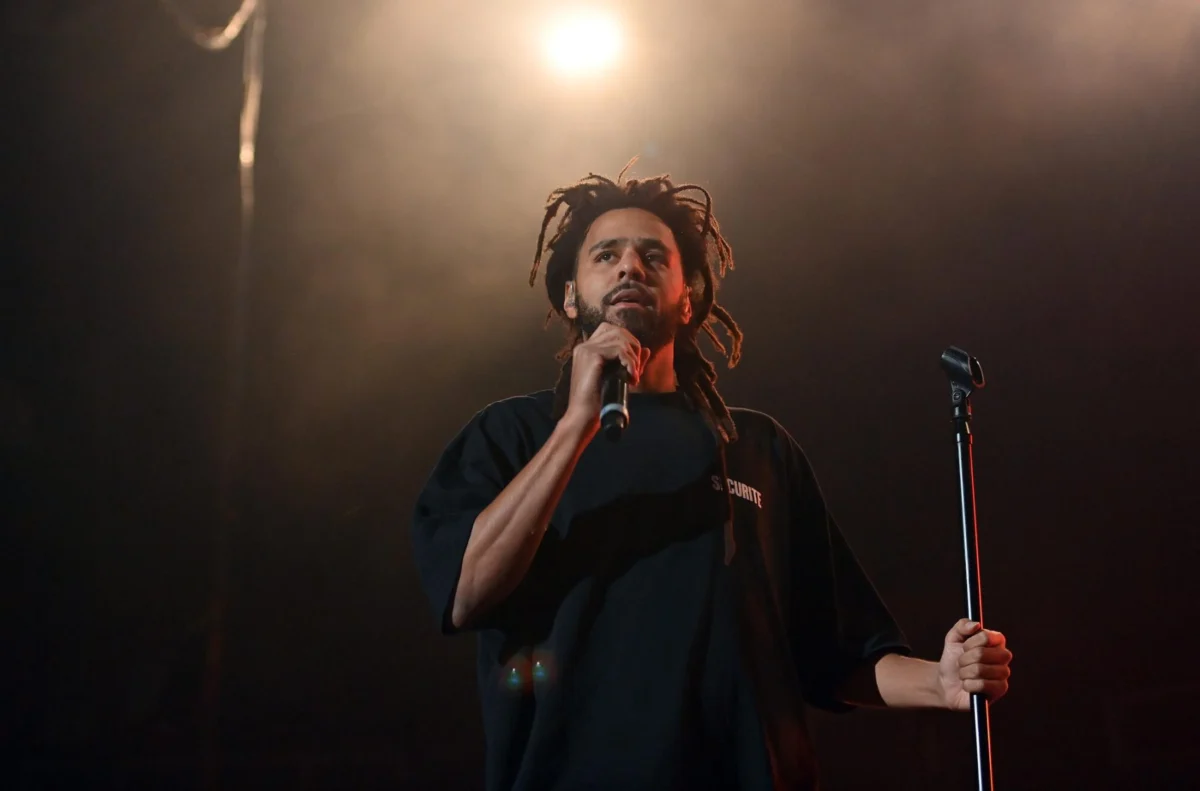
The North Carolina-born hip-hop heavyweight J. Cole has officially embarked on one of the most anticipated concert series of the year, The Fall-Off World Tour. As the tour progresses through its initial North American dates, it has already become a focal point for viral moments, ranging from high-stakes romantic gestures to nostalgic stage interactions that hark back to the early days of the rapper’s career. From the Kaseya Center in Miami to the State Farm Arena in Atlanta, the tour is proving to be more than just a musical showcase; it is functioning as a series of communal experiences that bridge the gap between the multi-platinum artist and his dedicated "Dreamville" fan base.
The Atlanta Performance: A Return to Nostalgia
During the tour’s fourth stop at Atlanta’s State Farm Arena, a venue with a capacity of approximately 21,000, J. Cole found himself at the center of a lighthearted moment that momentarily paused the high-energy set. While performing his 2011 hit single "Work Out," a track from his debut studio album Cole World: The Sideline Story, an audience member threw a bra onto the stage. The incident, while a common trope in rock and pop history, appeared to catch the 39-year-old rapper by surprise.
Holding the garment up for the crowd to see, Cole broke into a laugh, reflecting on the rarity of such an occurrence in the current era of his career. "N—a ain’t got a bra onstage in a long motherf—in’ time, boy," he told the cheering audience. His reaction, captured in numerous fan videos that subsequently went viral on social media platforms like X and TikTok, was one of genuine amusement. "You gotta cherish that sh—," he added before resuming the performance.
The choice of "Work Out" as the backdrop for this moment is significant. The song was Cole’s first major commercial success, peaking at number 13 on the Billboard Hot 100, though it was famously criticized by hip-hop purists and Cole’s own idol, Nas, for being "too commercial." By including it in his current setlist, Cole acknowledges his journey from a rising star seeking radio play to a seasoned veteran who can now laugh at the tropes of superstardom.
Miami Highlights: Engagements and Front-Row Upgrades
The Atlanta incident followed a series of equally impactful events during the tour’s two-night residency in Miami the previous week. On the second night at the Kaseya Center, the atmosphere shifted from high-octane performance to intimate celebration during the song "Life Sentence." The track, a standout from his latest album The Fall-Off, serves as an ode to long-term commitment and the sanctity of marriage, despite a title that traditionally carries a more somber legal connotation.
As the song played, a couple in the audience became engaged, drawing the immediate attention of the rapper. Cole paused to offer his congratulations from the stage, stating, "What’s up, baby girl? What’s up, my boy? God bless y’all. That’s f—ing beautiful. Y’all make some noise for them, man." This interaction highlighted Cole’s reputation for maintaining a high level of situational awareness during his performances, often interacting directly with fans in the "pit" or front rows.
In a separate but related incident in Miami, Cole and his management team, led by Dreamville co-founder Ibrahim "Ib" Hamad, demonstrated a commitment to fan experience that went beyond the music. A pair of long-time fans, who had followed Cole’s career since 2010, discovered that their purchased tickets had an "obstructed view" of the stage. Upon learning of the situation, Cole’s team upgraded the couple to front-row seats.
The fans later took to social media to express their gratitude, noting that they were scheduled to be married the day after the show. The groom-to-be, posting under the handle @0xQuez on X, thanked the team for creating a "core memory" and even extended a public invitation to Cole and Hamad to attend their wedding ceremony. While it was not confirmed if the artist attended the nuptials, the gesture of the ticket upgrade reinforced the "man of the people" persona that J. Cole has cultivated over the past decade.
Contextualizing The Fall-Off World Tour
The Fall-Off World Tour is ostensibly a victory lap for J. Cole, supporting his most recent studio efforts and potentially signaling a transition into a new phase of his career. For years, Cole has teased The Fall-Off as a definitive project, with many fans speculating it could be his final studio album before a rumored retirement or a shift into a purely executive role at Dreamville Records.
The tour’s production reflects the gravitas of this narrative. It features a sophisticated visual array and a setlist that spans his entire discography, from the mixtape era of The Warm Up and Friday Night Lights to the chart-topping dominance of 2014 Forest Hills Drive and 4 Your Eyez Only.
Supporting data suggests that the tour is on track to be one of the highest-grossing hip-hop tours of the year. Historically, Cole’s tours have shown immense staying power; his 2017 4 Your Eyez Only World Tour grossed over $30 million, and his subsequent 2018 KOD Tour and 2021 The Off-Season Tour continued to see upward trends in both attendance and secondary market demand.
The Role of Ibrahim Hamad and Dreamville Management
Much of the tour’s success and its focus on fan-centric experiences can be attributed to Ibrahim Hamad. As Cole’s long-time manager and the President of Dreamville Records, Hamad has been instrumental in building a brand that prioritizes authenticity over artifice. The decision to upgrade fans with obstructed views is consistent with the label’s "Dreamville Festival" philosophy, which emphasizes community and accessibility.
Hamad’s active presence on social media allows for a direct feedback loop between the artist’s camp and the audience. By acknowledging fan posts and coordinating logistics for special moments like the Miami engagement, the management team ensures that the tour maintains a personal feel despite the massive arena settings.
Broader Impact on the Live Music Industry
The incidents on The Fall-Off World Tour occur at a time when the live music industry is grappling with fan behavior. In recent months, several high-profile artists have been struck by objects thrown from the crowd, leading to injuries and interrupted performances. J. Cole’s lighthearted handling of the bra incident in Atlanta serves as a stark contrast to more dangerous trends, suggesting a level of mutual respect between the artist and his audience.
Furthermore, the "viral" nature of these concert moments serves as an effective marketing tool. In the digital age, a tour’s success is measured not just by ticket sales, but by its "shareability." The emotional resonance of a mid-concert engagement or the humor of a nostalgic stage gift generates organic reach that traditional advertising cannot replicate.
Chronology and Upcoming Dates
The American leg of the tour is scheduled to conclude in a highly symbolic location: J. Cole’s hometown of Fayetteville, North Carolina. The final domestic show will take place at the Crown Coliseum on September 3, a venue that has seen Cole grow from a local talent to an international icon. This "homecoming" is expected to be the emotional pinnacle of the North American dates.
Following a brief hiatus, the tour will transition to its European leg. The international dates are scheduled as follows:
- October 7: Uber Arena, Berlin, Germany
- October 15: The O2, London, UK (Multiple dates expected)
- October 28: Accor Arena, Paris, France
- November 12: Unity Arena, Oslo, Norway (Tour Finale)
The European leg marks Cole’s first major trek across the Atlantic in several years, and demand in markets like London and Berlin is reportedly at an all-time high.
Analysis of Implications
As J. Cole moves closer to the end of his "The Fall-Off" era, these tour moments solidify his legacy as a performer who values the human element of hip-hop. While many of his peers focus on spectacle and pyrotechnics, Cole’s tour relies heavily on narrative, lyricism, and direct engagement.
The success of the tour also provides a significant boost to the Dreamville brand. As Cole prepares for whatever his next chapter may be, he is leaving behind a blueprint for how a modern superstar can maintain relevance and intimacy simultaneously. Whether it is through a spontaneous congratulations to a newly engaged couple or a nostalgic laugh over a thrown garment, J. Cole continues to prove that his connection with his audience is the foundation of his enduring career.
As the tour moves toward its Fayetteville conclusion and its subsequent European expansion, fans are advised to remain attentive. If the first four stops are any indication, The Fall-Off World Tour will continue to produce headlines that celebrate the unpredictable and deeply personal nature of live hip-hop.