Pedro Pascal, the globally recognized star of The Last of Us and The Mandalorian, recently shared the chaotic and largely unplanned series of events that led to his surprise appearance during Bad Bunny’s headlining performance at the 2026 Super Bowl halftime show. In a detailed profile with Fantastic Man, Pascal revealed that despite his high-profile status in Hollywood, his involvement in the musical spectacle was the result of his own persistent outreach and a last-minute realization that he would be performing on the field rather than watching from the comfort of a luxury suite.
The actor’s account provides a rare glimpse into the high-stakes, often secretive world of Super Bowl production, where celebrity cameos are guarded with intense security and, occasionally, a degree of spontaneity that catches even the participants off guard. Pascal’s journey to the stage began not with a formal invitation from the NFL or Apple Music, but with his own desire to support an artist he deeply admires.
The Persistence of a Fan: From Volunteer to Guest Star
According to Pascal, his participation in the event was driven by a personal mission to witness and support Bad Bunny—born Benito Antonio Martínez Ocasio—during what was anticipated to be a landmark moment for Latin representation on a global stage. Pascal admitted that he was so eager to be involved that he was willing to take on any role, no matter how menial.
"I wanted to participate in any way—literally a volunteer position, like serving coffee if needed—and I put the feelers out through people I work with," Pascal told Fantastic Man. He emphasized that his motivation stemmed from a profound respect for Bad Bunny’s cultural impact. "When it comes to representation synchronized with celebration, there’s no one better than Benito at the moment, and that fills me with inspiration outside of just being super into his music."
Despite his enthusiasm, the road to the field was not immediate. Pascal explained that while he was busy filming Tony Gilroy’s upcoming project, Behemoth!, he had not received a definitive response from Bad Bunny’s camp. In an unconventional move to confirm his identity and reiterate his interest, Pascal took matters into his own hands. He sent an email to the singer’s team containing a selfie of himself sticking his tongue out, accompanied by the message, "It’s really me." The informal tactic worked; within 25 minutes, he received a call inviting him to the show.
The Beige Directive and the "Deer in Headlights" Moment
When Pascal arrived at Super Bowl LX, held at Levi’s Stadium in Santa Clara, California, he remained under the impression that his role was that of a high-profile spectator. He had been given a specific dress code—to wear beige—but he assumed this was a standard request for celebrities who might be captured by stadium cameras or official photographers in the VIP sections.
"I was under the impression that I would be in a suite," Pascal recalled. "So we’re up in the stands watching the game and somebody pulls me from my seat and takes me backstage."
It was only once he was behind the scenes that the scale of the commitment became clear. Pascal found himself in a staging area surrounded by some of the biggest names in music and film, including Cardi B, Young Miko, Karol G, and Jessica Alba. After a quick wardrobe check, producers informed him of the plan: "Okay, so the vibe is: you’re dancing."
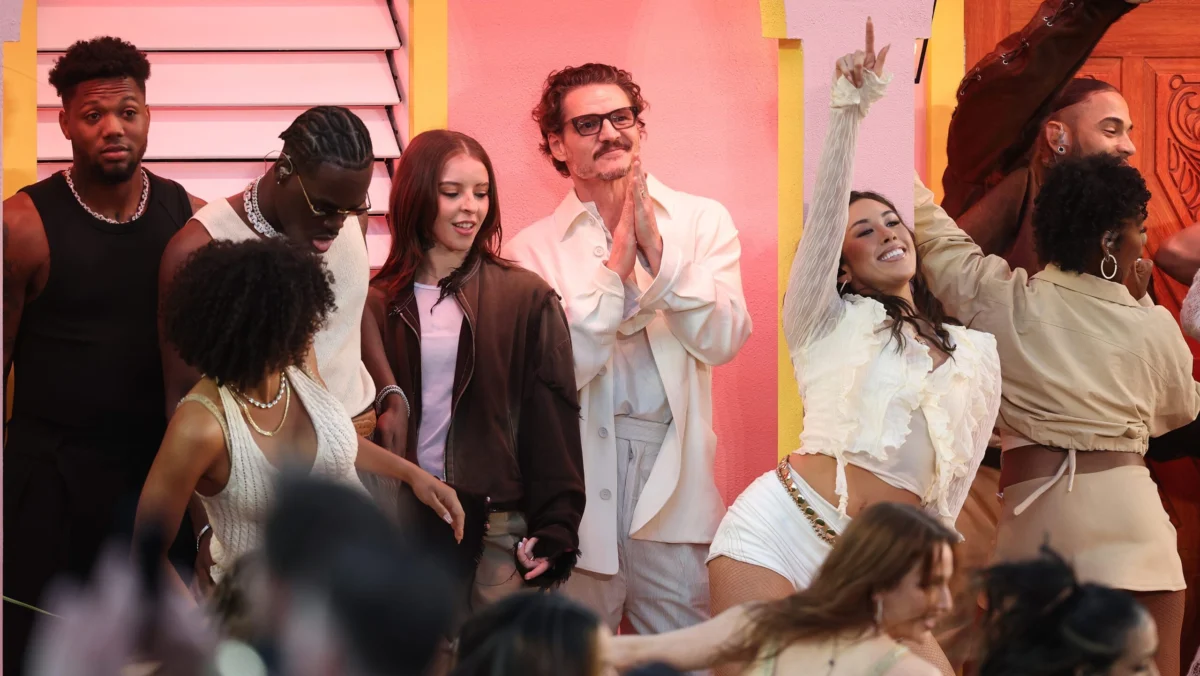
The actor confessed that the reality of the situation only fully dawned on him as he was being marched toward the center of the field. He realized he was being placed in "La Casita," a signature set piece Bad Bunny has utilized in his live tours to evoke the feeling of a home in Puerto Rico.
"I started to realize right before they started, and I was, like, ‘It’s the Casita. I’m such a fucking idiot. Oh my god, I’m going to be in the Casita,’" Pascal said. This sudden realization led to what he described as a "deer in headlights" expression during the live broadcast, a look that quickly went viral on social media platforms.
A Star-Studded Stage: The Ensemble of Super Bowl LX
Bad Bunny’s halftime show was notable not only for its high production value but also for its extensive roster of guest stars, which served as a tribute to the breadth of Latin music and its influence on global pop culture. While Pascal was a featured guest in the "La Casita" segment, the performance included several other major appearances.
In addition to the group Pascal was staged with—Cardi B, Young Miko, Karol G, and Jessica Alba—the set featured high-energy performances from Ricky Martin and Lady Gaga. The inclusion of Lady Gaga, in particular, was a highlight of the mid-set, while other figures like social media personality Alix Earle, hospitality mogul Dave Grutman, and MLB star Ronald Acuña Jr. also joined the "La Casita" gathering.
This diverse assembly of talent was designed to create a "house party" atmosphere, emphasizing community and shared success. For Pascal, being part of this group was a career highlight, even if the logistics were handled with a level of secrecy that left him momentarily bewildered.
The Cultural Significance of Bad Bunny’s Halftime Show
The 2026 Super Bowl halftime show marked a significant milestone in the history of the event. As the first solo Latin urban artist to headline the show, Bad Bunny’s performance was viewed by industry analysts as a definitive statement on the commercial and cultural dominance of Spanish-language music in the United States.
Data from Luminate and Billboard indicates that Latin music consumption has seen double-digit growth annually over the last five years, with Bad Bunny consistently ranking as one of the most-streamed artists globally. By bringing figures like Pedro Pascal and Jessica Alba onto the stage, the performance bridged the gap between the music industry and Hollywood, showcasing a unified front of Latin excellence.
The "La Casita" set piece was particularly symbolic. By recreating a Caribbean home in the middle of a massive American football stadium, Bad Bunny brought a specific cultural aesthetic to an audience of over 100 million viewers. For Pascal, who has often spoken about his Chilean heritage and the importance of visibility for Latino actors in Hollywood, the opportunity to stand in that "house" was worth the initial confusion.
Pascal’s Rising Influence and "The Pedro Pascal Renaissance"
Pedro Pascal’s appearance at the Super Bowl comes at a time when his career is at an all-time high. Often referred to by fans and media as the "Internet’s Daddy," Pascal has successfully transitioned from a respected character actor to a top-tier leading man.
Following his breakout roles in Game of Thrones and Narcos, Pascal has led two of the most successful franchises in modern television: Disney+’s The Mandalorian and HBO’s The Last of Us. His 2026 schedule remains packed, with the highly anticipated release of Tony Gilroy’s Behemoth! and his entry into the Marvel Cinematic Universe as Reed Richards in The Fantastic Four: First Steps.
His ability to move seamlessly between gritty dramas, big-budget blockbusters, and high-profile musical cameos speaks to a versatility that is rare in the current entertainment landscape. Industry experts suggest that Pascal’s presence in the halftime show likely helped capture a broader demographic, appealing to fans of prestige television and film who might not otherwise have been as engaged with the musical genre.
Broader Implications for Live Event Production
The anecdote shared by Pascal highlights an evolving trend in live event production: the "planned spontaneity." While Super Bowl performances are choreographed down to the millisecond, the inclusion of "vibe-based" cameos allows for a sense of organic energy that resonates well with modern audiences and social media algorithms.
The success of the 2026 halftime show, reinforced by Pascal’s viral reactions, suggests that the NFL and its production partners (including Roc Nation and Jesse Collins Entertainment) are increasingly leaning into the power of celebrity synergy. By creating a space where stars like Pascal can "volunteer" and be integrated into the show at the last minute, producers can generate a level of authenticity and "FOMO" (fear of missing out) that traditional, overly rehearsed segments might lack.
In the aftermath of the performance, social media metrics showed a significant spike in mentions of both Bad Bunny and Pedro Pascal, with "La Casita" trending globally for several hours. This synergy not only benefited the performers but also provided a massive boost for the brands associated with the event.
Conclusion: A Moment of Authenticity in a Mega-Event
Pedro Pascal’s "deer in headlights" moment in the 2026 Super Bowl halftime show has become a quintessential example of the actor’s relatability. Despite his status as one of the most sought-after actors in the world, his willingness to send a "tongue-out" selfie to get a job and his genuine shock at being moved from the stands to the stage have endeared him further to the public.
As Pascal continues his ascent in Hollywood, his Super Bowl cameo remains a testament to his fandom and his commitment to the "representation synchronized with celebration" that he so admires in Bad Bunny. While he may have felt like an "idiot" in the moment, his presence in "La Casita" served as a powerful visual of the cultural shift currently taking place in American entertainment—a shift where Latin icons are not just invited to the party, but are the ones hosting it.