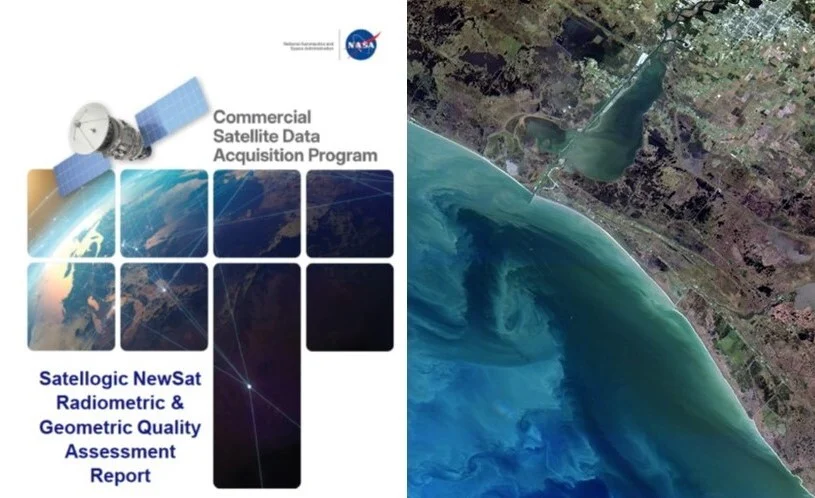
A significant milestone has been reached in the integration of commercial satellite data into Earth science research, with NASA’s Commercial Satellite Data Acquisition (CSDA) program officially approving the use of data from Satellogic’s NewSat constellation for scientific applications. This decision, documented in a comprehensive quality assessment report released on March 9, 2026, signifies NASA’s growing reliance on and validation of private sector advancements in Earth observation technology. The report specifically covers data from Satellogic’s Mark IV and Mark V sensor generations, marking a critical step in democratizing access to high-resolution satellite imagery for scientific inquiry.
The detailed evaluation, titled the Commercial Satellite Data Acquisition Program Satellogic NewSat Radiometric & Geometric Quality Assessment Report, was undertaken by a team of NASA subject matter experts (SMEs). These experts meticulously analyzed a dataset comprising 60 top-of-atmosphere reflectance images. The imagery, collected over a four-year period spanning from 2021 to 2025, was scrutinized for its radiometric accuracy and geometric precision across a variety of terrestrial sites. This rigorous vetting process is a cornerstone of the CSDA program’s mission to ensure that commercially sourced data meets the stringent requirements of NASA’s Earth science research endeavors.
Key Findings of the Quality Assessment
The assessment revealed generally robust radiometric accuracy across the NewSat constellation’s sensors. A substantial majority of the spectral bands demonstrated performance within a 10% deviation from the established Aqua MODIS reference values, a widely recognized benchmark in Earth observation. Furthermore, signal-to-noise ratio (SNR) metrics, crucial for distinguishing subtle variations in Earth’s surface, met the “Good” rating criteria for over half of the analyzed bands. This level of performance indicates a high fidelity in capturing spectral information, essential for applications ranging from vegetation health monitoring to atmospheric studies.
In terms of geometric performance, the NewSat constellation’s data exceeded specified sensor spatial response expectations. This metric relates to the ability of the sensor to accurately represent the spatial features on the ground, ensuring that maps and analyses derived from the data are geographically precise. However, the report did note some variability in geometric performance between the different sensor generations. The Mark IV sensors achieved an "Excellent" grade for their spatial response, highlighting their superior capability in resolving fine spatial details. In contrast, the Mark V sensors received a "Basic" grade in this category, suggesting areas where further refinement might be beneficial. This distinction is important for researchers who may need to select data based on specific spatial resolution requirements.
Satellogic’s Response and Ongoing Engagement
In the wake of the report’s release, Satellogic has proactively engaged with the findings and recommendations. The company has reportedly made adjustments to its data processing methodologies, aiming to address the identified areas for improvement, particularly concerning the geometric performance variations between sensor generations. NASA’s CSDA program is currently undertaking a follow-up quality assessment of these revised products. The results of this ongoing evaluation are expected to be published in the near future, demonstrating NASA’s commitment to continuous improvement and collaborative partnerships with commercial data providers. This iterative process underscores the dynamic nature of the commercial satellite industry and NASA’s adaptive approach to data acquisition.
The Role and Evolution of NASA’s CSDA Program
The Commercial Satellite Data Acquisition (CSDA) program, established by NASA’s Earth Science Division (ESD), plays a pivotal role in bridging the gap between cutting-edge commercial remote sensing capabilities and the demands of Earth science research. Its primary objective is to identify, rigorously evaluate, and strategically acquire commercial satellite data that can augment and enhance NASA’s ongoing scientific investigations and operational applications. The program acts as a crucial on-ramp for emerging commercial satellite data vendors, facilitating the integration of innovative data sources into NASA’s research ecosystem as the private sector continues its rapid evolution.
By fostering these public-private partnerships, NASA’s ESD aims to accelerate the pace of scientific discovery. The program seeks to expand the applications of Earth observation data, benefiting not only the immediate NASA research and applications community but also contributing to broader societal benefits through improved understanding of our planet. The CSDA program’s approach is designed to ensure that NASA gains timely access to high-quality, mission-relevant commercial data. Simultaneously, it provides invaluable feedback to private-sector providers, acting as a catalyst for innovation, driving improvements in data products, and ensuring that industry capabilities are closely aligned with NASA’s evolving scientific needs.
A Timeline of CSDA Program Development
The CSDA program has undergone significant development since its initial pilot phase. The program has conducted three distinct on-ramp activities, a structured process for introducing new vendors and their data. These activities have successfully led to the integration of several vendors into NASA’s sustained data acquisition pipeline. Recognizing the need for efficiency and thoroughness, the CSDA program has continuously refined its evaluation process. A key enhancement has been the introduction of high-quality, SME-led data assessments, which have significantly accelerated review timelines. This focus on expert-driven analysis has also strengthened NASA’s engagement with the rapidly expanding commercial data ecosystem, fostering a more collaborative and responsive relationship.
The evaluation criteria employed by the CSDA program are comprehensive, designed to assess data across multiple dimensions critical for scientific research. While the specific list of criteria is not detailed in the provided content, it is understood to encompass aspects such as:
- Radiometric Accuracy: How closely the sensor’s measurements of light intensity correspond to the true values.
- Radiometric Stability: The consistency of the sensor’s radiometric performance over time.
- Geometric Accuracy: The precision with which the data accurately represents geographic locations.
- Spatial Resolution: The level of detail that can be discerned in the imagery.
- Spectral Resolution: The number and width of spectral bands captured, determining the ability to differentiate materials based on their spectral signatures.
- Temporal Resolution: The frequency with which an area can be imaged.
- Signal-to-Noise Ratio (SNR): The strength of the desired signal relative to background noise, impacting data quality.
- Data Product Format and Metadata: The usability and completeness of the data delivery.
Broader Implications for Earth Science and Beyond
The approval of Satellogic’s NewSat constellation data marks a significant expansion of the data resources available to the Earth science community. High-resolution, frequently updated imagery from constellations like NewSat can provide unprecedented insights into dynamic Earth processes. This could include monitoring deforestation in near real-time, tracking urban sprawl, assessing crop health and yield for agricultural planning, mapping water resources, and observing the impacts of climate change on glaciers and coastlines. The increased availability of such data can democratize access to advanced Earth observation capabilities, empowering a wider range of researchers, policymakers, and even citizen scientists.
The success of the CSDA program in evaluating and integrating commercial data has broader implications for how government agencies procure and utilize innovative technologies. It demonstrates a model for adapting to the rapid pace of technological advancement in the private sector, allowing agencies to leverage external innovation without the extensive upfront investment in developing and launching their own dedicated missions for every data requirement. This approach can lead to more cost-effective and agile data acquisition strategies.
The collaboration between NASA and commercial entities like Satellogic also fosters a virtuous cycle of innovation. As NASA provides critical feedback and validation, commercial providers are incentivized to enhance their technologies and data processing capabilities. This, in turn, leads to more sophisticated and reliable data products that can be used not only by NASA but also by a global community of users, driving progress in fields as diverse as disaster management, climate modeling, and sustainable development.
Looking Ahead: Continued Collaboration and Data Integration
The CSDA program’s ongoing engagement with Satellogic and its commitment to evaluating revised data products underscore a forward-looking approach. As the commercial satellite industry continues to mature, with constellations offering ever-increasing resolution, revisit rates, and spectral capabilities, NASA’s CSDA program is poised to play an even more critical role in identifying and integrating these valuable assets. The program’s structured evaluation process ensures that scientific rigor is maintained while embracing the dynamism of the commercial space sector.
For those interested in delving deeper into the findings, the full Satellogic NewSat Radiometric & Geometric Quality Assessment Report is accessible on the CSDA website. Additionally, a recent CSDA Vendor Focus Webinar on Satellogic is available on the program’s YouTube channel, offering further insights into the partnership and its significance. The CSDA website also provides comprehensive information regarding the program’s methodologies for identifying and evaluating commercial satellite vendors for on-ramp and subsequent integration. This transparency and accessibility are vital for fostering trust and collaboration within the burgeoning Earth observation community. The continued success of initiatives like the CSDA program will be instrumental in unlocking the full potential of commercial satellite data for scientific advancement and addressing some of the world’s most pressing challenges.