The landscape of the American housing market has undergone a profound transformation in the second quarter of 2026, as domestic migration patterns reveal a decisive shift away from high-cost coastal hubs toward more affordable, climate-friendly regions. According to the latest data analysis from Redfin, a growing number of prospective homebuyers and renters are prioritizing financial sustainability over proximity to traditional corporate centers. This trend, which sees Las Vegas emerging as the premier destination for relocators, underscores a broader national recalibration of lifestyle expectations, spurred by persistent inflation, high interest rates, and the enduring prevalence of remote and hybrid work models.
A Seismic Shift in Geographic Preference
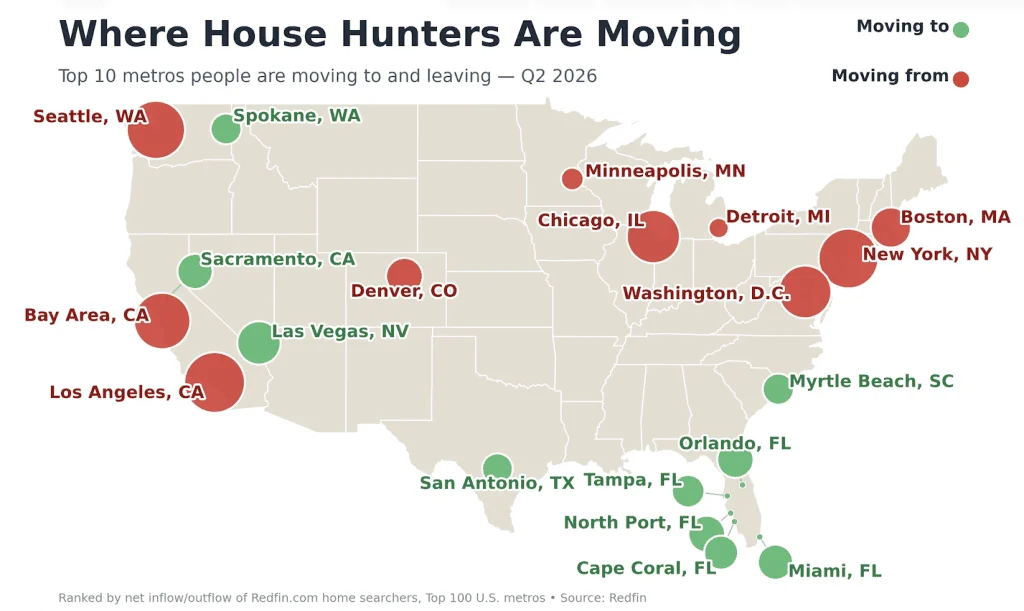
During the second quarter of 2026, Las Vegas, Nevada, secured the top spot as the most sought-after destination for house hunters looking to relocate from their home metropolitan areas. The city saw a significant net inflow of 9,581 Redfin.com users, a figure that highlights the enduring appeal of the region despite concerns regarding its climate. Following Las Vegas, the state of Florida dominated the list, with North Port, Orlando, and Miami rounding out the top four spots.
This movement is not merely a preference for warmer weather; it is a calculated economic strategy. The disparity in housing costs between origin cities and destination hubs is stark. For example, the typical home in Los Angeles—the primary source of new arrivals to Las Vegas—is valued at approximately $922,000. In contrast, a home in Las Vegas, while experiencing its own market pressures, sits at a more accessible median of $447,000. This price delta represents a massive incentive for families and professionals looking to optimize their purchasing power without sacrificing proximity to urban amenities.
The Exodus from Coastal Job Hubs
While the Sun Belt experiences a surge in interest, traditional economic powerhouses are witnessing a corresponding decline. Los Angeles, New York City, and Seattle currently lead the nation in net outflow, representing the largest pools of residents actively searching for properties outside of their current metro areas.
The data indicates that these relocations are not random; they follow well-established corridors of movement. Residents leaving New York City, for instance, are increasingly eyeing Philadelphia, where the median home price of $309,000 stands in sharp contrast to the $832,000 typical cost in the Big Apple. Similarly, residents exiting the San Jose area are gravitating toward the more affordable surroundings of Sacramento. This phenomenon suggests that for many Americans, the "cost of entry" into high-profile coastal markets has finally reached a breaking point, forcing a mass migration toward secondary cities that offer a higher quality of life for a fraction of the cost.
Historical Context and the Remote Work Evolution
To understand the current state of the market, one must look at the timeline of the post-pandemic recovery. Since 2021, the flexibility afforded by remote work has fundamentally decoupled employment from geography. In the early stages of this shift, migration was often motivated by a desire for space and safety. By 2026, however, the primary driver has transitioned to affordability.
In the second quarter of 2026, approximately 18.7% of all Redfin.com users were actively searching for homes outside their home metro area. This represents the highest share recorded in second-quarter data since 2021. While the percentage is high, analysts are quick to note that the raw volume of transactions is currently tempered by a sluggish national housing market. High mortgage rates and limited inventory continue to constrain the number of completed sales, meaning that while the desire to move is at a record high, the ability to execute that move is constrained by broader macroeconomic factors.
The Dominance of the Sunshine State
At the state level, the narrative is even more pronounced. Florida has established itself as the undisputed leader in net inflow, attracting more potential buyers than Arizona, South Carolina, and Tennessee combined. This surge in popularity for the Sunshine State reflects a long-term trend of internal migration that has been bolstered by favorable tax policies and a robust influx of retirees and remote workers.

Nevada, South Carolina, and Idaho have also seen significant gains, while California remains the nation’s primary source of outbound migration. The state of California saw a net outflow of 56,548 users in the second quarter of 2026, nearly double that of New York. These figures paint a picture of a nation in flux, where the economic gravity of the West Coast and Northeast is being countered by the affordability and growth potential of the Sun Belt and the Mountain West.
Economic Implications and Market Dynamics
The implications of this migration shift are far-reaching. For the destination cities, the influx of new residents creates a complex set of challenges and opportunities. Rapid population growth often leads to increased demand for infrastructure, schools, and public services, which can put a strain on local governments that are often unprepared for such a swift transition. Conversely, the arrival of new capital and a younger, often remote-based workforce can revitalize local economies, fueling growth in the service, hospitality, and retail sectors.
From a real estate perspective, the pressure on these destination markets is significant. As demand rises in areas like North Port, Florida, or Spokane, Washington, home prices are inevitably pushed upward. This creates a feedback loop: as these cities become more popular, their affordability—the very trait that attracted migrants in the first place—begins to erode. It is a cycle that has previously played out in cities like Austin, Texas, and Boise, Idaho, where rapid appreciation has forced local governments to grapple with housing affordability crises of their own.
The Role of Technology in Modern Relocation
The ease with which modern house hunters can research, view, and vet properties across state lines is largely due to the integration of comprehensive digital platforms. The Redfin analysis utilized data from users who viewed at least 20 for-sale homes in a destination metro during a single month. This methodology allows for a more nuanced understanding of "serious" buyers versus casual browsers.
The ability to search at scale, coupled with the ubiquity of virtual tours and digital transaction management, has lowered the barriers to entry for long-distance moving. Prospective buyers can now conduct a deep dive into the housing markets of cities they have never visited, allowing them to make data-driven decisions that were previously impossible without significant travel.
Future Outlook and Policy Considerations
Looking ahead, the sustainability of this trend will depend on several variables. First, the stability of remote work policies remains a critical factor. If major corporations continue to mandate a return to the office, the pace of this outward migration may slow, or at the very least, shift toward suburban areas within commuting distance of major metros rather than cross-country moves.
Second, the housing inventory crisis remains a national issue. Even in affordable metros, a lack of supply is keeping prices elevated. Unless there is a significant increase in new residential construction, the "affordability advantage" of the Sun Belt may diminish, potentially cooling the current migration heat.
Finally, the impact of climate change on migration patterns is an emerging factor. While the current data shows a clear preference for the Sun Belt, environmental challenges—such as extreme heat, drought, and insurance instability in coastal areas—could eventually alter the attractiveness of these regions.
In conclusion, the second quarter of 2026 serves as a definitive snapshot of a changing America. The migration of residents from expensive coastal hubs to more affordable, growth-oriented regions is a testament to the resilience and adaptability of the American workforce. As families continue to seek the best value for their money, the geographic distribution of the U.S. population will continue to evolve, reshaping the economic and cultural landscape of cities from Las Vegas to Miami and beyond. For policymakers and city planners, the task ahead is to manage this growth in a way that preserves the affordability and quality of life that these communities are currently so eager to offer.