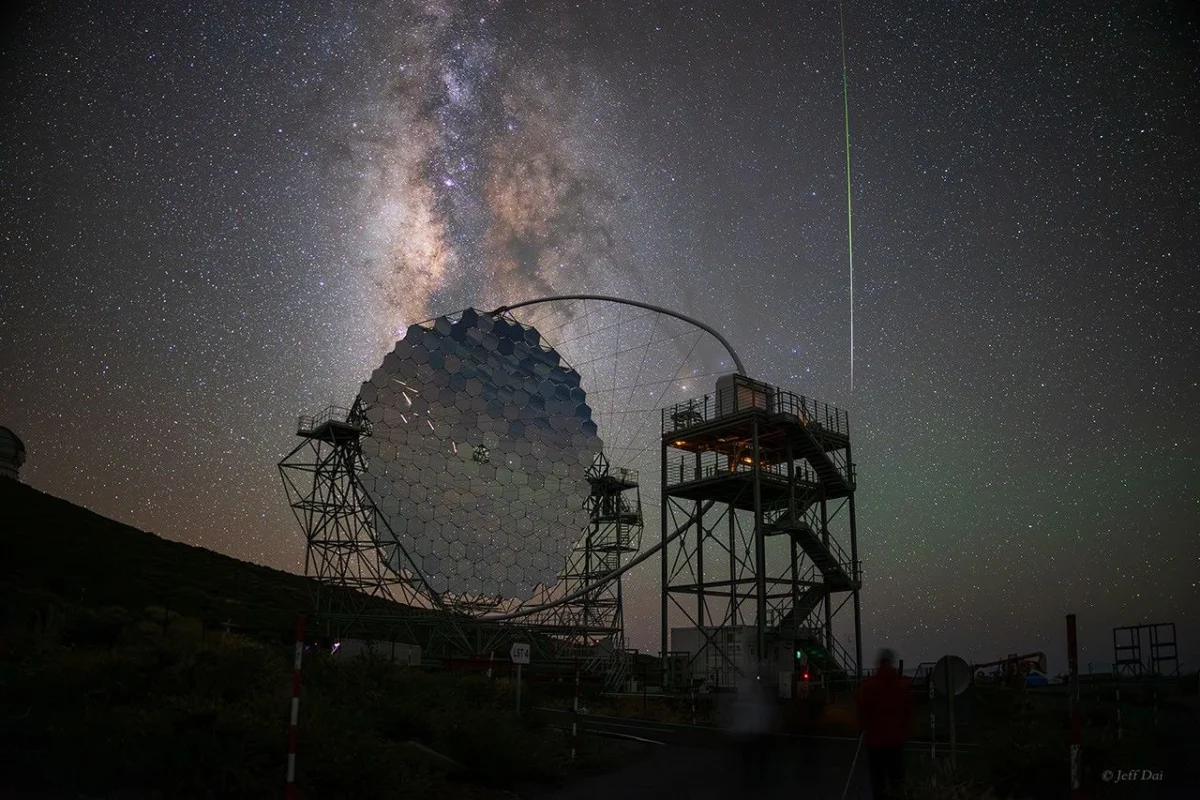
On August 15, 2026, the night sky over the Observatorio del Roque de los Muchachos on the island of La Palma, Spain, played host to a rare convergence of celestial beauty and cutting-edge astrophysics. A vivid Perseid meteor, part of the annual debris field shed by Comet 109P/Swift-Tuttle, cut a luminous path across the darkness, appearing in a striking photograph adjacent to the central band of the Milky Way galaxy. The image, captured by photographer Jeff Dai, serves not only as a record of a seasonal meteor shower but as a testament to the sophisticated infrastructure currently being deployed to study the high-energy universe.
The foreground of this image is dominated by the imposing structure of the Large-Sized Telescope (LST-1), a prototype instrument that serves as a cornerstone for the future Cherenkov Telescope Array Observatory (CTAO). The contrast between the ancient light of the Milky Way and the ultra-modern, high-precision engineering of the telescope highlights the ongoing evolution of ground-based astronomy.
The Anatomy of the Event
The Perseid meteor shower is one of the most reliable and intense annual celestial events, occurring as Earth passes through the orbital path of Comet Swift-Tuttle. The debris, consisting of dust and rock particles ranging from grains of sand to small pebbles, enters the Earth’s atmosphere at velocities exceeding 59 kilometers per second. Upon contact with the upper atmosphere, these particles undergo rapid deceleration and ionization, creating the characteristic "shooting stars" visible to the naked eye.
In this instance, the meteor’s trajectory was captured in the same frame as the Milky Way, with the galactic center’s interstellar dust clouds providing a textured backdrop. The alignment, while coincidental, provided a unique visual opportunity to document the intersection of local atmospheric phenomena—the meteor—with the distant light of our own galaxy.
The Role of LST-1 in Modern Astrophysics
The LST-1, positioned prominently in the foreground, represents a paradigm shift in how astronomers observe the high-energy universe. Unlike traditional optical telescopes that gather light from stars and galaxies over long exposure times, the LST-1 is a ground-based gamma-ray observatory. It is designed to detect Cherenkov radiation—faint, blue flashes of light that occur when extremely high-energy gamma rays interact with the Earth’s atmosphere.
The telescope features a 23-meter diameter mirror, composed of 198 individual hexagonal segments. This massive reflective surface focuses the extremely brief (approximately one-billionth of a second) flashes of Cherenkov light onto a highly sensitive, pixelated camera. Because these light pulses are so fleeting, the system must be capable of processing data at unprecedented speeds, effectively "freezing" the physics of the upper atmosphere to understand events happening millions or even billions of light-years away.
Chronology of the Cherenkov Telescope Array Project
The development of the LST-1 is the result of a multi-decade international collaboration. The path to its installation at La Palma follows a rigorous timeline of design, prototyping, and validation:

- 2010–2014: The conceptual framework for the Cherenkov Telescope Array (CTA) is solidified, with the international scientific community agreeing on a multi-tier telescope design (Large, Medium, and Small).
- 2015: The design for the Large-Sized Telescope (LST) is finalized, focusing on low-energy gamma-ray sensitivity.
- 2018: The LST-1 prototype is inaugurated at the Roque de los Muchachos Observatory, marking the first major installation for the CTA.
- 2020–2025: Extensive commissioning and calibration phases. The telescope undergoes rigorous testing to synchronize its mirror alignment and camera sensitivity.
- August 2026: The telescope is fully operational for observation, coincidentally capturing the atmospheric light of the Perseid meteor during a routine calibration and monitoring session.
Technical Specifications and Scientific Utility
The LST-1 is engineered for extreme precision. Its primary scientific mandate is to detect gamma rays from sources such as active galactic nuclei, supernova remnants, and potential dark matter annihilation signals. By studying these sources, researchers hope to solve long-standing mysteries regarding the acceleration of cosmic rays and the composition of the high-energy universe.
The telescope’s mirror system is particularly innovative. The 198 hexagonal segments are actively controlled by an alignment system that ensures the focal point remains stable despite changes in temperature, wind, or the orientation of the telescope. During the Perseid event, this sensitivity worked in two directions: while the telescope was scanning for celestial gamma rays, its mirrors also reflected the light from the meteor, inadvertently recording the meteor’s atmospheric passage as a reflection on the telescope’s surface.
Broader Implications for Observational Astronomy
The capture of this image underscores the symbiotic relationship between ground-based observatories and the night sky. For astronomers, the LST-1 represents a massive increase in sensitivity compared to previous generations of Cherenkov detectors. By lowering the energy threshold for detection, the CTAO will allow for the study of more distant galaxies that were previously invisible to ground-based gamma-ray telescopes.
Furthermore, the integration of such large-scale instruments into protected dark-sky sites like La Palma is crucial. The Roque de los Muchachos Observatory is situated at an altitude of approximately 2,400 meters, well above the dense, turbulent layers of the atmosphere that can distort optical images. The site’s clear skies and minimal light pollution make it an ideal location for both optical and gamma-ray observation.
Institutional Responses and Future Outlook
Representatives from the Cherenkov Telescope Array Observatory have noted that the LST-1’s performance during its early operational years has met or exceeded expectations. The ability to monitor transient events—such as gamma-ray bursts—is a primary objective for the coming decade. The incident on August 15, while not a gamma-ray detection, serves as a proof-of-concept for the telescope’s ability to remain highly responsive to the sky.
"The LST-1 is the pioneer for the northern array," noted a lead researcher affiliated with the project. "It demonstrates that we can achieve the necessary precision to look into the most violent processes in the universe, and we are now moving toward completing the full array to map the high-energy sky with unprecedented detail."
Conclusion: A Convergence of Eras
The photograph of the Perseid meteor above the LST-1 is more than a scenic curiosity; it is a snapshot of human ingenuity facing the infinite. The meteor, a fleeting remnant of a comet, represents the solar system’s chaotic history, while the LST-1 represents the systematic, scientific endeavor to quantify the laws of physics at the largest scales. As the CTAO continues its mission, the synergy between such advanced infrastructure and the natural wonders of the night sky will continue to provide both vital data and compelling visual records of our place in the cosmos.
For the scientific community, the focus remains on the upcoming data releases from the full CTA array. As these telescopes come online, they promise to unlock a new era of "multi-messenger" astronomy, where gamma-ray detection is combined with neutrino and gravitational wave data to provide a holistic view of the most powerful phenomena in existence. The image of the Perseid meteor, caught in the reflection of the LST-1, serves as a poignant reminder that while we look to the stars to understand the distant past, our tools for doing so are firmly rooted in the ever-changing conditions of our own atmosphere.