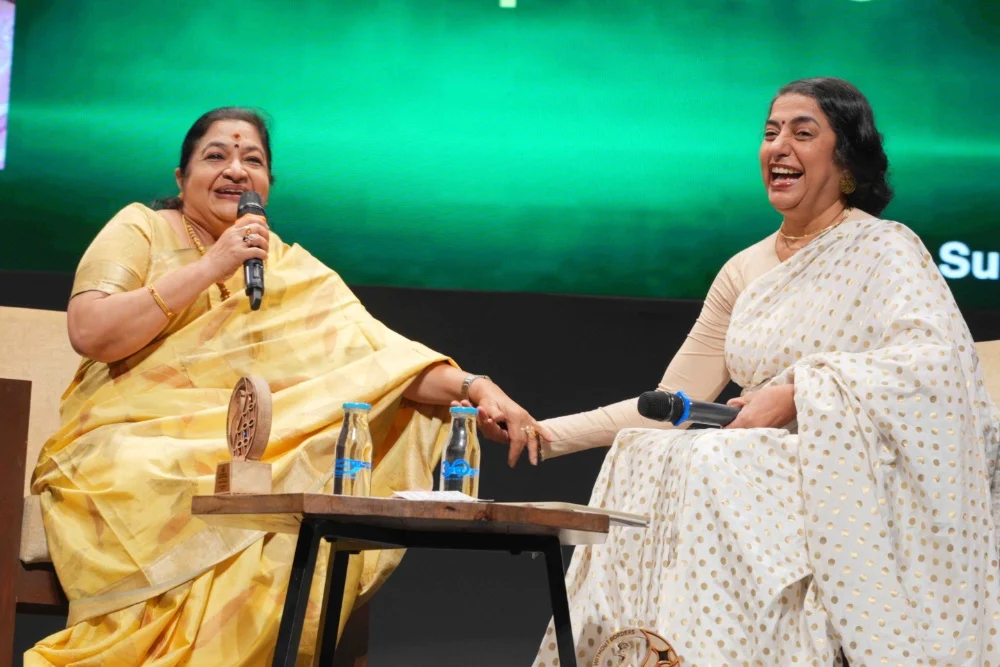
The 57th International Film Festival of India (IFFI), held against the scenic backdrop of Goa, served as a poignant stage for the celebration and remembrance of two of Indian cinema’s most towering musical figures: Asha Bhosle and S. Janaki. The annual "Lata Mangeshkar Talk: The Voice That Echoes Forever"—named in honor of Bhosle’s legendary elder sister—brought together acclaimed playback singer K.S. Chithra and celebrated actor-filmmaker Suhasini Maniratnam to pay tribute to the indelible legacies left behind by these musical titans.
The session unfolded against a backdrop of recent cultural mourning within the Indian film fraternity. Asha Bhosle, a two-time Grammy nominee whose illustrious career spanned over eight decades and whose global cultural footprint was famously immortalized in Cornershop’s 1997 chart-topping hit "Brimful of Asha," passed away in April at the age of 92. Just months later, in July, S. Janaki—affectionately revered by millions as the "Nightingale of South India"—died at the age of 88, marking the end of an era for regional and national cinema alike.
Shaping Musical Sensibilities: A Masterclass in Legacy
K.S. Chithra, whose own formidable career spans nearly five decades with over 25,000 recorded songs across multiple Indian languages, used the platform to reflect on the foundational influences that shaped her artistic sensibilities. Alongside Mangeshkar, Chithra cited P. Susheela and S. Janaki as the guiding lights of her formative years.
With visible fondness, Chithra recounted how she used to imitate Janaki during her childhood, though she readily acknowledged that the veteran singer’s extraordinarily distinctive style and vocal agility were utterly impossible to replicate. Turning her attention to Lata Mangeshkar, Chithra emphasized how the legendary singer’s devotional recordings left an enduring impression on her, particularly due to their profound emotional depth, pitch-perfect execution, and spiritual resonance.
Chithra also offered deep insights into Bhosle’s legendary versatility. Unlike many artists confined to a singular genre, Bhosle effortlessly traversed classical film songs, playful westernized numbers, high-tempo dance tracks, and soulful ghazals. Chithra noted that Bhosle fiercely guarded her own artistic identity, consciously working to step out of the towering shadow of her sister, Lata Mangeshkar, to forge a unique path. Recalling their very first encounter, Chithra shared an amusing anecdote in which Bhosle playfully questioned why the younger singer chose to sing in such an exceptionally high register, sparking a mentoring relationship built on mutual admiration.
Behind the Scenes: Anecdotes from the Recording Booth
The conversation took a deeply personal and entertaining turn when Suhasini Maniratnam shared behind-the-scenes memories from the making of the critically acclaimed 1997 Tamil film "Iruvar," directed by her husband, Mani Ratnam.
Suhasini recalled an instance involving Oscar-winning composer A.R. Rahman ("Slumdog Millionaire"). Rahman had invited Asha Bhosle to Chennai to record a track that required the sultry, distinctive vocal stylings of legendary Tamil playback singer L.R. Eswari. However, Rahman found himself hesitant and slightly intimidated about how to articulate the specific stylistic reference to a veteran of Bhosle’s stature.
Turning to Suhasini for assistance, Rahman asked her to bridge the communication gap. Suhasini willingly demonstrated Eswari’s iconic vocal delivery right in the studio. Armed with the reference, Bhosle effortlessly captured the essence of the style, stepping up to the microphone to deliver the memorable song "Venilla Venilla." The anecdote underscored the remarkable adaptability of Bhosle, who, even decades into her career, remained entirely receptive to directional nuances and regional stylistic demands.
The Incomparable S. Janaki: Character, Voice, and Camaraderie
Suhasini and Chithra painted a vivid picture of S. Janaki, highlighting her rare ability to completely inhabit a character through her vocal cords. Janaki was uniquely gifted with the ability to modulate her voice to sound like an innocent child or a struggling teenage boy, adapting her tone seamlessly to the narrative requirements of the cinematic screen.
Chithra shared an intimate glimpse into Janaki’s early dedication to her craft, revealing that Janaki was an ardent, lifelong admirer of Lata Mangeshkar. Long before achieving her own legendary status, Janaki would tune into radio broadcasts of Mangeshkar’s songs, deliberately lower the volume during the vocal portions, and practice singing along in real-time. Chithra charmingly described this self-taught ritual as "like a karaoke on her own."
Beyond her professional achievements, Chithra highlighted Janaki’s profound warmth and maternal kindness offstage. When visiting Janaki’s home, Chithra was often treated not merely as a peer, but as a cherished younger sister, with Janaki affectionately feeding her by hand—a testament to the deep bonds of camaraderie that existed among the female stalwarts of the Indian playback industry.
Technical Demands and Interactive Tributes
Moving beyond personal anecdotes, the panel discussion addressed the rigorous demands of playback recording in Indian cinema across different eras, touching upon the necessity for artists to honestly recognize and navigate their vocal limitations as they advanced in age.
The tribute session was punctuated by live musical moments. K.S. Chithra engaged the audience by singing brief, beautiful snippets of songs from her own extensive repertoire, alongside immortal classics popularized by both S. Janaki and Asha Bhosle.
The highlight of the event’s interactive segment was a meticulously planned quiz. Film clips from classic eras were projected onto screens with their original background musical scores entirely muted. Chithra was challenged to identify each film and song purely from visual cues and instantly perform them. Demonstrating her encyclopedic knowledge of Indian film music and her phenomenal auditory memory, Chithra successfully identified and sang all five selections to enthusiastic applause from the audience.
A Poetic Finale
The memorial session reached its emotional crescendo as the floor prepared for its final act. K.S. Chithra launched into a stirring rendition of "Paadariyen," the iconic musical piece from the 1985 classic film "Sindhu Bhairavi," directed by K. Balachander. It was this very song that earned Chithra the first of her six prestigious National Film Awards.
As Chithra’s crystal-clear notes filled the auditorium, Suhasini Maniratnam—who starred in the original cinematic masterpiece—rose to join her on stage. In a poignant moment of cinematic and musical synergy, Suhasini gracefully lip-synced alongside Chithra, bringing the emotional tribute full circle. The moving collaboration served as a living bridge between the silver screen and the golden voices of Indian cinema, reminding the audience in Goa that while icons like Asha Bhosle and S. Janaki have departed, the cultural resonance of their artistry will continue to echo across generations.