India is positioning itself at the forefront of the global artificial intelligence revolution by setting an ambitious target to train and integrate at least 10 million workers into its burgeoning AI workforce. This massive capability-building initiative stems from the recently launched National AI Talent Mission, a flagship policy framework spearheaded by Prime Minister Narendra Modi. The initiative aims to future-proof the nation’s economy, bridge the digital divide, and cement India’s status as a global hub for technological innovation and skilled digital labor.
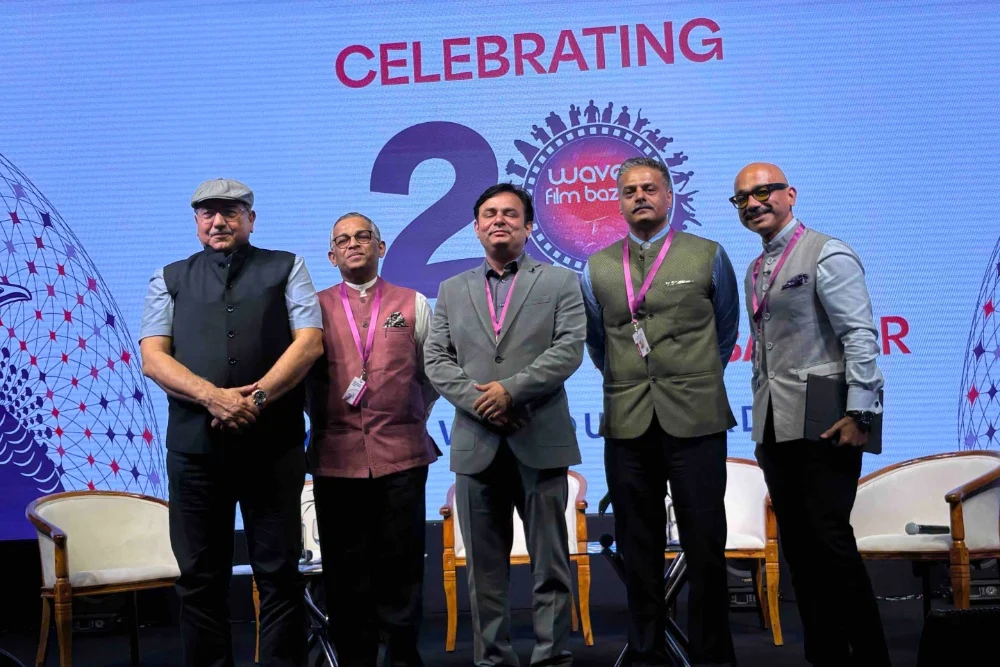
The announcement was made by Lt. Col. Vikram Singh Bhati, director of the National Council for Vocational Education and Training (NCVET), during a high-profile panel discussion titled “AI and the Future of Creative Skills: Transforming India’s Media & Entertainment Workforce.” The session took place at the WAVES Film Bazaar, a premier industry marketplace held alongside the 57th International Film Festival of India (IFFI) in Goa.
The panel discussion brought together key stakeholders from government ministries, public broadcasting, technical education, and private sector animation and visual effects studios. Moderated by renowned voice-over artist and actor Vijay Vikram Singh, the panel featured Amit Meena, director at the Ministry of Skill Development and Entrepreneurship; K. Satish Nambudiripad, former director general of India’s public broadcaster Doordarshan and chairperson of the Centre for Creative Economy and Public Policy at the National Institute of Technology Calicut; and Biren Ghose, founder and CEO of Astra Studios.
The Genesis of India’s AI Skilling Initiative
The roadmap for reaching the 10-million-worker milestone relies heavily on structured government intervention coupled with private-sector collaboration. According to Lt. Col. Bhati, the foundational steps of this workforce transformation began with the introduction of the SOAR (Skilling for AI Readiness) scheme, an initiative launched by the Ministry of Skill Development and Entrepreneurship designed to systematically prepare India’s labor force for the realities of automated and AI-integrated workplaces.
Bhati emphasized that government policy alone cannot achieve the required scale. He issued a direct call to action for corporations and business leaders to actively participate by adopting apprenticeship models. Integrating apprenticeships into corporate structures will enable both seasoned legacy workers and fresh labor market entrants to seamlessly adapt to shifting technological demands without facing displacement.
The push comes at a critical juncture for India’s economy. As automation and machine learning reshape traditional employment sectors, proactive reskilling is viewed by policymakers as essential to preventing widespread job obsolescence and maintaining economic competitiveness on the world stage.
Transforming the Media and Entertainment Production Chain
The implications of artificial intelligence are perhaps nowhere more profound than in the media, entertainment, and creative industries. Amit Meena of the Ministry of Skill Development and Entrepreneurship noted during the Goa panel that AI is fundamentally altering every stage of the production chain, stretching from initial conceptualization to final theatrical or digital release.
"It is democratizing the whole process," Meena stated, highlighting how powerful generative tools and automated workflows are lowering the traditional barriers to entry for content creation. However, this democratization carries a simultaneous mandate: the urgent necessity to aggressively reskill existing professionals so they can leverage these tools rather than compete against them.
While democratization allows smaller creators and independent studios to produce high-quality visual assets that were once restricted to major Hollywood or Bollywood conglomerates, it also introduces significant structural challenges regarding labor dynamics, intellectual property, and artistic originality.
Preserving Cultural Diversity in an Age of Algorithmic Uniformity
As AI adoption accelerates, industry experts have raised concerns regarding the inherent biases and homogenizing tendencies of large language models and generative software. K. Satish Nambudiripad offered a sharp cautionary perspective during the discussion, warning that India’s rich tapestry of folklore, regional languages, and cultural nuances risks being flattened if AI training datasets and educational frameworks fail to account for the nation’s profound diversity.
"You ask five people to write a concept note—if you are going through AI, every one of them will write the same," Nambudiripad observed, pointing to the standardizing nature of current commercial algorithms. To counteract this cultural homogenization, he advocated for deep institutional collaboration between technical academies, specialized film schools, and industry leaders. Furthermore, Nambudiripad stressed that skilling initiatives must not remain confined to India’s major metropolitan areas, but must actively penetrate tier-two and tier-three cities where much of the country’s grassroots creative talent resides.
Shifting from Execution to Imagination: The Evolution of Creative Labor
Addressing the philosophical and practical evolution of creative professions, Biren Ghose, founder and CEO of Astra Studios, argued that the nature of creative labor is fundamentally pivoting "from execution to imagination." In the contemporary technological landscape, workers are transitioning from mastering specific software packages to orchestrating complex technological ecosystems.
Reflecting on the rapid pace of change, Ghose remarked, "In the past we were wondering when the tools would catch up with us, and now we’re wondering when we would catch up with the tools." This sentiment captures the anxiety and exhilaration defining modern creative industries as generative tools evolve faster than traditional educational curricula can adapt.
Ghose also advocated for the broader recognition of creative technology skills, noting that these competencies are no longer isolated to cinema and gaming studios. Instead, they are becoming vital across diverse commercial sectors, including architecture, advertising, industrial design, and virtual simulation.
Concluding his remarks, Ghose offered a philosophical anchor for the ongoing technological transition: "No technology has ever invented anything. Everything that got invented has been invented by the ideas of man." This perspective reinforces the core tenet of India’s National AI Talent Mission—that human ingenuity remains the indispensable driver of technological progress, with AI serving merely as a force multiplier.
Broader Implications and Strategic Outlook
The launch of the National AI Talent Mission and its integration into cultural hubs like the IFFI WAVES Film Bazaar underscores India’s strategic pivot toward becoming a global powerhouse in digital technologies. By targeting 10 million workers, the government is addressing both domestic unemployment pressures and the global shortfall in certified AI talent.
However, the success of this mission will depend on several critical execution factors:
- Curriculum Agility: Educational boards must continuously update training modules to keep pace with rapid advancements in generative AI.
- Inclusive Access: Bridging the digital divide to ensure that candidates from rural and semi-urban backgrounds have equitable access to high-bandwidth infrastructure and quality AI training.
- Ethical Frameworks: Establishing robust guidelines to protect indigenous intellectual property, regional content creators, and cultural heritage from algorithmic erasure.
As India moves forward with the SOAR scheme and expands its vocational training frameworks under the NCVET, the country’s approach offers a compelling model for emerging economies seeking to harness the disruptive potential of artificial intelligence while safeguarding human creativity and socio-cultural diversity.