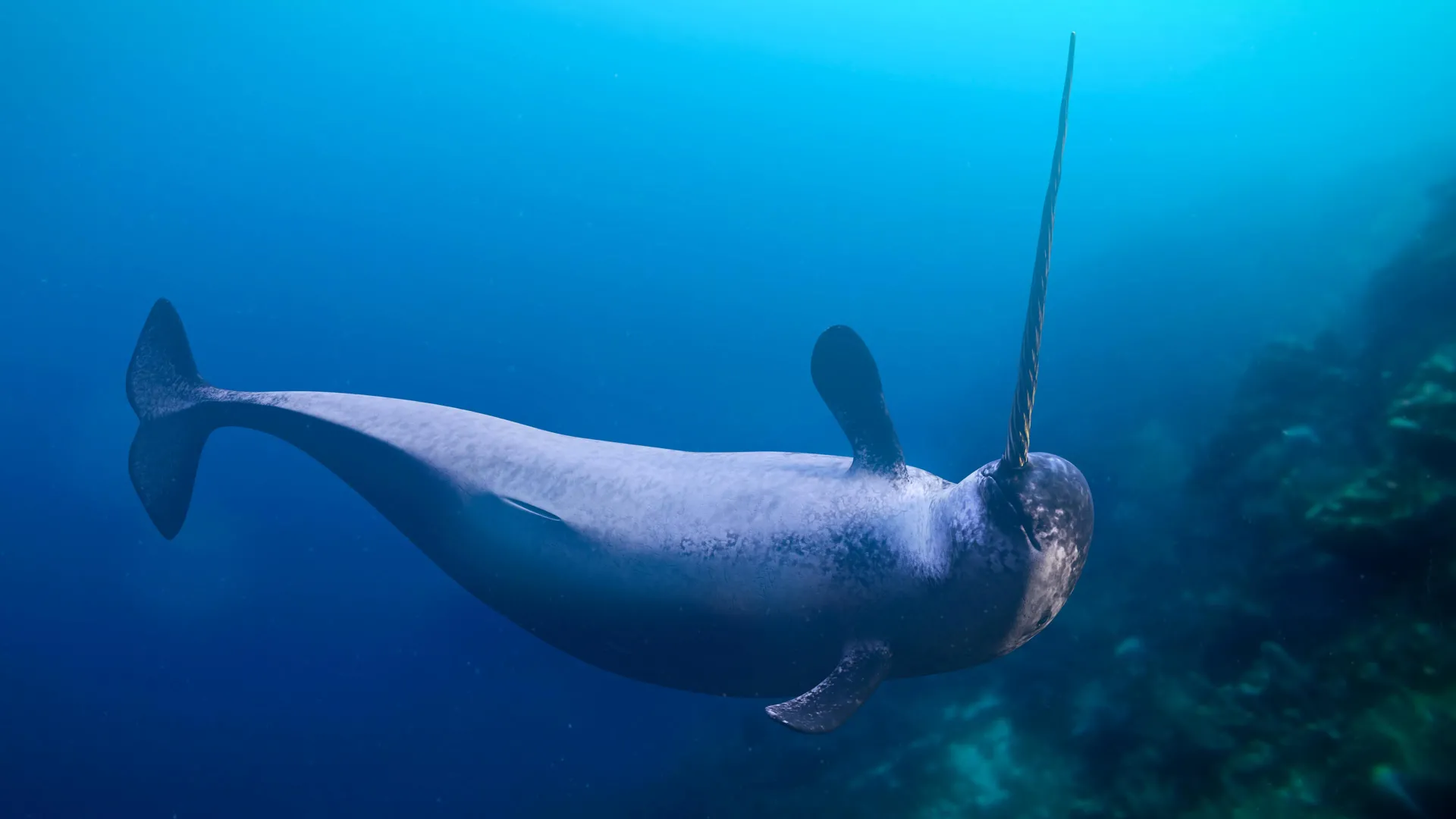
In the 17th century, the courts of Europe were obsessed with the existence of the unicorn, a creature of myth whose horn was rumored to cure diseases and neutralize poisons. For the Danish King Frederik III, this legend was not merely a fairytale but a tangible ambition. Frederik III possessed a throne fashioned entirely from these prized artifacts, which he believed to be the horns of the elusive unicorn. History, however, would eventually demystify these objects; they were not horns at all, but the elongated, spiraling teeth of the narwhal, a whale species native to the frigid waters of the Arctic. While the Danish crown used these tusks to project power and divine authority across Europe, the biological reality of the tusk remained a profound mystery for centuries. Today, thanks to a multi-year interdisciplinary study involving advanced synchrotron radiation, scientists have finally decoded the structural secrets of this biological marvel, revealing an architectural complexity that rivals modern composite engineering.
A Biological Anomaly in the Deep North
The narwhal, Monodon monoceros, is one of the most enigmatic inhabitants of the Arctic. Unlike the tusks of walruses or the incisors of beavers, which grow in relatively simple, curved geometries, the male narwhal develops a singular, corkscrew-shaped tooth. This structure, which is typically the upper left canine, erupts through the upper lip and twists counterclockwise as it extends. These tusks can grow to lengths of up to two meters—an astonishing appendage considering that in many cases, it accounts for nearly half of the animal’s total body length.
For biologists, the primary question has long been how such a structure maintains its integrity. A tooth of this length, projecting from the face of a marine mammal navigating high-pressure, turbulent Arctic currents, is subject to immense hydrodynamic forces. If the tusk were brittle, it would snap; if it were too heavy, it would impede the whale’s mobility. The recent findings, published in the journal Nature Communications, suggest that the narwhal has evolved a solution that effectively functions like reinforced concrete, blending hardness with flexible durability.
The Synchrotron Investigation: A Global Scientific Effort
The investigation into the narwhal tusk was a high-stakes, international endeavor, bringing together expertise from the Swiss Light Source (SLS) at the Paul Scherrer Institute (PSI), the MAX IV Laboratory in Sweden, and the European Synchrotron Radiation Facility (ESRF) in France. The research team, led by Henrik Birkedal of Aarhus University, sought to understand the tusk’s microscopic architecture using tensor tomography—a sophisticated X-ray imaging method.
Unlike standard dental X-rays, which provide a two-dimensional "shadow" of density, synchrotron radiation allows researchers to peer into the sub-nanometer scale. By rotating the tusk within the intense X-ray beams of these specialized facilities, the team could collect millions of data points, mapping the orientation of the mineralized collagen fibers that comprise the bulk of the tusk. The goal was to determine how these microscopic building blocks—measured in nanometers—contributed to the macroscopic spiral shape visible to the naked eye.
Decoding the Helix: The "Paint-by-Numbers" Breakthrough
When the research team first processed their data, they encountered a significant setback. They expected to see a clear helical pattern in the microscopic orientation of the collagen fibers that mirrored the spiral of the tusk itself. Instead, the initial data appeared frustratingly uniform.
"That puzzled us quite a bit," noted Marianne Liebi, a researcher at PSI and a co-author of the study. The team realized that they were looking at the data too broadly. By shifting their methodology to analyze how individual points of the internal structure related to their immediate neighbors—effectively "connecting the dots"—a hidden pattern emerged. The team discovered that the tusk is not a monolithic structure, but a composite of two opposing helices.
The outer layer, composed of cementum, forms a left-handed helix, while the underlying dentin core spirals in the opposite direction. This counter-helical arrangement is a masterpiece of evolutionary engineering. Much like the strands of a high-tension steel cable, the two spirals work in tandem to provide resistance against torsion—the twisting force—and mechanical stress. This duality explains how the tusk can remain both rigid enough to function in combat or display and flexible enough to endure the physical pressures of the Arctic ocean.
Mechanical Properties: The Reinforced Concrete Analogy
The structural logic of the narwhal tusk is fundamentally similar to the principles used in civil engineering. In the same way that reinforced concrete uses steel rebar to resist tensile forces and concrete to withstand compression, the narwhal tusk uses a mineralized collagen matrix.
The collagen provides the "framework," offering elasticity and preventing the tooth from shattering, while the mineral crystals provide the "hardness" required for its structural role. According to Adrian Rodriguez-Palomo, the study’s lead author, this composite nature allows the tusk to maintain its form throughout the whale’s life. Given that narwhals can live for up to 70 years, the tusk is a long-term investment in structural stability, growing continuously as the animal ages.
Broader Implications: The Tusk as a Climate Archive
The research conducted by the international team is part of a larger project, “Narwhal tusks – a tale with a twist,” funded by NordForsk and the European Union’s Horizon 2020 program. Beyond uncovering the mechanical properties of the tusk, the researchers are interested in the biological "record" stored within these teeth.
As the tusk grows in annual layers, it acts much like the rings of an ancient tree. These layers capture chemical markers from the environment, effectively acting as an Arctic archive. By analyzing these layers, scientists believe they can reconstruct decades of climate data, including shifts in ocean temperature and changes in prey availability. This offers a unique window into the history of the Arctic, a region currently undergoing rapid transformation due to climate change.
The ability of the narwhal to record its environmental history in its own physiology provides a vital baseline for understanding how these marine mammals have adapted to their surroundings over the last century. As the Arctic ecosystem faces unprecedented pressure, the narwhal tusk is proving to be more than just a biological curiosity; it is a vital diagnostic tool for ecologists and climate scientists.
A Legacy of Curiosity
The transition of the narwhal tusk from a "mythical unicorn horn" of the 17th-century Danish court to a subject of rigorous synchrotron-based materials science represents the progression of human understanding. Frederik III’s fascination with the object was driven by a desire for prestige and the magical allure of the unknown. Today’s researchers are driven by a different, though no less compelling, goal: to understand the evolutionary ingenuity of one of the planet’s most specialized creatures.
The findings from the ESRF, MAX IV, and SLS facilities underscore the importance of interdisciplinary collaboration. By applying the tools of physics to the biological structures of the natural world, scientists have identified a solution to a mechanical problem that has persisted for millions of years. The narwhal’s tusk is not merely a weapon for social interaction or a secondary sexual characteristic; it is a sophisticated, highly optimized composite structure that stands as a testament to the power of natural selection.
As the scientific community continues to analyze the data collected during these synchrotron experiments, the implications for material science are also being considered. Engineers looking to design flexible, high-strength composite materials may find inspiration in the narwhal’s opposing helical design. In this way, the "unicorn" of the Arctic continues to influence the world—not through the magical properties once attributed to it by kings, but through the enduring, elegant, and complex reality of its own biology. The study stands as a benchmark in modern zoology, proving that even in the most well-known of natural oddities, there are layers of complexity waiting to be uncovered by the right combination of technology and inquiry.