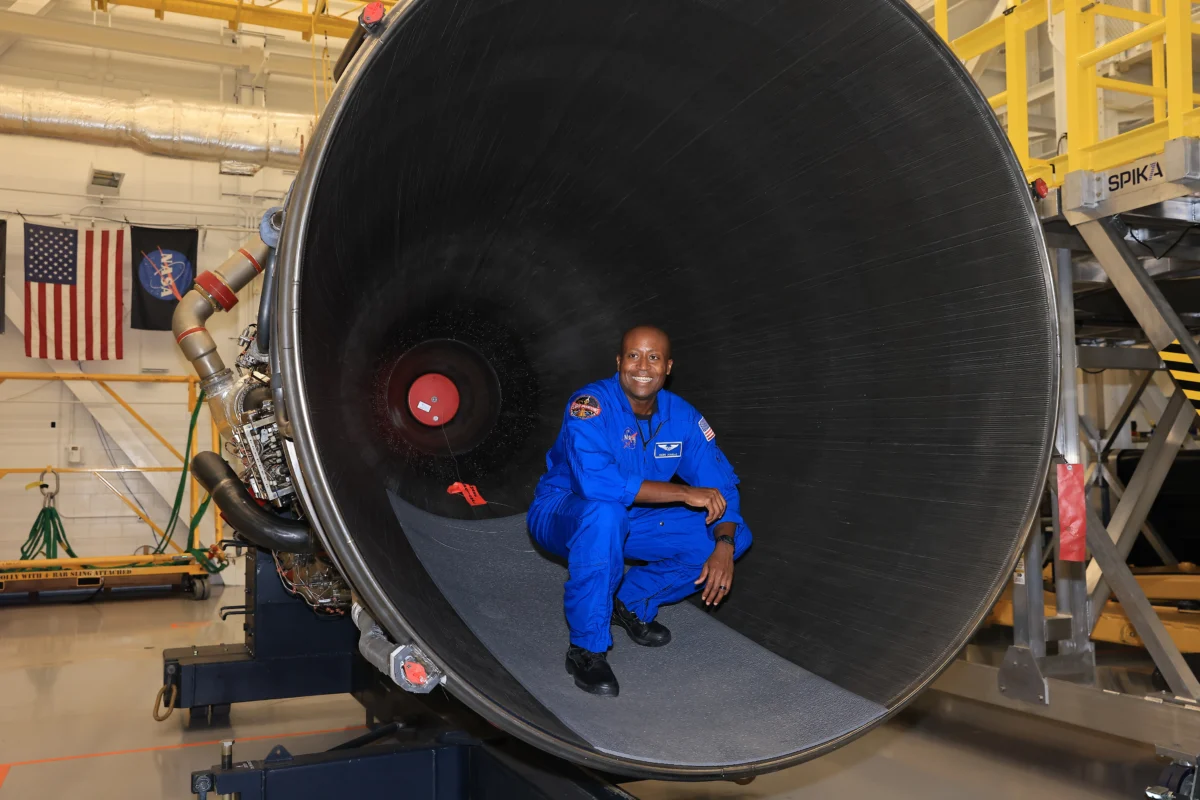
The propulsion systems that will carry humanity back to the lunar vicinity have undergone a high-profile inspection, marking a pivotal moment in the lead-up to the Artemis III mission. On November 17, 2026, NASA astronaut and Artemis III mission specialist Andre Douglas visited the iconic Vehicle Assembly Building (VAB) at the Kennedy Space Center in Florida to examine the RS-25 engine test hardware. This visit serves as more than a ceremonial walkthrough; it underscores the rigorous integration and verification processes required to ensure the Space Launch System (SLS) remains the world’s most powerful launch vehicle. As NASA shifts its focus toward the complex maneuvers required for the Artemis III flight, the technical readiness of the RS-25 engines has become the focal point of mission assurance protocols.
The Technological Backbone of Artemis III
The RS-25 engine, a masterpiece of liquid-propellant rocket engineering, is the powerhouse of the SLS rocket. Originally derived from the Space Shuttle Main Engine (SSME) program, the modern RS-25 has been upgraded with new controllers and advanced manufacturing techniques, such as additive manufacturing, to reduce costs while maintaining the high performance required for deep-space transit.
During the Artemis III mission, the SLS core stage will utilize four of these engines to provide the massive thrust necessary to escape Earth’s gravitational well. Unlike subsequent missions that target a lunar landing, the Artemis III flight profile is uniquely structured to focus on rendezvous and docking capabilities. The core stage must perform with extreme precision to place the Orion spacecraft into a precise trajectory, allowing it to interface with lunar lander systems currently being developed through the Human Landing System (HLS) program.
Chronology and Mission Development
The road to Artemis III has been a multi-year effort of design, testing, and infrastructure development. Following the successful uncrewed flight of Artemis I and the lunar flyby of Artemis II, the Artemis III mission represents the next threshold in human spaceflight.
- 2022: The successful launch of Artemis I validated the basic flight performance of the SLS and Orion.
- 2024-2025: Extensive testing of the RS-25 engine variants at the Stennis Space Center verified that the upgraded controllers could withstand the extreme pressures and thermal loads of launch.
- November 2026: Astronaut Andre Douglas performs a physical inspection of the flight-ready hardware at the Vehicle Assembly Building, symbolizing the final stages of integration.
- 2027 (Projected): Final integration of the core stage with the solid rocket boosters and the upper stage.
- 2028 (Projected): Scheduled launch of the Artemis III mission, focusing on critical orbital docking maneuvers.
This timeline reflects the deliberate, step-by-step approach NASA has adopted to mitigate risk. By focusing on rendezvous and docking in low Earth orbit (LEO) during Artemis III, NASA is effectively "stress-testing" the docking mechanisms in a controlled environment before attempting the same operations in the much more challenging lunar environment.
Technical Specifications and Performance Data
The RS-25 engine is capable of generating 418,000 pounds of thrust at sea level, with a vacuum thrust of 512,000 pounds. When configured in a cluster of four, the total liftoff thrust exceeds 1.6 million pounds, which is then augmented by the two five-segment solid rocket boosters that provide an additional 7.2 million pounds of thrust.
The integration of these engines into the SLS core stage is a feat of modern logistics. Each engine stands approximately 14 feet tall and weighs over 7,000 pounds. The engine controllers—the "brains" of the propulsion system—are designed to adjust the engine’s performance in real-time, monitoring for anomalies and optimizing fuel consumption. This reliability is critical for Artemis III, as the mission relies on the core stage’s ability to conduct specific burns to align the Orion spacecraft with its target lander.
Official Perspectives and Mission Readiness
While NASA officials have maintained a disciplined schedule, the inspection by Andre Douglas highlights the human element of space exploration. Mission specialists like Douglas are tasked with bridging the gap between engineering specifications and operational reality. By standing within the engine test article, astronauts gain a tactile understanding of the vehicle they will eventually entrust with their lives.
"The hardware we see here today represents thousands of hours of testing, analysis, and refinement," noted a spokesperson from the Kennedy Space Center following the inspection. "The focus on the RS-25 at this stage is a testament to the fact that propulsion is the heartbeat of the mission. Without the precise performance of these engines, the rendezvous objectives of Artemis III cannot be achieved."
Industry partners, including Aerojet Rocketdyne, which manufactures the RS-25, have emphasized that the engines have met every certification milestone required for the upcoming flight. The consensus among the engineering teams is that the transition from ground testing to flight configuration is proceeding as planned, with no major technical obstacles currently hindering the assembly timeline.
Broader Implications for Human Spaceflight
The Artemis III mission is widely regarded as a "capability-building" mission. While the public often equates Artemis with landing on the Moon, the engineering reality is that each mission builds upon the last. By conducting docking tests in Earth orbit, NASA is solving the "last mile" problem of lunar exploration. If a docking maneuver fails in Earth orbit, the crew can abort and return to the ground. If it fails in lunar orbit, the stakes are exponentially higher.
Furthermore, the lessons learned during this mission will have direct applications for the eventual construction of the Lunar Gateway, a space station that will orbit the Moon. The docking procedures verified by the Artemis III crew will become the standard operating procedure for all future lunar logistics, fueling, and crew transfers.
The economic and geopolitical implications of the SLS program are also significant. As international competition in the space sector intensifies, the ability to launch heavy payloads with high reliability is a strategic asset for the United States. The investment in RS-25 engine technology is not merely for the Moon; it is an investment in the underlying propulsion architecture that will facilitate deep-space exploration for the next several decades, including potential missions to Mars.
Analyzing the Risks and Success Metrics
The success of the Artemis III mission will be measured by several key performance indicators:
- Engine Performance Reliability: The RS-25s must operate within a 0.1% margin of the predicted thrust and fuel consumption profiles.
- Docking Precision: The ability to achieve a "soft capture" between the Orion spacecraft and the lunar lander is the primary mission objective.
- Crew Safety: Throughout the propulsion phases, the environmental control systems must maintain crew health under the high G-loads generated by the SLS core stage.
While the technical complexity is immense, the systematic approach—from the ground testing at Stennis to the VAB integration at Kennedy—minimizes the probability of failure. The presence of astronauts like Andre Douglas in the assembly process serves as a final quality control gate, ensuring that the human interface with the machine is as optimized as the mechanical components themselves.
Conclusion
As NASA moves toward the launch of Artemis III, the inspection of the RS-25 hardware stands as a symbol of the immense preparation required to push the boundaries of human exploration. The integration of these engines into the SLS core stage is a critical milestone that brings the agency closer to its goal of establishing a sustainable presence on the Moon. With the rigorous testing protocols, the dedication of the workforce at Kennedy Space Center, and the focused mission profile, NASA is steadily constructing the infrastructure necessary to take humanity further into the solar system than ever before. The Artemis III mission, therefore, stands as a cornerstone of 21st-century aerospace achievement, setting the stage for the next era of discovery.