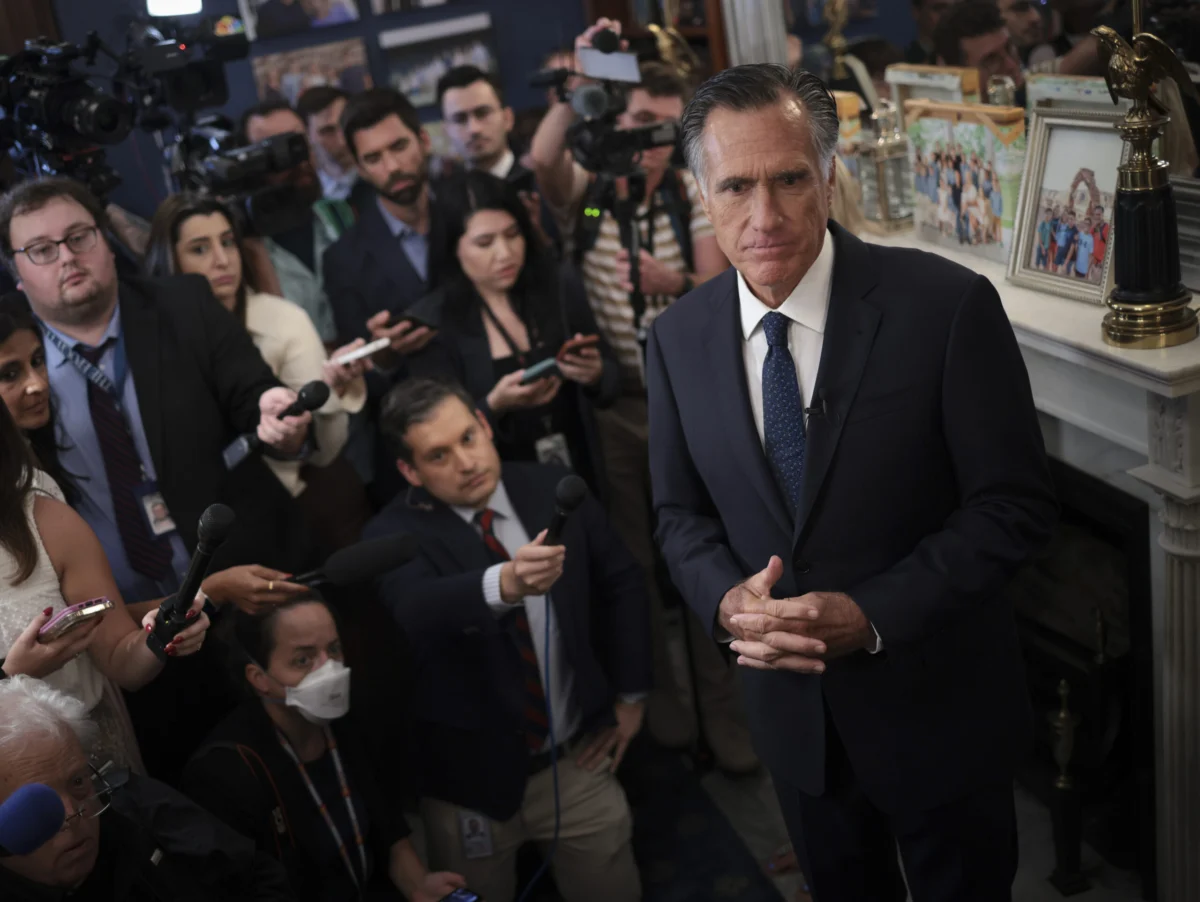
Utah Senator Mitt Romney announced on Wednesday, September 13, 2023, that he would not seek re-election in 2024, signaling the impending departure of one of the last prominent moderate and vocally anti-Donald Trump Republicans from the United States Senate. While the immediate electoral consequence for Utah’s Class I Senate seat is likely minimal, as the state is reliably Republican, Romney’s decision carries significant weight for the ideological landscape of the Republican Party and the broader U.S. political arena. His exit underscores a continuing trend of dwindling space for traditional, establishment-aligned conservatives and dissenting voices within a GOP increasingly defined by its populist wing.
A Career Defined by Public Service and Shifting Tides
Mitt Romney’s political journey is a testament to a career marked by both significant accomplishments and profound ideological shifts within his party. Born into a prominent political family—his father, George W. Romney, was a three-term Governor of Michigan and a U.S. Presidential candidate—Mitt Romney carved out his own path, first achieving remarkable success in the private sector. As co-founder of Bain Capital, a global investment firm, he amassed a substantial fortune and honed a reputation for business acumen.
His entry into public service began in Massachusetts, where he was elected Governor in 2002. Representing a state known for its progressive leanings, Romney governed as a moderate Republican, navigating complex policy issues and achieving bipartisan successes, most notably the Massachusetts Health Care Reform Act of 2006, a precursor to the Affordable Care Act. This period solidified his image as a pragmatic, results-oriented leader, fitting the mold of "Bay State Republicans" who often found success by appealing to a broad electorate.
Romney’s national ambitions led him to two bids for the U.S. Presidency. In 2008, he launched a campaign that ultimately fell short against Senator John McCain in the Republican primaries. Undeterred, he mounted a second, more successful campaign in 2012, securing the Republican nomination to challenge incumbent President Barack Obama. Despite a well-funded and organized effort, Romney lost the general election, marking the last time the Republican Party nominated a presidential candidate not named Donald Trump.
The Trump Era and a Senator’s Dissent
The period following the 2012 election witnessed a seismic shift within the Republican Party, culminating in the rise of Donald Trump in 2016. Trump’s ascendant populism and confrontational style dramatically reshaped the GOP’s identity, moving it away from the establishment conservatism that Romney embodied. This transformation saw a significant number of moderate and anti-Trump Republicans either retire or lose their seats in Congress.
Against this backdrop, Mitt Romney made a remarkable return to politics in 2018, successfully running for the U.S. Senate from Utah. His election was notable precisely because it bucked the national trend. Utah, with its significant population of members of the Church of Jesus Christ of Latter-day Saints (including Romney himself), presented a unique political environment. While overwhelmingly Republican, a segment of its GOP electorate harbored skepticism towards Donald Trump, creating an opening for a figure like Romney.
Upon entering the Senate, Romney quickly distinguished himself as one of the most outspoken critics of President Trump within his own party. His dissent was not merely rhetorical; it manifested in concrete legislative actions and votes. Most notably, Senator Romney became the only senator in U.S. history to vote to convict a president of his own party in an impeachment trial, doing so in both of Trump’s impeachment proceedings. In February 2020, he voted to convict Trump on charges of abuse of power related to Ukraine, citing his "oath before God" and his conscience. A year later, in February 2021, he again voted to convict Trump following the January 6th Capitol insurrection, stating that Trump’s actions constituted "a profound moral disgrace." These votes placed him squarely at odds with the vast majority of his Republican colleagues and the party’s base.
A Moderate Record in an Increasingly Polarized Chamber
Beyond his vocal opposition to Donald Trump, Senator Romney cultivated a distinctly moderate voting record, further setting him apart from the conservative mainstream of the contemporary Republican Party. This moderation was reflected in various key votes throughout his tenure. For instance, he voted to confirm Justice Ketanji Brown Jackson to the Supreme Court in 2022, joining a small group of Republican senators in supporting President Biden’s nominee. He also voted to overturn Trump’s emergency declaration aimed at funding a border wall in 2019, aligning with Democrats and a handful of other Republicans in a rebuke of presidential overreach.
A common quantitative measure of ideological positioning in Congress is the DW-NOMINATE score, which analyzes roll-call votes. On this scale, where 1 represents the most conservative and -1 the most liberal, Senator Romney’s score of 0.288 places him as more moderate than all but three current Republican senators. This data point vividly illustrates his position as an outlier in a party that has steadily shifted rightward.
The "endangered species" analogy used to describe moderate Republicans is borne out by the numbers. Of the 17 Republicans across both chambers who voted to impeach or convict Donald Trump in either of his impeachment trials, only six remain in Congress following Romney’s announced retirement. This includes figures like Senators Susan Collins (R-ME) and Lisa Murkowski (R-AK), both often considered moderates. Furthermore, the number of Senate Republicans with DW-NOMINATE scores below 0.300—indicating a more centrist stance—is at its lowest point in at least 40 years. This demographic shift within the GOP has significant implications for legislative compromise and the party’s ability to forge broader coalitions.

Motivations for Retirement: Age, Primary Fears, and Party Dynamics
Senator Romney cited his age as a primary factor in his decision not to seek re-election. At 76, he would have been 83 at the conclusion of a potential second term. In his retirement video, he stressed the need for a "new generation of leadership" in the U.S., reflecting a sentiment often expressed by long-serving politicians stepping aside. This stated reason is plausible and aligns with a common narrative for senior statesmen.
However, political analysts also suggest that his unique standing within the Republican Party likely played an indirect, if not direct, role. His anti-Trump stance and moderate voting record made him relatively unpopular among a significant portion of Republican voters in Utah, despite the state’s mild Trump skepticism. An August 7-14, 2023, poll conducted by Dan Jones & Associates revealed that only 56 percent of registered Republican voters in Utah approved of Romney’s job performance. While not disastrous, this figure is considered mediocre for an incumbent among their own party base. For comparison, national polls, such as one from Quinnipiac University, showed former President Trump enjoying an 81 percent favorable opinion among Republican registered voters at a similar time.
The same poll indicated that in a hypothetical primary matchup, Romney garnered only 45 percent support among Republicans. While no other candidate exceeded 7 percent, and 27 percent expressed support for an unnamed "other candidate," an incumbent receiving less than 50 percent in their own primary poll is often a warning sign. This situation draws parallels to former Senator Jeff Flake (R-AZ), a vocal Trump critic who opted not to seek re-election in 2018, admitting he could not win a GOP primary in his increasingly conservative state. The fear of a challenging and potentially losing primary battle, particularly against a pro-Trump challenger, may have weighed on Romney’s decision.
Interestingly, the timing of his announcement was somewhat curious given that the same poll showed his approval rating among Republicans on the rise, increasing from 40 percent in May to 56 percent in August. This upward trend might suggest a clearer path to renomination than previously perceived, leading some to speculate that his decision was less about immediate primary viability and more about a broader assessment of the political climate and his personal desire to step away from the current partisan rancor.
The Future of Utah’s Senate Seat: A Republican Stronghold
Senator Romney’s retirement creates an open seat, but it is highly unlikely to shift the balance of power in the U.S. Senate. Utah remains a deeply red state, consistently voting for Republican presidential candidates by significant margins. In 2020, Donald Trump carried Utah by more than 20 percentage points, despite Romney’s own opposition to him. Democrats have not won a statewide election in the Beehive State since 1996, underscoring the formidable challenge any non-Republican candidate faces.
The 2022 Senate race between Republican Senator Mike Lee and anti-Trump independent Evan McMullin offered a glimpse into Utah’s complex political dynamics. Democrats opted not to nominate a candidate, endorsing McMullin in an attempt to consolidate the anti-Lee vote. Despite this strategic advantage, McMullin ultimately lost to Lee by 10.4 percentage points. While this was a narrower margin than many expected in a state of Utah’s partisan lean, it reaffirmed the Republican Party’s overall dominance in statewide contests.
Consequently, the real contest for Romney’s seat will unfold in the state’s June 25, 2024, Republican primary. The field of announced and rumored candidates suggests a strong inclination toward more conservative and/or explicitly pro-Trump figures, indicating that Romney’s successor will likely be far more aligned with the national GOP’s populist wing.
Among the early contenders is State House Speaker Brad Wilson, who has already formed an exploratory committee and is actively campaigning as a "conservative champion." Wilson notably introduced a legislative resolution in 2020 paying tribute to Donald Trump after his first impeachment trial, signaling his alignment with the former president. Riverton Mayor Trent Staggs, another announced candidate, has been an outspoken critic of Romney, assailing him for his support of "wokeness" and his impeachment votes. This aggressive stance positions Staggs as a clear choice for the pro-Trump base. Utah Attorney General Sean Reyes, who served as co-chair of Trump’s re-election campaign in the state and supported efforts to overturn the results of the 2020 election, is also a rumored candidate, which would further solidify the field’s conservative and Trump-aligned tilt.
While the current crop of candidates leans heavily toward the party’s right wing, there remains a possibility for a more Romney-esque candidate to emerge, especially if the conservative/pro-Trump vote becomes fragmented among multiple contenders. Utah does possess a discernible contingent of Trump-skeptical Republicans, as evidenced by figures like former state Representative Becky Edwards, a Republican who voted for President Biden and performed strongly in a special primary election for Utah’s 2nd Congressional District. However, any such candidate would face an uphill battle without the name recognition, financial resources, and established political machine that Mitt Romney commanded.
Broader Implications for the Republican Party
Senator Romney’s retirement marks a significant moment for the Republican Party. It symbolizes the further marginalization of a once-dominant faction within the GOP—the traditional, fiscally conservative, and internationally engaged wing—in favor of a more populist, nationalist, and often isolationist ideology. His departure removes a critical voice of internal dissent, making it even more challenging for the party to engage in self-reflection or pivot away from the influence of Donald Trump.
For Republicans who yearn for a return to what they perceive as the party’s pre-Trump principles, Romney’s exit is undeniably a "gut punch." It signifies the shrinking space for ideological diversity and robust internal debate. As the party continues its trajectory, the absence of figures like Romney in the Senate will likely contribute to a more ideologically homogenous and consolidated conservative bloc, with potential ramifications for legislative strategy, electoral appeal, and the party’s long-term identity in American politics. His departure thus not only concludes a remarkable career but also closes a chapter in the ongoing evolution of one of America’s two major political parties.