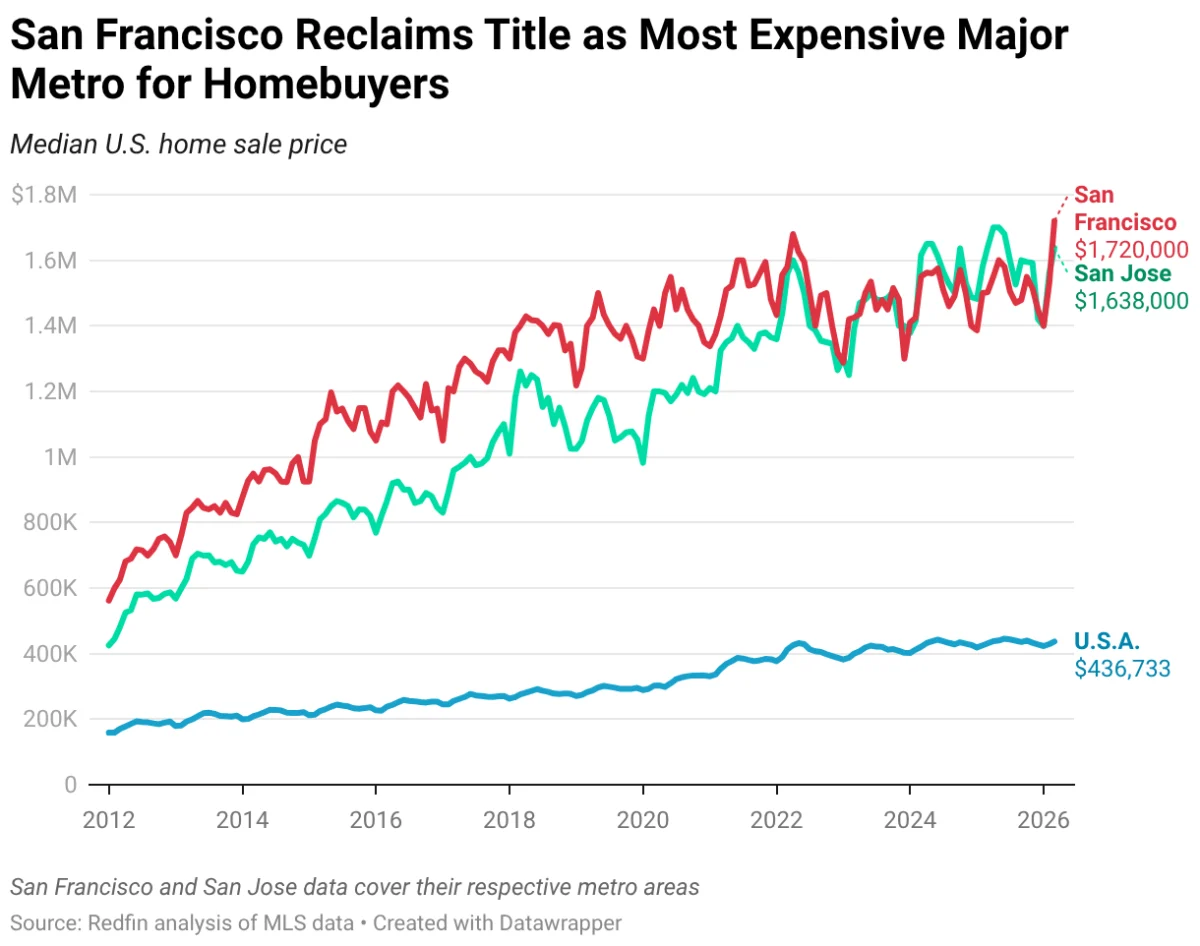
The San Francisco metropolitan area has solidified its position as the most expensive and competitive housing market in the United States, with the median home sale price reaching a historic high of $1.7 million in March 2026. This milestone represents a 14.4% year-over-year increase, the most significant price jump the region has seen since early 2018. According to the latest market data, San Francisco’s growth outperformed all 50 of the most populous metropolitan areas in the country, signaling a robust recovery and a dramatic shift in market sentiment following several years of post-pandemic volatility.
The surge is being driven by a unique convergence of economic factors: a localized gold rush in the artificial intelligence sector, strict new return-to-office mandates for thousands of workers, and a persistent, acute shortage of available inventory. While the broader United States housing market remains characterized by sluggish sales and high borrowing costs, San Francisco has decoupled from national trends, reclaiming its title as the nation’s priciest metro from neighboring San Jose.
The AI Catalyst and the Return of the Tech Workforce
Central to the rapid appreciation of property values is the explosive growth of the artificial intelligence industry, which has centered its operations in the San Francisco Bay Area. This technological boom has minted a new generation of high-net-worth buyers. Real estate professionals on the ground report that the influx of capital into the AI sector is directly translating into real estate transactions, with young professionals entering the market with unprecedented purchasing power.
Ali Mafi, a Redfin Premier real estate agent based in the area, noted that the demographic of buyers has shifted significantly. "A lot of 22-year-olds are getting $500,000 signing bonuses from AI companies, and they’re excited to buy homes," Mafi stated. This surge in high-earning individuals has created a competitive environment where quality homes in desirable neighborhoods are receiving as many as 20 offers, frequently selling for $900,000 or more above the initial asking price.
Complementing the AI boom is a renewed emphasis on physical office presence. Recently, approximately 8,000 San Francisco city workers returned to their offices four days a week, a move mirrored by many private-sector tech giants. This shift has reinvigorated the local economy and increased the premium on housing located within commuting distance of major employment hubs. The "work-from-home" exodus that defined the 2020-2022 period appears to have reversed, at least within the core urban centers of the Bay Area.
The Condo Market and Inventory Constraints
Perhaps the most surprising element of the March 2026 data is the performance of the condominium sector. San Francisco condo prices rose by 24.4% year-over-year, the fastest rate of growth for this property type since 2013. For years, the condo market had lagged behind single-family homes as buyers sought more space and private yards. However, the return-to-office trend and the high cost of detached houses have pushed buyers back toward high-density urban living.
The price appreciation is exacerbated by a critical lack of supply. San Francisco currently operates with just 1.8 months of housing supply—well below the 3.2 months seen nationally. In real estate terms, "months of supply" indicates how long it would take for current inventory to be exhausted at the present sales pace. A balanced market typically requires four to six months of supply; at 1.8 months, San Francisco remains in a state of extreme scarcity.
Sellers, sensing that prices may continue to climb, have been hesitant to list their properties. Many have held onto their homes in hopes of securing even higher valuations later in the year. However, market analysts suggest that the "time to sell is now," as the current imbalance between high demand and low inventory has created a "seller’s paradise" for those with well-maintained properties.
A Comparative Analysis: San Francisco vs. The Nation
The divergence between the San Francisco market and the rest of the United States is stark. Nationally, the median home sale price rose a modest 1.2% year-over-year to $436,733. While this is the fastest growth the national market has seen in five months, it remains historically low and pales in comparison to San Francisco’s 14.4% jump.
In terms of pricing psychology, San Francisco homes sold for an average of 8.9% more than their final list price in March. This represents the largest "March premium" since the height of the pandemic-era housing frenzy in 2022. Conversely, the typical American home sold for 1.3% below its list price—the largest March discount recorded since 2020. This indicates that while San Francisco buyers are engaged in aggressive bidding wars, buyers in much of the rest of the country still hold significant negotiating power.
| Metric (March 2026) | San Francisco | United States |
|---|---|---|
| Median Sale Price | $1,720,000 | $436,733 |
| Price Change (Y/Y) | +14.4% | +1.2% |
| Months of Supply | 1.8 | 3.2 |
| Sale-to-List Ratio | 108.9% | 98.7% |
| Median Days on Mkt | 13 | 55 |
Regional Trends Across the Top 50 Metros
While San Francisco leads the nation, other metropolitan areas are experiencing varying degrees of volatility. The March 2026 data reveals a highly fragmented national landscape:
- California Strength: Beyond San Francisco, other California markets showed resilience. Anaheim saw median prices reach $1.26 million, while San Diego held steady at $915,000. San Jose, despite losing its top spot to San Francisco, maintained a high median price of $1.638 million.
- The Sun Belt Slowdown: Cities that saw explosive growth during the pandemic are now cooling. Austin, Texas, saw prices drop 2.3% year-over-year, with homes sitting on the market for a median of 93 days. Dallas and Houston also saw price declines of 4.5% and 2.0%, respectively.
- The Rust Belt Recovery: Detroit, Michigan, emerged as a surprise leader in percentage growth, with median prices jumping 11.1% to $200,000. This suggests a continued interest in more affordable, "secondary" markets where the cost of living remains low.
- Florida’s Mixed Bag: Miami saw a slight price increase of 1.8%, but new listings and active listings fell sharply (down 13.3% and 7.7%, respectively), indicating a tightening market similar to San Francisco but at a lower price point.
Mortgage Rates and Economic Headwinds
Despite the localized heat in the Bay Area, the national housing market is struggling under the weight of a 6.18% average 30-year fixed mortgage rate. While this is a decrease from the highs seen in 2024, it remains a barrier for many first-time buyers and those looking to move up.
Nationally, pending home sales fell 2.6% from a year earlier, and the median time a home spent on the market rose to 55 days—the slowest March pace in a decade. Economists attribute this to a "wait-and-see" approach from both buyers and sellers. Sellers are often "locked in" to lower mortgage rates from years past, making them reluctant to sell and take on a new loan at 6%. Buyers, meanwhile, are squeezed by the combination of high prices and elevated borrowing costs.
Expert Recommendations for Sellers
In a market as aggressive as San Francisco’s, real estate experts emphasize the importance of property presentation. Ali Mafi noted that while demand is high, buyers are still discerning about quality. He suggests that a strategic $20,000 investment in cleaning, staging, and painting can often yield a $100,000 increase in the final sale price.
"When you have 20 offers on the table, the difference between a home that is ‘turn-key’ and one that needs minor work can be hundreds of thousands of dollars," Mafi said. "Buyers in this price bracket, especially those coming from high-stress tech jobs, want to move in immediately without dealing with renovations."
Broader Implications and Future Outlook
The resurgence of San Francisco’s real estate market carries significant implications for the city’s broader recovery. The "urban doom loop" narrative—which suggested that San Francisco was in a permanent decline due to remote work and retail flight—is being actively challenged by these figures. The record-high home prices suggest a deep, long-term confidence in the city’s economic future, anchored by its dominance in the AI sector.
However, this growth also raises concerns about affordability and the "missing middle" of the workforce. With a median price of $1.7 million, even high-earning service workers, teachers, and healthcare professionals find themselves priced out of the city. As the AI industry continues to concentrate wealth in a small geographic area, the pressure on the city to increase housing production will likely intensify.
Looking toward the summer of 2026, analysts expect San Francisco to remain a seller’s market. Unless there is a significant influx of new listings or a major economic shift that dampens the tech sector’s hiring spree, the competition for the limited number of homes available will likely keep prices at or near record levels. For the rest of the country, the market is expected to remain "bifurcated," with high-demand tech hubs and affordable Midwestern cities outperforming the previously overheated Sun Belt.