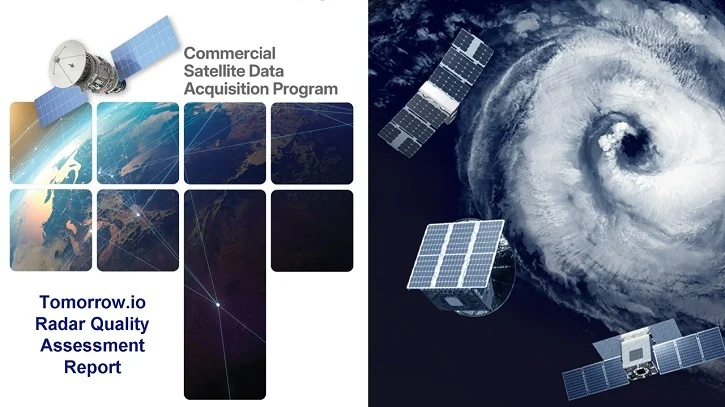
NASA’s Commercial Satellite Data Acquisition (CSDA) program has officially approved the use of precipitation radar data from Tomorrow.io for NASA scientific applications, marking a significant milestone in the integration of commercial Earth observation data into national scientific endeavors. This approval, detailed in a comprehensive quality assessment report issued on March 9, 2026, signifies a growing trust in the capabilities of the private sector to deliver high-quality data crucial for advancing our understanding of Earth’s climate and weather systems.
Rigorous Evaluation Process Underpins Approval
The Commercial Satellite Data Acquisition Program Tomorrow.io Radar Quality Assessment Report outlines the meticulous evaluation undertaken by NASA’s subject matter experts (SMEs). These experts were tasked with scrutinizing the data quality of the Ka-band Precipitation Radars aboard Tomorrow.io’s R1 and R2 spacecraft. The assessment focused on Tomorrow.io’s Level 2 Precipitation products, specifically examining their accuracy and geolocation precision.
The findings presented in the report indicate a strong alignment between NASA’s independent analysis and the data provided by Tomorrow.io in its algorithm theoretical basis document. The geolocation assessment demonstrated a remarkable "excellent correlation" of 0.98 when compared against a Digital Elevation Model (DEM) reference. This high correlation suggests that Tomorrow.io’s systems are accurately pinpointing the location of precipitation events on the ground.
Furthermore, comparisons of Tomorrow.io’s data with established ground-based radar networks yielded encouraging results. Both R1 and R2 radars showed good agreement with ground observations, achieving correlation coefficients of 0.73 and 0.93, respectively. While R2 exhibited slightly higher accuracy, with biases of -6% compared to R1’s -22%, these figures are considered favorable and indicative of reliable data collection. The SMEs concluded that Tomorrow.io’s precipitation radar data is suitable for NASA scientific use, provided it aligns with specific science objectives and application requirements.
Tomorrow.io Welcomes NASA’s Validation
For Tomorrow.io, this independent validation by NASA’s CSDA program is a testament to their commitment to delivering science-quality data from space. Rei Goffer, Chief Strategy Officer and Founder of Tomorrow.io, expressed his pride in the outcome. "When NASA’s own subject matter experts validate that a commercially built space-based radar system can contribute meaningfully alongside programs like NASA’s Global Precipitation Measurement missions, that opens a new chapter for Earth observation," Goffer stated. "We built these instruments to demonstrate that the commercial sector can deliver science-quality data from space, and we’re proud that NASA’s assessment supports that vision."
This endorsement is expected to instill confidence within the broader scientific community, encouraging wider adoption and reliance on commercial Earth observation data for critical research. The ability of commercial entities to complement and potentially expand upon existing government-led initiatives, such as NASA’s Global Precipitation Measurement (GPM) mission, signifies a maturing and collaborative landscape in Earth science.
The Role of NASA’s CSDA Program
The CSDA program, established by NASA’s Earth Science Division (ESD), plays a pivotal role in identifying, evaluating, and acquiring commercial remote sensing data. Its mission is to enhance NASA’s Earth science research and applications by integrating innovative data sources from the evolving private sector. The program offers structured "on-ramp" opportunities for emerging commercial satellite data vendors, ensuring NASA can continuously leverage cutting-edge technologies.
The CSDA program’s approach is designed to accelerate scientific discovery and broaden the applications of Earth observation data, benefiting not only NASA’s research community but also society at large. By fostering partnerships with commercial providers, NASA aims to gain timely access to high-quality, mission-relevant data while simultaneously providing valuable feedback to these companies. This symbiotic relationship drives innovation, encourages the development of improved data products, and ensures that industry capabilities remain aligned with NASA’s evolving scientific needs.
Evolution of the CSDA Program’s Evaluation Process
Since its inception, the CSDA Program has undergone significant evolution to streamline its evaluation process and enhance its effectiveness. The program has successfully conducted three on-ramp activities, leading to the integration of several vendors into its sustained data acquisition efforts. A key development has been the introduction of high-quality, SME-led data assessments, which have accelerated review times and strengthened NASA’s engagement with the rapidly expanding commercial data ecosystem.
The evaluation criteria employed by CSDA are comprehensive and designed to ensure the scientific utility of commercial data. While the original article did not explicitly list these criteria, typical evaluation frameworks for such programs often include:
- Data Accuracy and Precision: Assessing the degree to which the data reflects true geophysical values and the consistency of measurements.
- Geolocational Accuracy: Verifying the precision with which data points are tied to their physical locations on Earth.
- Calibration and Validation: Ensuring the instruments are properly calibrated and that the data has been validated against independent, reliable sources.
- Data Product Maturity: Evaluating the readiness of the data products for scientific research, including their format, documentation, and processing levels.
- Algorithm Performance: Scrutinizing the algorithms used to derive geophysical parameters from raw sensor data.
- Radiometric Stability: Assessing the consistency of measurements over time and across different viewing conditions.
- Coverage and Temporal Resolution: Evaluating the spatial and temporal extent of the data provided.
- Data Accessibility and Usability: Considering the ease with which researchers can access, process, and utilize the data.
- Compliance with Standards: Ensuring adherence to relevant data standards and interoperability protocols.
This rigorous, multi-faceted approach ensures that NASA gains access to data that is not only technically sound but also directly applicable to its scientific objectives. The feedback loop provided by CSDA to vendors is invaluable, guiding them in refining their products and capabilities to meet the stringent demands of Earth science research.
Implications for Earth Observation and Climate Science
The approval of Tomorrow.io’s precipitation radar data has several significant implications for the field of Earth observation and climate science.
Enhanced Precipitation Monitoring
Precipitation is a fundamental component of the Earth’s water cycle and a critical driver of weather and climate. Accurate and widespread precipitation data is essential for a wide range of applications, including:
- Weather Forecasting: Improving the accuracy of short-term weather predictions, storm tracking, and severe weather warnings.
- Climate Modeling: Providing crucial input for climate models to understand past climate trends, project future climate scenarios, and assess the impacts of climate change.
- Hydrological Studies: Supporting research into water resource management, flood prediction, drought monitoring, and the dynamics of river basins.
- Disaster Management: Aiding in the response and mitigation efforts for natural disasters such as floods, landslides, and tropical cyclones.
- Agriculture: Providing data for crop yield forecasting, irrigation management, and understanding the impact of precipitation patterns on food security.
By integrating commercial data sources like Tomorrow.io’s, NASA can potentially increase the spatial and temporal resolution of precipitation observations, filling gaps in existing coverage and providing a more comprehensive global picture. This is particularly important in regions where ground-based radar networks are sparse or non-existent.
The Growing Role of Commercial Satellites in Science
This development underscores a broader trend: the increasing reliance of scientific agencies on commercial satellite data. The private sector’s agility, innovation, and ability to deploy new technologies more rapidly can complement and extend the capabilities of government-funded missions. This partnership model allows agencies like NASA to focus on fundamental research and mission-critical objectives while leveraging commercial assets for broader data acquisition and applications.
The CSDA program acts as a crucial bridge, ensuring that commercial data meets the high scientific standards required for rigorous research. This validation process not only benefits NASA but also provides a clear pathway for commercial vendors to align their offerings with scientific needs, fostering a more robust and synergistic Earth observation ecosystem.
Future Opportunities and Collaboration
The successful integration of Tomorrow.io’s data paves the way for further collaboration between NASA and other commercial entities. As the commercial space industry continues to mature, we can anticipate more innovative sensors and data products becoming available. NASA’s CSDA program is strategically positioned to identify and evaluate these emerging capabilities, ensuring that the scientific community has access to the most advanced tools for Earth observation.
The "Vendor Focus webinar" mentioned in the original article likely provided further insights into Tomorrow.io’s commercial data offerings and how they can be utilized by researchers. These webinars and similar outreach initiatives are vital for disseminating information about newly available data sources and fostering their adoption within the scientific community.
The explicit mention of Tomorrow.io’s data being considered contingent upon alignment with "science objectives and application needs" highlights the pragmatic approach of the CSDA program. It emphasizes that while commercial data can be valuable, its scientific utility must be rigorously demonstrated for specific research questions. This ensures that NASA’s investments in commercial data are targeted and yield the greatest scientific return.
In conclusion, the approval of Tomorrow.io’s precipitation radar data by NASA’s CSDA program represents a significant advancement in Earth observation. It validates the capabilities of commercial providers, strengthens NASA’s data acquisition strategy, and promises to enhance our understanding of critical Earth processes, ultimately contributing to scientific discovery and societal well-being. The continued evolution of programs like CSDA will be instrumental in harnessing the full potential of the burgeoning commercial space sector for the benefit of global science and humanity.