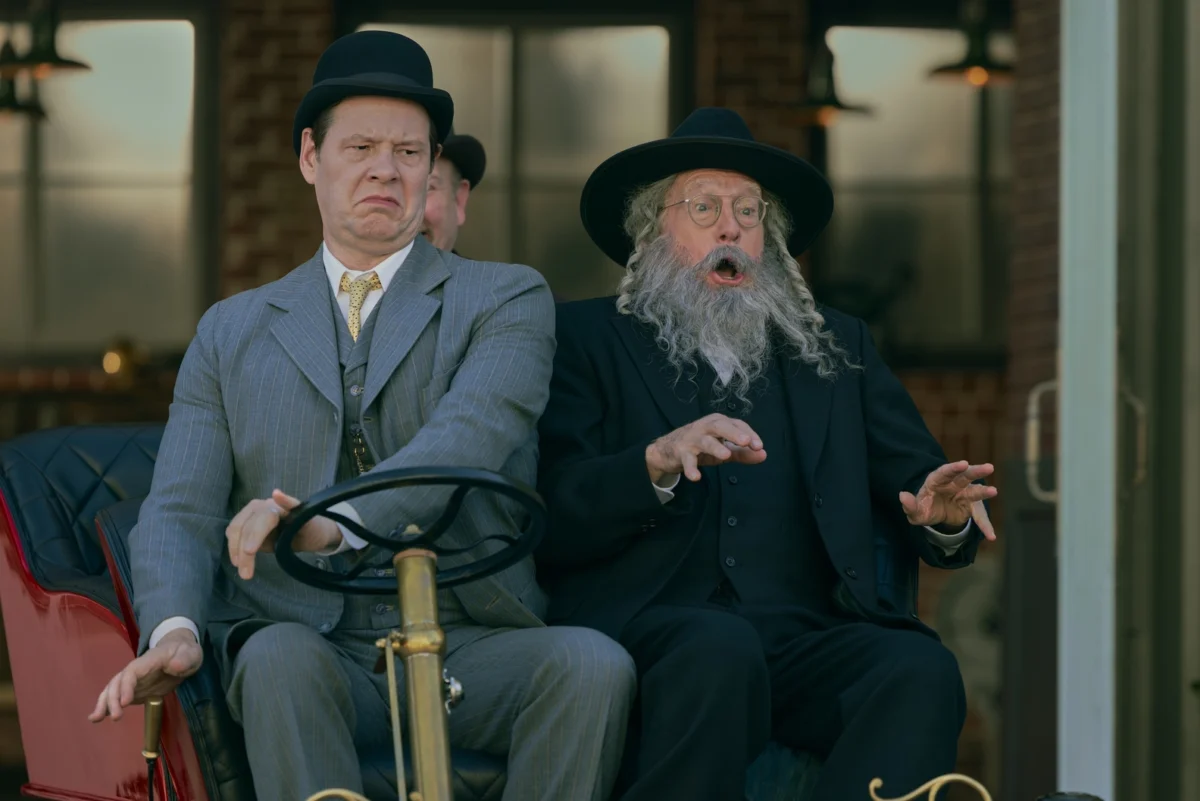
Following the historic conclusion of his long-running, semi-autobiographical series Curb Your Enthusiasm, Larry David has re-emerged on HBO Max with an ambitious new project titled Life, Larry and the Pursuit of Unhappiness. This historical sketch comedy series marks a significant departure from David’s previous work in contemporary improvisational comedy, shifting his focus toward the annals of American history. The production is a high-profile collaboration between David and Higher Ground Productions, the production company founded by former President Barack Obama and Michelle Obama. While David serves as the primary creative force and lead performer, the series is notable for its sprawling ensemble cast, featuring dozens of Hollywood’s most prominent actors, comedians, and political figures portraying iconic historical personalities.
The series is structured as an episodic exploration of American milestones, viewed through the lens of David’s signature "curmudgeon" persona. Each episode features over a dozen celebrity guests, ranging from David’s former Seinfeld and Curb Your Enthusiasm collaborators to Academy Award winners and Broadway icons. The production quality reflects a significant investment from HBO Max, with elaborate period costuming and set designs that serve as the backdrop for David’s social critiques. According to industry analysts, the partnership with the Obamas’ Higher Ground Productions provides the series with a unique prestige, blending high-concept historical education with satirical commentary on modern American life.
Production Background and Creative Partnership
Life, Larry and the Pursuit of Unhappiness represents a strategic move for HBO Max as it seeks to retain the audience built over twelve seasons of Curb Your Enthusiasm. The involvement of Barack and Michelle Obama as executive producers has been a focal point of the show’s marketing. Higher Ground Productions has previously focused on documentaries and dramas, such as the Oscar-winning American Factory, making this foray into absurdist comedy a notable shift in their content portfolio.
The series serves as a comedic celebration of the United States as it approaches its semiquincentennial (250th anniversary). By placing David into pivotal moments of the nation’s founding and development, the show explores the "pursuit of unhappiness"—a play on the Declaration of Independence’s "pursuit of happiness"—by highlighting the petty grievances and social awkwardness that David suggests have existed throughout human history. The series airs Friday nights at 9 p.m. ET on HBO and is simultaneously available for streaming on HBO Max.
Detailed Chronology of Episodes and Performances
The debut season of Life, Larry and the Pursuit of Unhappiness is organized by thematic historical eras, utilizing a recurring narration by Samuel L. Jackson to bridge the gap between sketches.
Episode 1: Livingston and the Birth of a Nation
The series premiere, titled "Livingston," opens with a meta-commentary by former President Barack Obama. In his appearance, Obama offers a standard presidential tribute to the nation before engaging in a scripted comedic exchange with David, establishing the show’s tone of blending reverence with irreverence. The episode’s primary sketch features David as Robert Livingston, a member of the Committee of Five tasked with drafting the Declaration of Independence. David’s Livingston attempts to insert personal grievances into the document, only to be rebuffed by John Hancock (Henry Winkler), Benjamin Franklin (Chris Parnell), and Thomas Jefferson (Alan Tudyk).
The episode further explores the late 19th century with David portraying Alexander Graham Bell. In a sequence featuring Richard Kind as Thomas Watson, the sketch parodies modern consumer entitlement, as a crowd of 1870s revelers (played by Alison Becker, Mary Sohn, and Rodney J. Hobbs) demands features like text messaging and aesthetic color options for the newly invented telephone. The premiere concludes with a World War I trench warfare segment featuring Michael Chiklis and a civil rights sketch featuring Jurnee Smollett as Rosa Parks, where David’s character creates social friction as an annoying bus passenger.
Episode 2: Farewell and the Seinfeld Reunion
The second episode, "Farewell," gained significant media attention for featuring the first major on-screen reunion between Larry David and Jerry Seinfeld since the Curb Your Enthusiasm series finale. The duo portrays Meriwether Lewis and William Clark during their 1804 expedition. The sketch reinterprets the military mission as a thinly veiled excuse for two friends to avoid their social obligations, with Rita Wilson appearing as Mavis Lewis, the skeptical wife of Meriwether.
This episode also marks the final screen performance of the late Rob Reiner. Reiner portrays George Washington delivering a speech on presidential term limits. The sketch serves as a vehicle for contemporary political satire, with David’s character and a crowd member played by Jimmy Kimmel making pointed, though veiled, references to modern political figures and the concept of executive power. Additional segments in this episode cover the 1876 contested election involving Samuel Tilden and a Great Depression-era breadline featuring Kaley Cuoco and Colton Dunn.
Episode 3: McCarthy and the Red Scare
In the third installment, "McCarthy," the series tackles the Cold War era and the American Revolution. The episode’s highlight is David’s portrayal of Senator Joseph McCarthy during the infamous Army-McCarthy hearings of 1954. Opposite David is Michael McKean, who delivers a rendition of Joseph Welch’s famous "Have you no decency?" line, while Rob Huebel plays Senator Karl Mundt.
The episode also features Lin-Manuel Miranda in a sketch centered on the Boston Tea Party. Leveraging Miranda’s association with Revolutionary War history via Hamilton, the sketch portrays David as a colonist who is excluded from the rebellion for failing to adhere to the group’s dress code. Other notable segments include J.B. Smoove as a passenger on the Underground Railroad with unrealistic hospitality demands and Jon Hamm and Sean Hayes as Orville and Wilbur Wright, dealing with David as a fictional, third Wright brother who lacks technical aptitude.
Episode 4: Deepthroat and Public Health Politics
The fourth episode, "Deepthroat," focuses on 20th-century political and scientific milestones. The title sketch features David as the anonymous Watergate informant "Deep Throat," meeting Bob Woodward (Beck Bennett) in a parking garage. Rather than providing state secrets, David’s character offers trivial complaints about the local infrastructure.
A significant portion of the episode is dedicated to a parody of current public health discourse. David portrays Dora Salk, the mother of Jonas Salk (Adam Lustick), bragging about the polio vaccine to a neighbor (Judy Gold). The sketch takes a sharp turn into contemporary satire as a character named Bobby (Gregg "Jeep" Perrie) enters to argue against the vaccine’s safety. This segment has been interpreted by critics as a direct parody of the anti-vaccine rhetoric associated with Robert F. Kennedy Jr., the husband of David’s former co-star Cheryl Hines.
Episode 5: Lincoln and the O.K. Corral
The fifth episode, "Lincoln," focuses on the American West and the Civil War era. Timothy Olyphant and Don Johnson guest star as Wyatt Earp and Doc Holliday, respectively. The sketch applies David’s characteristic obsession with "social etiquette" to the Gunfight at the O.K. Corral, with the outlaws arguing over the logistics of the shootout.
The episode concludes with a reimagining of the Lincoln assassination. Bill Hader portrays Abraham Lincoln as a man burdened by a difficult marriage to Mary Todd Lincoln (Kathryn Hahn). The sketch depicts the events at Ford’s Theatre not as a political tragedy, but as a series of petty arguments over stolen clothing and seating arrangements, mirroring the narrative structure of a typical Curb Your Enthusiasm episode.
Analysis of Implications and Cultural Impact
The launch of Life, Larry and the Pursuit of Unhappiness indicates a shifting landscape for premium cable comedy. By moving away from the "cringe comedy" of the present day and into the "cringe comedy" of history, David is exploring whether his brand of humor is universal across different eras. The involvement of Higher Ground Productions suggests a desire to use comedy as a tool for historical reflection, even if the reflection is primarily satirical.
Industry data suggests that the series has performed well in its Friday night slot, benefiting from the "appointment viewing" model that HBO has maintained despite the industry-wide shift toward streaming. The high volume of celebrity cameos—including Samuel L. Jackson’s consistent narration—has made the show a frequent topic of social media discussion, particularly regarding the political subtext found in the Washington and Salk sketches.
Furthermore, the series provides a unique venue for established actors to perform outside their typical genres. Seeing Michael Chiklis in a WWI trench or Jon Hamm as a pioneer of aviation allows for a "stunt casting" appeal that has become a hallmark of the show. As the series continues its run, it remains a central pillar of HBO Max’s post-Curb strategy, proving that Larry David’s creative influence remains potent even when applied to the distant past.
The show’s ability to attract such a high caliber of talent is a testament to David’s standing in the industry. For many of the guest stars, the opportunity to work with the creator of Seinfeld outweighs the brevity of the sketches. As the first season progresses, the series is expected to continue its trend of utilizing historical milestones to comment on the enduring nature of human frustration and social incompetence.