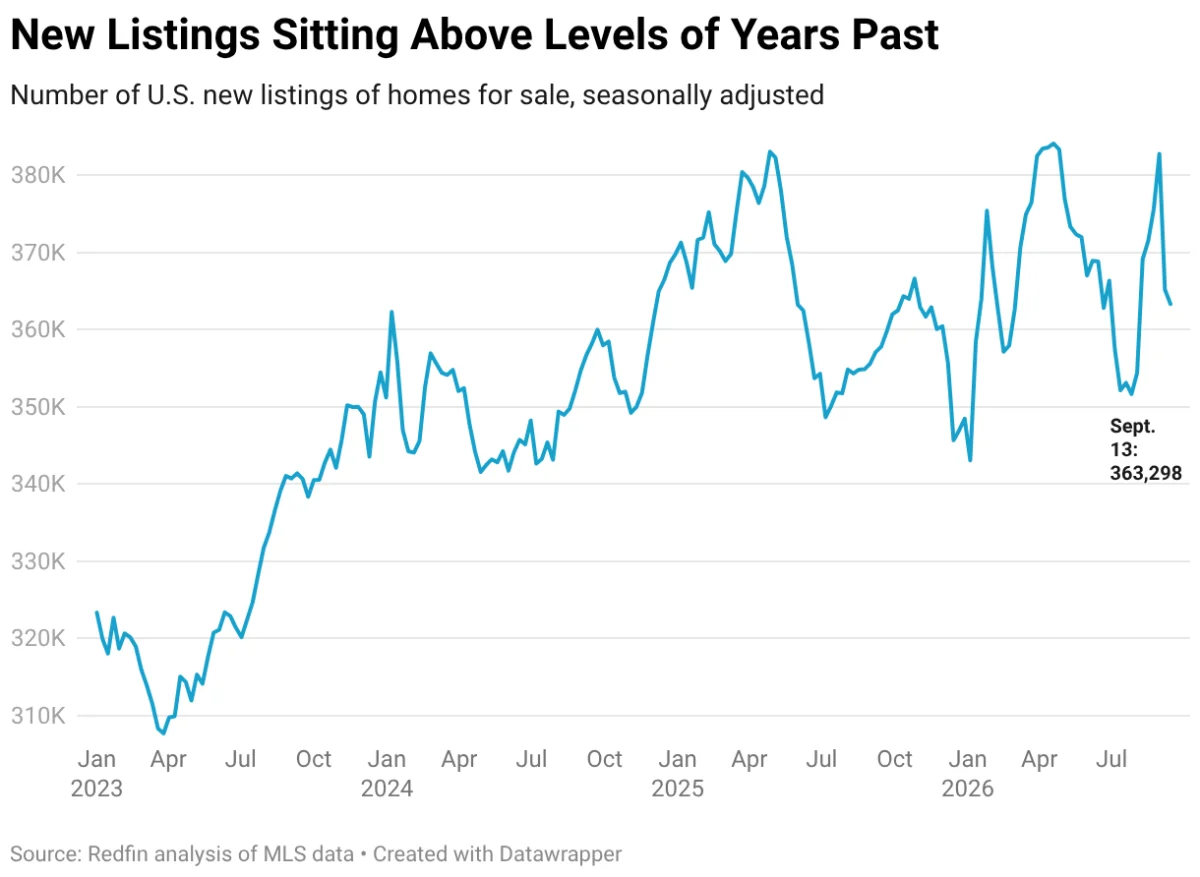
The American residential real estate landscape is undergoing a significant transformation as the autumn season approaches, characterized by a persistent tug-of-war between elevated borrowing costs and a shift in leverage toward the buyer. For the four-week period ending September 13, 2026, prospective homeowners faced a landscape defined by mortgage rates hovering near their highest levels since January 2025, a reality that has effectively tempered buyer enthusiasm and slowed transaction volume across the country.
Data released by Redfin indicates that while inventory levels remain relatively tight in historical terms, the combination of high interest rates and broader economic uncertainty has created a cooling effect. The median sale price for a home in the United States currently sits at $397,633, reflecting a modest year-over-year increase of 2%. However, the underlying metrics suggest a market that is increasingly sensitive to price, as evidenced by a rising share of listings experiencing price reductions.
A Chronology of Cooling Demand
The current market conditions are the culmination of a months-long drift in buyer sentiment. Mortgage interest rates, which serve as the primary catalyst for market activity, have climbed steadily throughout the third quarter. As of September 16, the daily average 30-year fixed mortgage rate reached 7.24%, a stark contrast to the 6.25% observed at the same time last year. This sharp ascent has forced many potential buyers to the sidelines, leading to a 19% year-over-year decline in mortgage-purchase applications as of the week ending September 11.
The shift in market sentiment is also visible in digital search behavior and physical engagement. Google Trends data shows that searches for "homes for sale" have plummeted by 12% over the last month and 15% year-over-year. Similarly, physical touring activity—often considered a precursor to contract signings—has dropped 3% since the start of the year. This stands in stark contrast to the same period in 2025, when touring activity was trending upward by 26%.
The Emerging Buyer’s Advantage
Despite the financial hurdles, those who remain in the market are finding themselves in a significantly stronger negotiating position than in years past. The inventory situation, while not abundant, is shifting toward a more balanced state. Currently, there are approximately 4.1 months of housing supply available. While this remains below the traditional benchmark of 5 to 6 months often cited as a "balanced" market, it represents a notable increase from the 3.9 months recorded last year.
This uptick in supply, paired with a decrease in active bidding wars, has given buyers more breathing room. The share of homes sold above the original list price has stabilized at 25.1%, while the average sale-to-list price ratio remains at 98.6%. Crucially, the share of home listings that have undergone price drops has risen to 20.8%, up from 19.7% a year ago. This suggests that sellers are increasingly compelled to align their expectations with the current reality of dampened demand.
Regional Divergence in Market Performance
The national data masks a high degree of regional variation. While some markets are experiencing cooling, others remain remarkably resilient or are suffering from sharper corrections.
In terms of median sale price appreciation, the Midwest and select coastal hubs are leading the growth. San Francisco reported a 10.2% year-over-year increase in median sale prices, followed by Milwaukee at 9.3% and Kansas City at 7.9%. Conversely, the tech-heavy markets of the West Coast and parts of the Sun Belt are experiencing downward price pressure. San Jose saw a 5% decline in median sale prices, with Austin, Texas, and San Antonio following closely behind with decreases of 4.6% and 4.3%, respectively.

Pending sales—a key indicator of future closed transactions—have hit their lowest levels in nearly three years, currently totaling 299,126, a 5.4% decrease year-over-year. This decline is particularly acute in cities like Seattle, which saw a 20.3% drop in pending sales, and Denver, which experienced a 15% decline. These regional disparities reflect local economic factors, including shifts in corporate return-to-office policies and the relative affordability of secondary versus primary markets.
Macroeconomic Implications and Interest Rate Sensitivity
The primary driver of the current market stagnation remains the Federal Reserve’s monetary policy and its subsequent impact on the bond market. Because mortgage rates are tied to the yield on 10-year Treasury notes, the current environment of persistent inflation and hawkish economic outlooks has kept borrowing costs at levels that exclude a significant portion of first-time homebuyers.
Economists note that the median monthly mortgage payment has climbed to $2,633—a 3.4% increase from last year. This creates a "lock-in" effect where existing homeowners with low-interest mortgages from 2020 or 2021 are unwilling to list their properties, as trading up would result in a significant increase in their monthly housing expenditures. This inventory constraint continues to put a floor under home prices, preventing a widespread crash despite the drop in buyer demand.
The Outlook for the Remainder of 2026
Looking forward, the housing market is expected to remain in a period of transition. The reduction in competition is a welcome development for those who have been priced out of the market during the post-pandemic housing frenzy, yet the barrier to entry remains high due to the cost of capital.
For sellers, the implication is clear: the era of "automatic" price appreciation is largely over. Homes that are priced aggressively without consideration for local demand trends are sitting on the market longer, with the median days on market holding steady at 46 days. Marketing, staging, and realistic pricing are once again becoming the cornerstones of a successful sale.
For buyers, the environment demands a more cautious and analytical approach. With more time to conduct inspections and negotiate contingencies, the frantic pace of 2021 and 2022 has been replaced by a more methodical process. However, the cost of financing means that the "affordability gap" remains a significant hurdle.
As the industry looks toward the final quarter of the year, the focus will remain on whether mortgage rates show signs of stabilization or if further upward pressure will push pending sales to even lower levels. With inventory showing signs of accumulation—albeit slowly—the market is entering a phase where the balance of power is shifting, even if the price of admission remains high.
The ongoing data from major metropolitan areas suggests that while the housing market is not collapsing, it is certainly recalibrating. The combination of high rates, lower transaction volume, and a growing share of price reductions indicates that the market is attempting to find a new equilibrium, one that balances the needs of sellers looking to exit and buyers looking for value in an increasingly expensive economic environment. Whether this leads to a broader price correction or a sustained period of stagnation will depend largely on the trajectory of inflation and the subsequent decisions by the Federal Reserve in the months ahead.