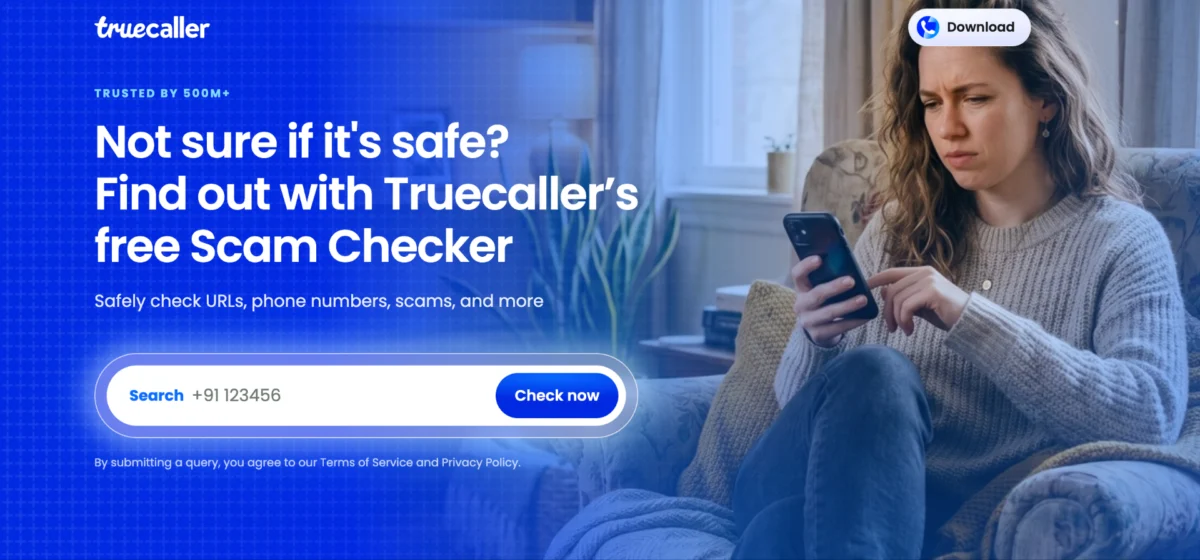
After more than a decade of establishing itself as the global leader in caller identification, Truecaller is evolving its strategy to combat the modern, multi-channel nature of digital fraud. On Sunday, the Swedish tech giant officially launched "Scam Checker," a versatile web-based and Android-integrated service designed to allow users to verify the legitimacy of suspicious phone numbers, hyperlinks, and text messages without the requirement of an app installation or user account sign-in. This strategic pivot marks a significant departure from the company’s traditional reliance on its core caller ID application, positioning its vast proprietary database as a standalone security utility for the broader internet.
The Evolution of Digital Deception
The transition toward a web-based verification tool comes in response to a fundamental shift in how bad actors operate. While telephone-based fraud remains a persistent nuisance, the landscape of cybercrime has increasingly migrated to messaging platforms, social media, and malicious web links. According to a 2025 GSMA survey of Indian consumers, the vectors of deception have diversified significantly: 46% of respondents who reported falling victim to scams cited messaging apps as the primary point of contact, while 37% identified SMS, and 32% pointed to traditional voice calls.
Truecaller’s own internal data underscores this trend. Between September 14 and September 20 of this year alone, the company analyzed over 12.9 billion messages globally, successfully identifying and flagging 20.3 million of them as fraudulent. By introducing the Scam Checker, the company aims to provide a "front-line defense" for users who encounter suspicious content while browsing the web or using messaging services like WhatsApp, where they are often removed from the safety net of the Truecaller app.
How the Scam Checker Functions
The Scam Checker operates as an intelligent filter for uncertainty. Users can input a suspicious URL, a phone number, or an entire text message into the portal. The service then employs a multi-layered verification process. For links, the tool proactively expands shortened URLs and follows redirects to reach the final destination, scanning that endpoint against Truecaller’s proprietary risk database.
If a user submits a text message, the tool utilizes natural language processing to extract embedded phone numbers or links, cross-referencing them against its "ScamFeed"—a crowdsourced database that currently hosts approximately 20,000 active scam reports in India alone. This community-driven approach is a pillar of the system, with roughly 1,300 new reports being added to the feed on a weekly basis.
While the tool provides a "scam or safe" verdict based on community signals and internal risk assessments, Truecaller has kept certain premium features gated. Detailed information, such as the specific name associated with a private phone number, remains restricted to the primary Truecaller application, which requires user authentication. This ensures that the company maintains its core business model while providing a valuable, friction-less utility to the public.
Strategic Context and Market Dynamics
The launch of Scam Checker arrives at a critical juncture for Truecaller. For years, the company has thrived as the gatekeeper of mobile communications in India, its largest market with over 350 million active users. However, the regulatory and technological environment has become increasingly crowded.
In India, the federal government has begun rolling out the "Calling Name Presentation" (CNAP) service, an initiative that could potentially render third-party caller ID services redundant by integrating similar functionality directly into the telecom network. Simultaneously, smartphone titans Apple and Google have aggressively expanded their own built-in spam-protection and caller-identification features, placing direct pressure on Truecaller’s primary value proposition.

Furthermore, the regulatory landscape is shifting. Just last week, India’s telecom regulator issued a mandate requiring caller-ID apps to share their user-submitted spam reports directly with telecom operators. Truecaller, while complying, publicly voiced concerns regarding the nature of this data sharing, describing the arrangement as a "one-way exchange" that places the burden of intelligence gathering on the private sector while potentially compromising the company’s competitive advantage.
A Pivot to Multi-Channel Security
Rishit Jhunjhunwala, CEO of Truecaller, acknowledged that the company must move beyond the "caller ID" label if it intends to remain relevant in a rapidly evolving threat landscape. "Caller ID was the first problem we solved, and it’s still how most people find us," Jhunjhunwala stated in an interview. "But scams moved to a more multi-channel approach with links and messages, and increasingly to voice and video. Our protection has to follow the scammer."
The development of the Scam Checker was heavily informed by user behavior. The company estimates that approximately 14 million web searches are conducted each month by people attempting to manually verify suspicious links or phone numbers. Recognizing this pattern, the company sought to capture that intent by providing a dedicated, trustworthy destination for such queries. "When you need it, you’re usually somewhere else," Jhunjhunwala noted. "The link shows up on WhatsApp. Your mother gets a message about a traffic fine. A friend forwards you a screenshot and asks, ‘Is this real?’ What people do in that moment is search. We are now the destination for that search."
Future Roadmap and Global Expansion
While the tool is currently live in India—the company’s primary testing ground—the rollout plan is ambitious. Truecaller intends to expand the service into Latin America, the Middle East, Africa, and Southeast Asia in the coming months. These regions share similar patterns of mobile-first digital adoption, where messaging-app fraud is often rampant and regulatory oversight of telecommunications can be fragmented.
Future iterations of the Scam Checker are expected to be more sophisticated. The company has announced plans to broaden the scope of detectable threats and, crucially, to introduce a feature that allows users to upload screenshots of suspicious messages. This would bypass the need for copy-pasting text, allowing the tool to use optical character recognition (OCR) to identify malicious elements within an image file—a common way that scams are disseminated via social media screenshots.
Implications for the Security Ecosystem
The introduction of this tool also serves as a strategic lead-generation engine for Truecaller. By offering a high-utility service to non-users, the company lowers the barrier to entry for its broader ecosystem. While the tool is technically separate from its enterprise-focused "Truecaller for Business" suite, the intelligence gathered through the Scam Checker contributes to a more robust, holistic view of the scam ecosystem, which eventually benefits the company’s enterprise risk products.
From an industry perspective, Truecaller’s move signals a broader trend: as scammers diversify their tactics, security companies must transition from protecting specific hardware endpoints (the phone) to protecting the user’s digital experience across the entire web. By commoditizing its database, Truecaller is attempting to transition from a utility app to an indispensable layer of the internet’s infrastructure.
Whether this move will be enough to offset the mounting pressure from telecom regulators and Big Tech competitors remains to be seen. However, by shifting focus toward the "scammer’s journey" rather than just the "caller’s ID," Truecaller is positioning itself as a proactive participant in the fight against global digital fraud. As the company continues to refine its algorithms and expand its reach, the efficacy of the Scam Checker will likely serve as a litmus test for whether the company can successfully transcend its original, single-purpose roots to become a comprehensive digital security provider for the next generation of internet users.