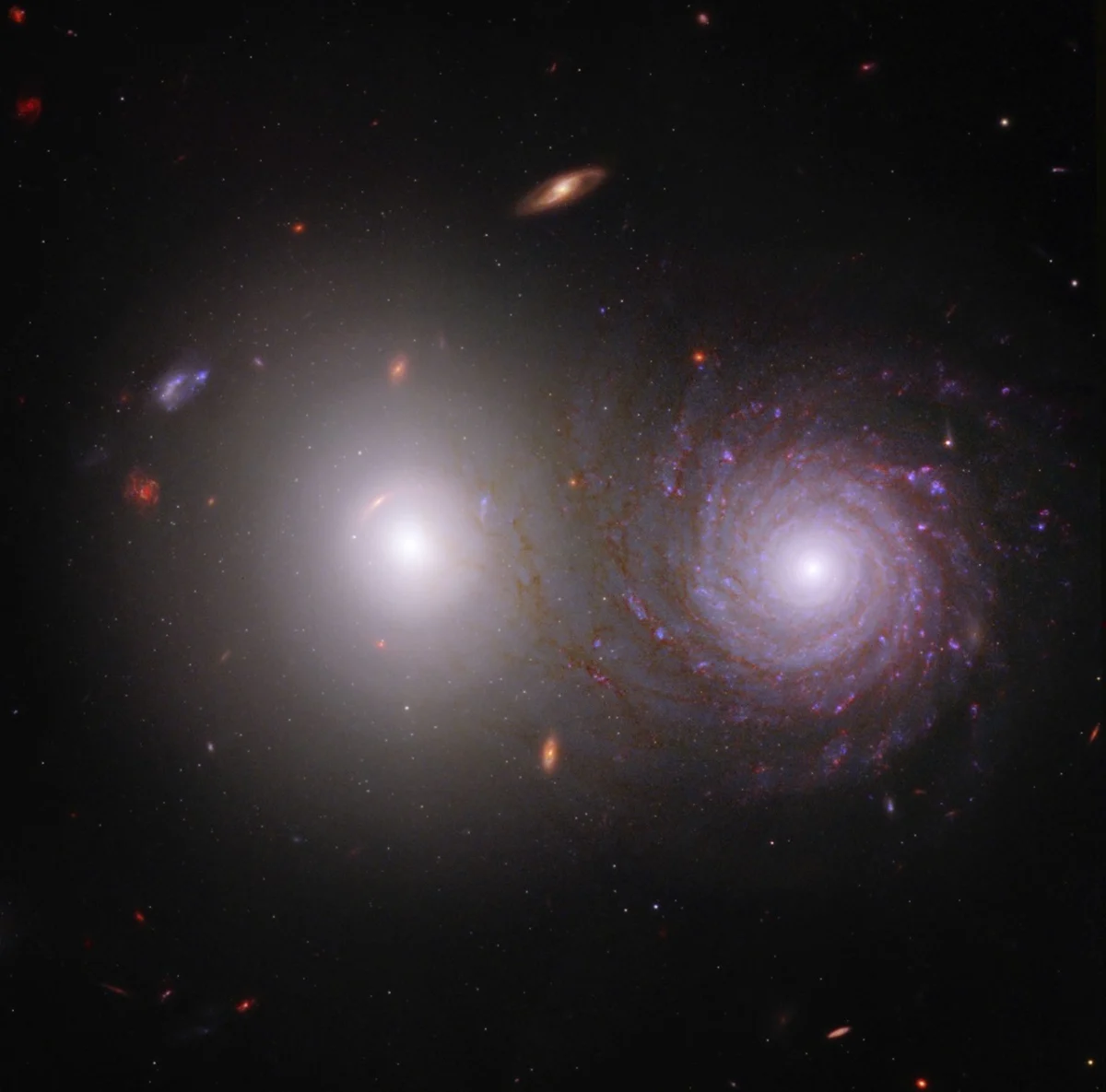
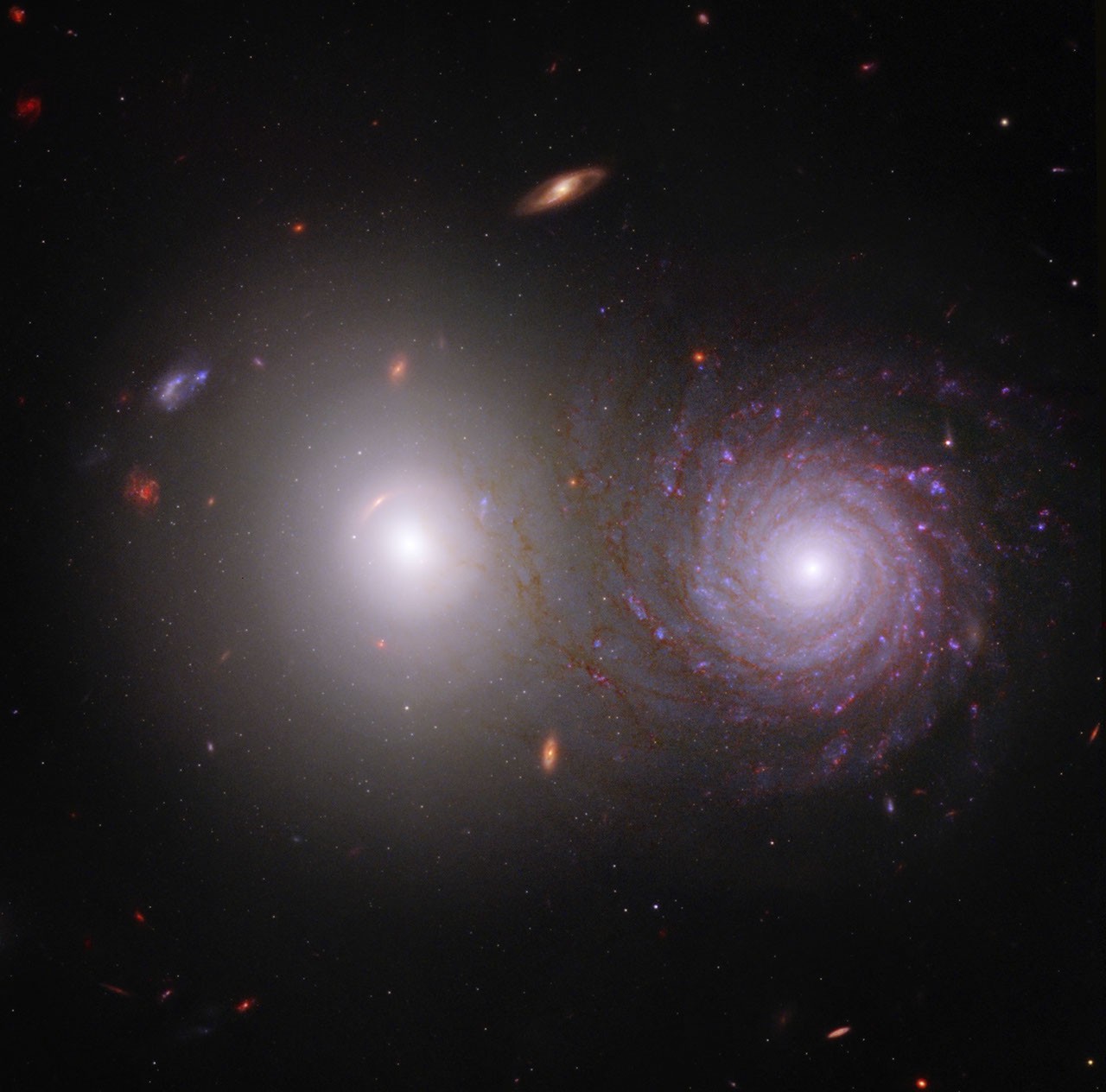
Galaxies are the fundamental building blocks of the observable universe, immense gravitational structures containing billions of stars, complex molecular clouds, and vast reservoirs of interstellar dust. While these structures are typically observed in isolation or within established galactic clusters, the vastness of space occasionally produces a phenomenon known as an overlapping galaxy pair. These rare events occur when two galaxies, situated at vastly different distances from Earth, align perfectly along our line of sight. By acting as a natural backlight, the more distant galaxy serves as a cosmic lamp, allowing the nearer galaxy to cast a silhouette of its internal dust structure against the starlight. To harness this unique astronomical phenomenon, NASA has officially launched Overlap Zoo, a new citizen science project designed to crowdsource the identification and classification of these rare alignments.
The Mechanics of Cosmic Backlighting
The utility of overlapping galaxies in modern astrophysics cannot be overstated. Interstellar dust is a notorious obstacle for astronomers; it absorbs and scatters visible light, effectively hiding the cores of galaxies and distorting the perceived distance and luminosity of stars. Because dust is notoriously difficult to measure in a vacuum, researchers require a "calibration standard."
When a foreground galaxy obscures a background one, the resulting silhouette provides a high-resolution map of the dust’s density, composition, and distribution. By analyzing the way light is dimmed or "reddened" as it passes through the foreground galaxy’s spiral arms or halo, scientists can determine the optical depth of the dust with unprecedented precision. This data is critical for refining the "cosmic distance ladder," the series of measurements that allow astronomers to calculate the size and age of the universe. Without accurate accounting for how dust dims starlight, estimates regarding the distance of remote galaxies can be significantly skewed, potentially leading to errors in our understanding of the expansion rate of the universe.
Chronology of the Galaxy Zoo Evolution
The inception of Overlap Zoo is the latest milestone in a two-decade history of public participation in astronomical research. The journey began in 2007 with the original Galaxy Zoo project, which sought to categorize the morphological types of galaxies—spirals, ellipticals, and irregulars—that were being cataloged by the Sloan Digital Sky Survey.
The success of the original initiative demonstrated that the human brain remains superior to early machine-learning algorithms in identifying subtle patterns and irregular shapes in deep-space imagery. Following the success of Galaxy Zoo, which has engaged hundreds of thousands of volunteers worldwide, NASA and its partners expanded the concept to include specialized projects such as Planet Hunters, Radio Galaxy Zoo, and now, Overlap Zoo. Each iteration has leveraged the growing volume of data provided by modern space-based telescopes, including the James Webb Space Telescope (JWST) and the Nancy Grace Roman Space Telescope, which are currently producing terabytes of imagery that would take individual research teams lifetimes to process.
The Challenge of Big Data
As of late 2026, the volume of astronomical data being generated has reached a critical threshold. Projects like the Legacy Survey of Space and Time (LSST) at the Vera C. Rubin Observatory are expected to catalog billions of galaxies over the next decade. While automated software can perform basic object detection, distinguishing between an actual, physically interacting galaxy pair and a mere optical alignment—a "chance projection"—remains a complex task.
"As new and better observations of galaxies continue to multiply, it is becoming incredibly difficult for astronomers to classify every candidate galaxy pair," notes Trevor Butrum, a graduate researcher and the lead for the Overlap Zoo project. The bottleneck is not the collection of data, but the classification of it. Machine learning models require "ground truth" data—examples verified by human eyes—to train effectively. By engaging the public, NASA is creating a verified, high-quality dataset that will serve as the foundation for the next generation of automated astronomical research.
Methodology and Volunteer Participation
The Overlap Zoo platform operates on a simplified interface that requires no professional training. Volunteers are presented with pre-selected images that have been flagged by the Galaxy Zoo algorithm as potential candidates for overlap. The process is broken down into three distinct steps:
- Verification: The user determines if the two galaxies are truly overlapping or if they are simply part of a single, larger merging system.
- Feature Identification: Volunteers mark specific features of the foreground galaxy, such as spiral arms, the galactic center, or diffuse halos, which are the primary areas where dust density is highest.
- Annotation: Users provide boundary outlines for both the foreground and background galaxies, creating a spatial mask that researchers use to isolate the light curves of the background galaxy.
This crowdsourced approach ensures that every candidate is reviewed by multiple individuals, a process known as "consensus classification," which minimizes the impact of human error.
Implications for Galactic Evolution Models
The scientific implications of building a comprehensive catalog of overlapping galaxies are profound. Current models of galactic evolution struggle to account for the exact "dust budget" of a galaxy—how much dust is created by dying stars versus how much is destroyed by supernova shocks. By gathering a large enough sample size of overlaps, astronomers hope to build a statistical map of how dust properties change over cosmic time.
For instance, by comparing the dust silhouettes of young, star-forming galaxies to those of older, quiescent galaxies, researchers can observe how the lifecycle of a galaxy alters its chemical composition. This data provides a direct window into the chemical enrichment of the interstellar medium, which is the raw material for future generations of stars and planets. If the Overlap Zoo project reaches its target of several thousand verified pairs, it will provide the largest empirical dataset on extragalactic dust ever assembled, effectively rewriting textbooks on galactic dynamics.
Broader Impact on Public Science
The launch of Overlap Zoo serves as a case study in the democratization of science. In an era where scientific complexity often alienates the general public, citizen science projects provide a tangible bridge between professional astrophysicists and enthusiasts. The initiative does not merely offload menial labor; it provides participants with the opportunity to contribute to published, peer-reviewed research.
Furthermore, the data collected by Overlap Zoo will be made publicly available through the NASA Science portal. This commitment to "Open Science" ensures that any researcher, regardless of their institutional affiliation or funding status, can utilize the catalog for their own studies. This inclusive approach is expected to foster a global community of amateur researchers who may eventually transition into professional roles, bolstered by the hands-on experience gained through the platform.
Looking Toward the Future
As the Overlap Zoo initiative matures, project leaders anticipate integrating AI-assisted tagging to help volunteers move more quickly through the data backlog. However, the human element remains irreplaceable. The nuances of light, shadow, and galactic structure—especially in cases where galaxies are partially obscured by intervening stars within our own Milky Way—often require the lateral thinking and contextual pattern recognition that only human participants can provide.
For those interested in participating, the barrier to entry is minimal. The project requires only a standard web browser and an internet connection. As the project gains momentum, NASA plans to release periodic updates regarding the "discoveries of the month," highlighting specific pairs that have revealed particularly interesting dust structures or unusual light-dimming patterns.
The study of the universe has long been a pursuit of light—the study of what we can see. Through Overlap Zoo, NASA is inviting the public to help them study what is hidden, using the shadows cast by the vast, silent structures of the cosmos to illuminate the invisible forces that shape the evolution of everything from stars to galaxies, and ultimately, the architecture of the universe itself. By participating in this project, citizens are not merely observing the night sky; they are actively assisting in the meticulous process of mapping the dark, dusty foundations of our cosmic neighborhood.