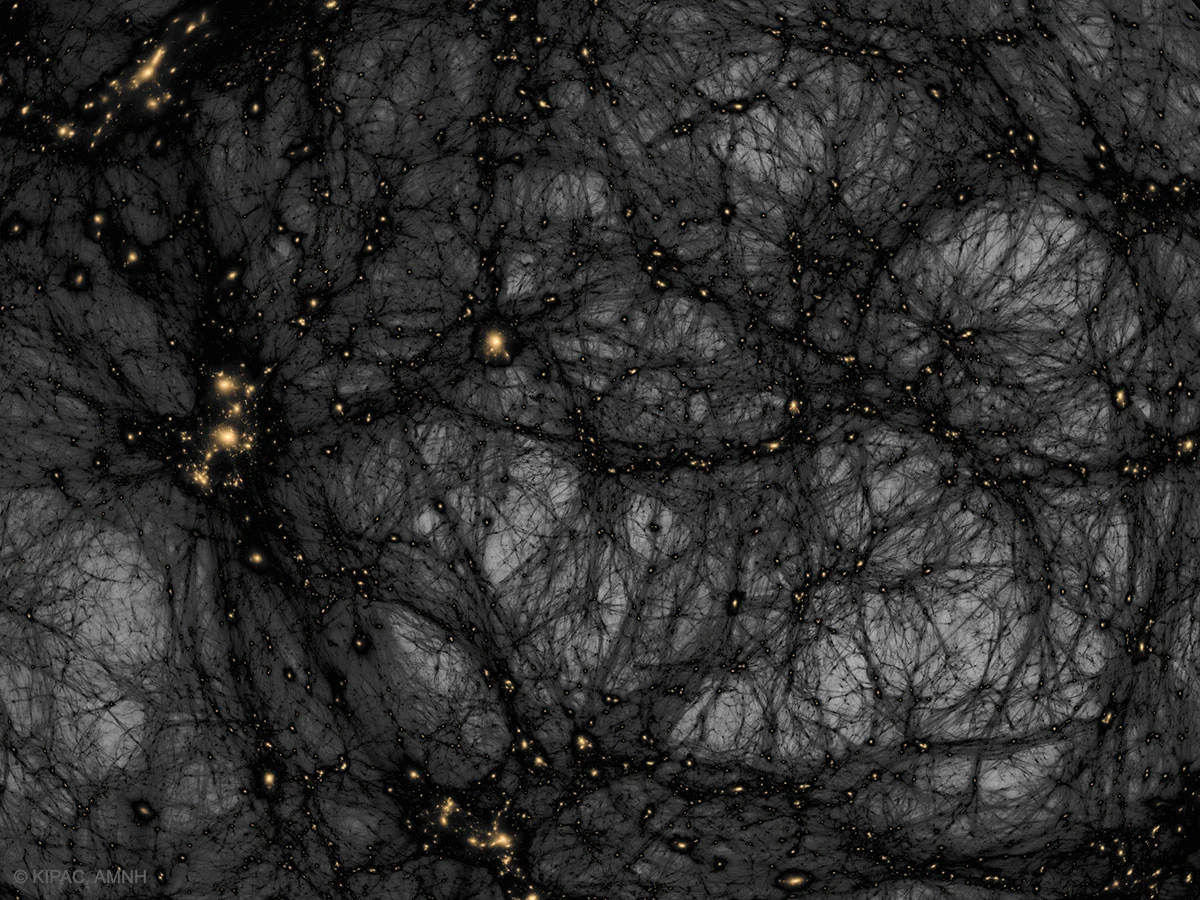
The structure of our universe is defined by a colossal, invisible framework that dictates the motion of galaxies and the evolution of the cosmos itself. Known as dark matter, this mysterious substance has long been the primary subject of investigation for astrophysicists seeking to understand why the observable universe behaves in ways that defy classical gravitational expectations. Recent visual data, including simulations produced by the American Museum of Natural History’s Hayden Planetarium for their "Dark Universe" exhibition, provide a compelling look at this hidden scaffolding. These simulations illustrate a web-like distribution of matter where dark matter serves as the gravitational glue holding the structures of the universe together, while ordinary matter—the stuff of stars, planets, and people—clumps in the isolated, brightly lit nodes of this vast network.
The Problem of Missing Mass and Galactic Rotation
The scientific consensus regarding dark matter did not emerge overnight; it is the culmination of decades of astronomical observation that revealed a significant discrepancy in the universe’s mass. In the 1970s, astronomers such as Vera Rubin and Kent Ford conducted groundbreaking observations of spiral galaxies. They discovered that stars on the outer edges of galaxies were moving just as fast as those near the center. According to Newtonian mechanics, the orbital velocity of stars should decrease with distance from the galactic core, much like the planets in our solar system. The fact that these stars maintained high speeds indicated the presence of a vast amount of unseen mass providing the necessary gravitational pull to keep them from flying off into intergalactic space.
This "missing mass" problem is not limited to individual galaxies. Observations of galaxy clusters have shown that these massive collections of galaxies move at speeds that would otherwise cause them to disperse, given the amount of visible matter present. Furthermore, gravitational lensing—the bending of light from distant objects as it passes by massive foreground structures—consistently reveals that there is far more mass present in these clusters than what can be accounted for by stars, gas, and dust. This overwhelming weight of evidence points to the existence of dark matter: a form of matter that does not emit, absorb, or reflect light, rendering it entirely invisible to traditional electromagnetic telescopes.
A Chronology of Discovery and Simulation
The journey to characterize dark matter has moved from theoretical necessity to complex computer modeling. The history of this field can be categorized into several distinct phases:
- 1930s: Fritz Zwicky, while studying the Coma Cluster of galaxies, identifies the need for "dunkle Materie" (dark matter) to explain the high orbital speeds of galaxies within the cluster.
- 1970s: Vera Rubin and Kent Ford provide the definitive observational proof through galaxy rotation curves, establishing dark matter as a fundamental requirement for galactic stability.
- 1980s-1990s: The emergence of Cold Dark Matter (CDM) theory, which suggests that dark matter particles move slowly compared to the speed of light, allowing for the hierarchical formation of structures in the universe.
- 2000s-Present: The era of high-resolution numerical simulations, such as the Illustris and Bolshoi simulations, which utilize supercomputers to replicate the evolution of the universe over billions of years. These simulations confirm that the distribution of dark matter creates the cosmic web observed today.
The image provided by the Hayden Planetarium is a direct product of this modern computational era. By using sophisticated algorithms to model the gravitational interactions of billions of particles, researchers have produced maps that match the distribution of galaxies observed by surveys such as the Sloan Digital Sky Survey. These simulations reveal that dark matter forms a sprawling "spider web" of filaments, creating the gravitational wells into which baryonic (visible) matter falls, eventually forming the luminous galaxies we observe today.
The Hierarchy of Matter
To understand the universe, one must distinguish between two primary components: baryonic matter and dark matter. Baryonic matter is composed of protons, neutrons, and electrons—the building blocks of all atoms. Despite its ubiquity in our immediate experience, it constitutes a mere 5% of the total energy-matter density of the universe. Dark matter, by contrast, is estimated to account for roughly 27% of the universe’s composition.
The interaction between these two forms is essential to structure formation. As the universe cooled following the Big Bang, dark matter, which does not interact via the electromagnetic force, began to collapse under its own gravity to form dense filaments. These filaments created the "skeleton" of the universe. Baryonic matter, which is susceptible to electromagnetic interactions, was pulled into these gravitational wells, where it compressed, heated up, and eventually ignited to form the first generation of stars and galaxies. Without the underlying framework of dark matter, the universe would likely be a diffuse, featureless gas, devoid of the complex galactic structures required to host life.

The Emergence of Dark Energy: A New Frontier
While dark matter is essential to the internal stability of galaxies and clusters, its influence is surpassed on a cosmological scale by a phenomenon even more enigmatic: dark energy. In 1998, observations of distant Type Ia supernovae revealed that the expansion of the universe is not slowing down due to gravity, as previously assumed, but is instead accelerating.
This discovery shifted the paradigm of modern cosmology. Dark energy is hypothesized to be a uniform energy density that permeates all of space, acting as a form of "repulsive gravity" that drives galaxies apart. Unlike dark matter, which acts as an attractive force to pull structures together, dark energy pushes the fabric of space-time outward. Current estimates suggest that dark energy comprises approximately 68% of the universe, dwarfing both dark matter and baryonic matter.
The relationship between dark matter and dark energy remains one of the most active and challenging areas of physics. While dark matter dictates the local architecture of the universe, dark energy dictates its ultimate fate. If dark energy continues to dominate, the universe will continue to expand at an ever-increasing rate, eventually stretching the cosmic web until the filaments of dark matter are pulled apart and the universe reaches a state of "Big Freeze" or heat death.
Implications and Ongoing Research
The scientific community continues to pursue the direct detection of dark matter particles. Numerous underground experiments, such as the LUX-ZEPLIN (LZ) experiment, are designed to detect the faint signature of a Weakly Interacting Massive Particle (WIMP) colliding with an atomic nucleus. Despite the high sensitivity of these detectors, a definitive detection has remained elusive, leading some theorists to explore alternative explanations, such as Modified Newtonian Dynamics (MOND) or the existence of axions—hypothetical, ultra-light particles.
The implications of these findings are profound. Every time a new simulation or observational study maps the dark matter distribution, it refines our understanding of the history of the cosmos. These studies serve as a testament to the fact that our understanding of the physical world is constantly evolving. The "haunted" appearance of the universe—the vast, unseen network of dark matter—serves as a reminder of how much of reality remains outside the reach of our direct senses.
As observational technology advances, particularly with the deployment of next-generation space telescopes and ground-based observatories, the precision of our dark matter maps will only increase. By analyzing the subtle distortions in light from distant galaxies, scientists are essentially performing a "cosmic autopsy" on the universe, peeling back the layers of visible light to reveal the hidden mechanics of space-time.
Ultimately, the study of dark matter is an exploration of the fundamental nature of existence. Whether it is composed of WIMPs, axions, or some other undiscovered particle, dark matter serves as the silent architect of our universe. Its role in shaping the stars, galaxies, and perhaps even the conditions necessary for life, ensures that it will remain the focal point of astrophysics for the foreseeable future. As we continue to gaze at the cosmos, we are not just observing light; we are learning to see the invisible, mapping the vast, dark tapestry that defines our place in the universe.