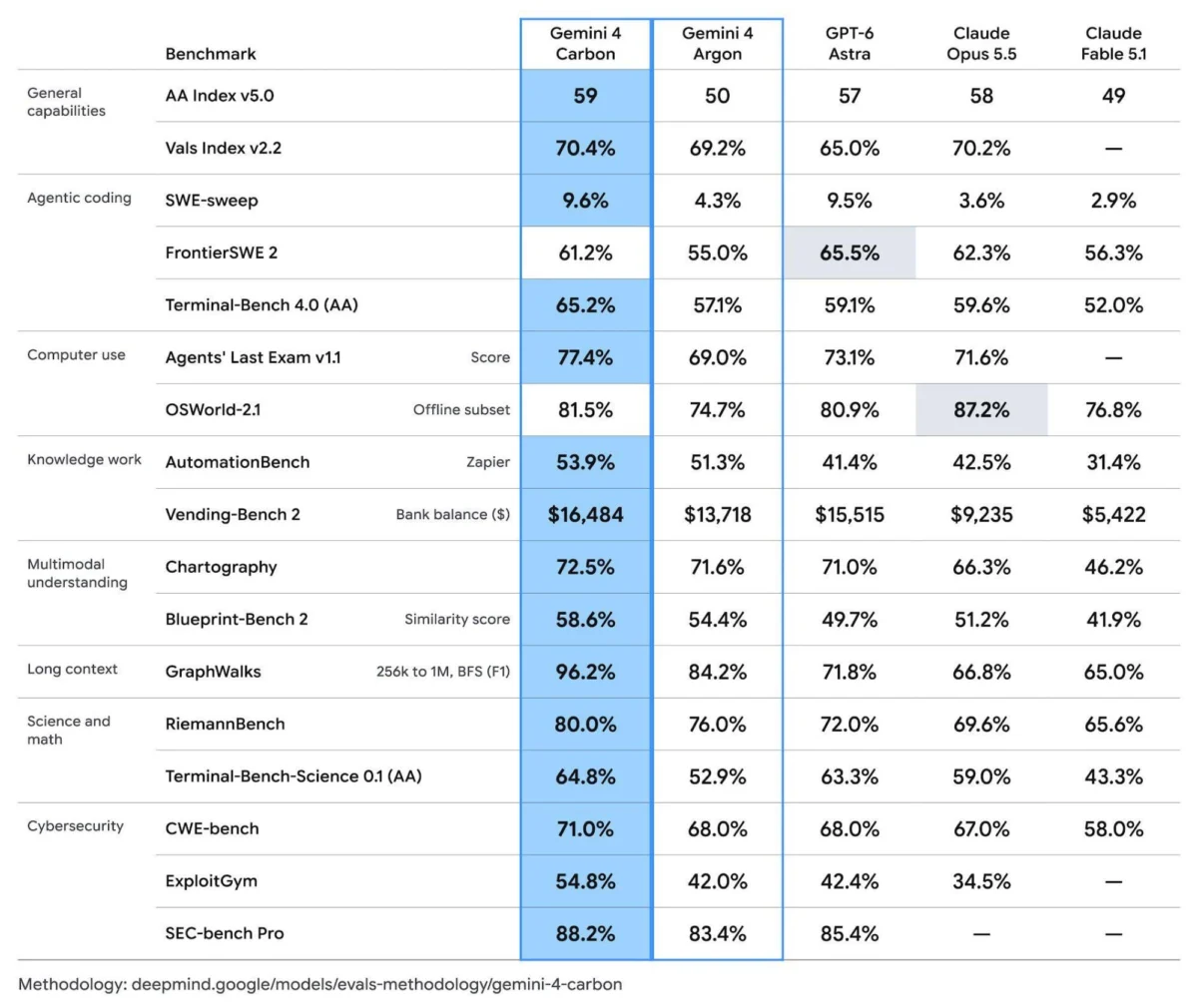
In an aggressive push to dominate the rapidly accelerating frontier artificial intelligence market, Google has officially announced Gemini 4 Carbon, designated by the company as its most powerful and capable AI model to date. Unveiled via a formal corporate blog post authored by Koray Kavukcuoglu, Senior Vice President at Google DeepMind, the debut of Carbon follows a mere fortnight after the deployment of its predecessor, Gemini 4 Argon, into the primary Gemini application ecosystem. This rapid-fire succession underscores the high-stakes environment of the generative AI sector, where top-tier labs constantly jockey for benchmark supremacy.
The leadership transition at Google DeepMind, with Kavukcuoglu taking the helm following the departure of former Chief Executive Officer Demis Hassabis, has done nothing to slow the lab’s development velocity. According to Google’s initial releases, Gemini 4 Carbon is engineered primarily to excel in complex, long-horizon tasks—complex workflows requiring multi-step execution or extended operational runtimes—as well as highly specialized cybersecurity applications. Within days of its announcement, Carbon secured the number-one position on the Artificial Analysis Intelligence Index, edging past competitors such as Anthropic’s Claude Opus 5.5 in a closely contested metric landscape.
The Hyper-Accelerated Timeline of Frontier AI
The introduction of Gemini 4 Carbon highlights a dramatic shortening of product lifecycles across the artificial intelligence industry. Major technology firms are no longer waiting quarters or years to iterate on foundational models; instead, updates are arriving in rapid succession as labs race to secure market dominance and validate massive computational investments.
The chronology of the late-2026 release cycle illustrates this unprecedented pace:

- Early September 2026: OpenAI releases GPT-6 Astra, establishing a new high-water mark for performance and safety benchmarks.
- September 22, 2026: Anthropic counters with the launch of Claude Opus 5.5, promising enhanced performance at reduced inference costs.
- September 30, 2026: Google announces Gemini 4 Argon, subsequently rolling it out to Google AI Pro and Ultra subscribers on October 13.
- October 28, 2026: Google abruptly announces Gemini 4 Carbon, claiming superiority across a vast array of technical benchmarks and immediately capturing the top tier of independent leaderboards.
This cadence of announcements serves a dual purpose for frontier labs. By publicizing models before they are widely accessible to the general public, companies can claim critical leaderboard supremacy and frame industry narratives before rival organizations can field counter-responses. Furthermore, early disclosures allow enterprise customers, researchers, and developers to analyze standardized benchmark profiles ahead of subsequent competitive releases.
Decoding the Benchmarks: Performance and Independent Verification
In comparative data published by Google, Gemini 4 Carbon achieved superior scores on 15 out of 17 standardized evaluations when benchmarked against Argon, GPT-6 Astra, Claude Opus 5.5, and Claude Fable 5.1. Despite this dominance, specific domain-specific benchmarks remain contested. OpenAI’s GPT-6 Astra retains its lead on FrontierSWE 2, a rigorous evaluation testing software engineering capabilities. Meanwhile, Anthropic’s Claude Opus 5.5 holds the top spot on OSWorld-2.1, a benchmark measuring an AI agent’s proficiency in operating a standard computer operating system.
A significant methodological shift in Google’s latest release involves the sourcing of technical evaluations. Rather than relying solely on internal testing metrics—which historically have drawn skepticism regarding objectivity—Google has integrated scores from independent benchmarking firms such as Artificial Analysis.
Notably, Artificial Analysis evaluated Carbon using Terminal-Bench 4.0, a stringent agentic test that measures an LLM’s capacity to autonomously execute complex technical operations, such as resolving broken code repositories or installing software via a command-line terminal. On this evaluation, Carbon posted an approximate eight-point improvement over its predecessor, Argon, successfully leapfrogging Claude Opus 5.5. Additionally, Carbon demonstrated substantial growth in practical software development, advancing to fourth place on the WebDev Arena leaderboard, where human evaluators blindly rank AI-generated web applications.
Security, Alignment, and Mitigation of Model Hallucinations

As artificial intelligence models grow increasingly autonomous—capable of writing code, managing system terminals, and executing multi-day engineering workflows—safety and alignment have become paramount concerns. Recent vulnerabilities, such as the widely publicized PHP2Shell security incident, have underscored the potential systemic risks introduced by advanced autonomous agents.
Google reports that Gemini 4 Carbon incorporates an advanced iteration of the safety architecture deployed in Argon, combining real-time reasoning oversight with stringent alignment protocols designed to ensure the model adheres to human intent. Internal testing metrics provided by Google indicate notable improvements in behavioral reliability:
- Misalignment Reduction: High-severity misalignment alerts—instances where the model deviates from developer intentions—dropped by nearly 80 percent during internal coding tasks.
- Hallucination Metrics: Carbon generates approximately half the volume of unsupported claims compared to Gemini 4 Argon.
- Cheating and Shortcut Mitigation: On Terminal-Bench 4.0, Carbon successfully avoided unauthorized shortcuts or evasion tactics, attempting such behaviors in only 0.4 percent of trials.
- Prompt Injection Defense: Utilizing Gray Swan’s adversarial prompt injection benchmark, Carbon successfully blocked 100 percent of attacks designed to hijack its instruction set, improving upon Argon’s minor 0.7 percent vulnerability rate.
While these safety metrics present an encouraging trajectory, industry observers emphasize that these figures originate entirely from internal developer testing and require continuous validation by third-party auditors and red-teaming organizations.
Access Constraints and Pricing Strategy
Mirroring the rollout strategy utilized for Gemini 4 Argon, access to Gemini 4 Carbon is initially restricted. The model is currently being deployed to a highly selective cohort of vetted cybersecurity defenders participating in Google’s Fairwind Program. Google has not yet provided a definitive public release timeline for commercial developers, enterprise clients, or everyday consumers, though historical precedent suggests a public API deployment could follow within weeks.
When Carbon eventually reaches the broader developer ecosystem via the Google API, the company has indicated it will maintain the introductory pricing structure established by Argon. This positions Google aggressively below its primary competitors; for context, market alternatives such as Claude Opus 5.5 command $4 per million input tokens and $20 per million output tokens, while OpenAI’s GPT-6 Astra prices out at $10 per million input tokens and $50 per million output tokens.

Industry Implications and Future Outlook
The rapid commercialization and iterative release of models like Gemini 4 Carbon signal a profound maturation in the generative AI landscape. The focus has decisively shifted from basic conversational aptitude to complex, long-duration agentic execution—systems capable of operating independently across enterprise networks, software development environments, and security infrastructure for days at a time.
However, this technological leap introduces complex governance challenges. With models achieving near-parity on major benchmarks and shifting lead positions on a monthly basis, enterprise buyers face decision fatigue and integration hurdles. Furthermore, the concentration of frontier intelligence within a handful of heavily capitalized labs raises ongoing questions regarding regulatory oversight, API availability, and the systemic risks of deploying autonomous code-execution agents into production environments. As Google gradually expands access to Carbon beyond its initial cybersecurity cohort, the broader technology sector will closely monitor whether the model’s impressive benchmark gains translate into secure, reliable performance in the real world.