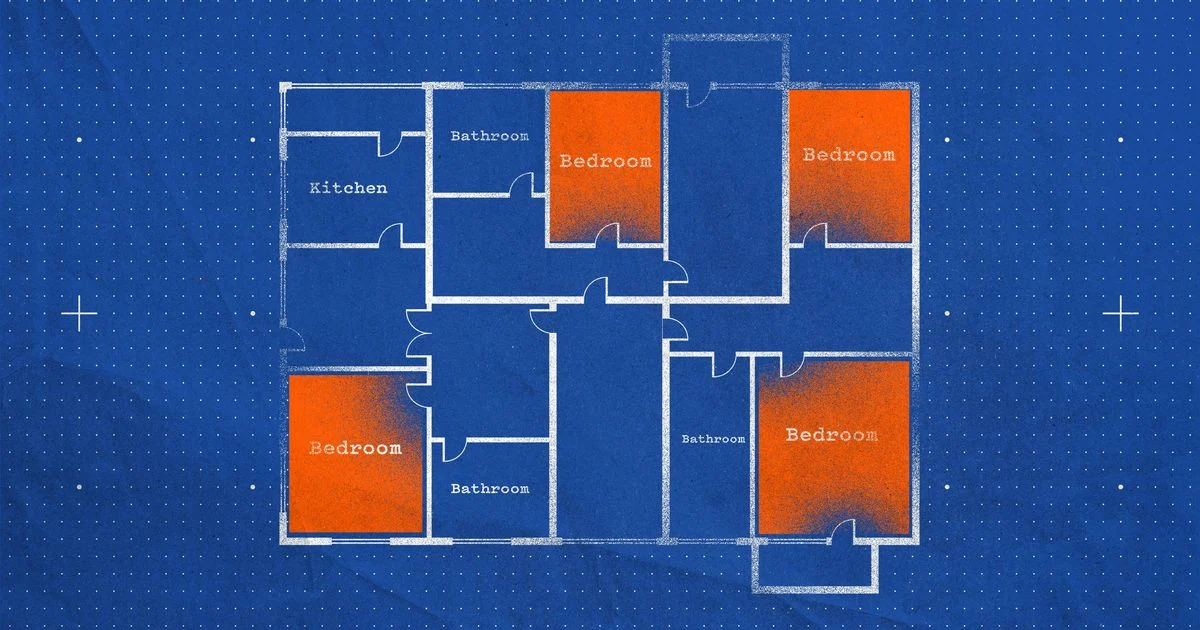
In the upper echelons of the New York City real estate market, a notable architectural and cultural shift is quietly reshaping luxury developments across Manhattan and Brooklyn. For decades, developers prioritizing sales velocity and maximum financial returns heavily favored compact footprints, filling new residential towers with studios, one-bedrooms, and occasional two-bedroom units. Today, however, a contrasting philosophy has taken root. Driven by affluent buyers seeking suburban proportions combined with urban convenience, the four-bedroom-plus condominium has emerged as the definitive modern status symbol.
This trend marks a distinct departure from historical development patterns in the nation’s most densely populated real estate market. According to comprehensive data from market research firm Marketproof, approximately 10 percent of all Manhattan and Brooklyn condo proposals accepted by the New York Attorney General’s Office since 2024 featured apartment mixes where half or more of the units contained four or more bedrooms. This figure represents a significant increase from the 2015-to-2023 period, during which fewer than 4 percent of submitted condo plans emphasized such sprawling layouts.
The Evolution of Luxury Demand and Suburban Flight
The surging appetite for oversized urban residences is largely fueled by changing lifestyle preferences among high-net-worth professionals, growing families, and affluent empty-nesters. Following years of pandemic-era shifts that prompted many urban dwellers to evaluate their living spaces, a significant segment of wealthy buyers has sought out properties that replicate the functional amenities of a suburban estate without requiring a relocation to Westchester County or coastal Connecticut.
Real estate analysts point to specific demographic segments driving this demand. Young, well-compensated families working in finance, corporate law, and the expanding artificial intelligence sector are increasingly willing to pay multi-million-dollar premiums for multi-room layouts. These configurations typically include dedicated home offices for remote or hybrid work schedules, generous in-unit laundry facilities, and distinct zones designed to separate adult living spaces from children’s play areas.
A physician and her businessman husband who recently relocated from suburban Southern California to an $8.9 million, four-bedroom residence at Extell’s 50 West 66th Street on the Upper West Side illustrated this exact requirement. Faced with limited options on the market, the family prioritized a layout featuring separate spaces for professional work, domestic duties, and child-rearing. Real estate professionals note that similar motivations are inspiring buyers to snap up oversized units at boutique projects such as the Myles on West 21st Street in Chelsea—where the majority of units feature four or five bedrooms—and Douglas Elliman’s 260 East 72nd Street development.
Financial Realities and Developer Economics
While constructing sprawling residences goes against the traditional strategy of maximizing unit counts, developers are finding compelling financial justifications for the shift. Jonathan Miller, director of markets at StreetMatrix, notes that while rental developers benefit from high concentrations of smaller units, the sales market commands a distinct price premium for large, contiguous square footage.
This pricing power was demonstrated at a 36-unit boutique condominium project at 200 West 88th Street, developed by Nortco. Originally conceptualized with a traditional unit mix of one- and two-bedroom apartments, the development team altered its plans after analyzing market data. By reconfiguring the building to feature larger residences—with the smallest layout starting at three bedrooms—developers achieved price-per-square-foot metrics up to 50 percent higher than comparable properties featuring smaller units. Furthermore, the absorption rate—the speed at which units were purchased—exceeded expectations, securing a rapid return on investment.
Stephen Kliegerman, president of development marketing at Brown Harris Stevens, explains that construction efficiency also plays a role in favoring larger floor plans. Multi-bedroom configurations require fewer total kitchens and bathrooms relative to the overall square footage than a building partitioned into dozens of individual studios and one-bedroom units.
The "Silver Tsunami" and Intergenerational Wealth
Beyond young families with children, the market for expansive condominiums is heavily influenced by older, affluent buyers. Often referred to in the brokerage community as the "silver tsunami," this demographic consists of empty-nesters transitioning out of multi-thousand-square-foot suburban homes or historic townhouses.
Rather than downsizing their spatial expectations, these buyers are seeking comparable square footage within the city. Such residences allow them to host children and grandchildren during holidays and extended visits without the ongoing maintenance burdens associated with a standalone suburban house. This desire for large-scale city living has expanded the demand for four-bedroom properties beyond traditional strongholds like the Upper East Side and Upper West Side, spurring new construction and conversions in vibrant downtown neighborhoods.
Charles Snyder, senior vice-president of research and analytics at Douglas Elliman, observes an unprecedented crossover between downtown and uptown buyers. Wealthy older individuals and established families increasingly want proximity to downtown dining, retail, and cultural amenities while retaining the grand proportions they are accustomed to.

Historical Parallels and Market Risks
The current prevalence of massive luxury apartments bears a striking historical resemblance to the architectural trends of the late Gilded Age. At the turn of the 20th century, affluent families routinely inhabited sprawling apartments along Park Avenue and Central Park West, complete with dedicated quarters for live-in domestic staff. Many of these historic layouts were subsequently subdivided into smaller units during the economic pressures of the Great Depression.
Today’s luxury boom mirrors those historical socioeconomic divides, occurring amid heightened economic inequality and ongoing public debate regarding urban housing affordability. While policymakers and advocates continually call for the construction of diverse housing stock to address regional shortages, market economics heavily incentivize developers to target the most affluent consumer tier.
Industry experts caution that specializing exclusively in large-format condominiums carries inherent risks. While a development consisting of diverse apartment sizes can be pivoted to a rental model during a severe economic downturn—reminiscent of the market corrections seen in 2008 and 2009—a boutique building composed entirely of multi-million-dollar, four-bedroom residences offers far less operational flexibility if market conditions sharply deteriorate.
Nevertheless, as long as high-net-worth buyers continue to prioritize expansive square footage, dedicated home offices, and multi-room layouts, the four-bedroom apartment will remain the premier structural symbol of modern urban wealth.