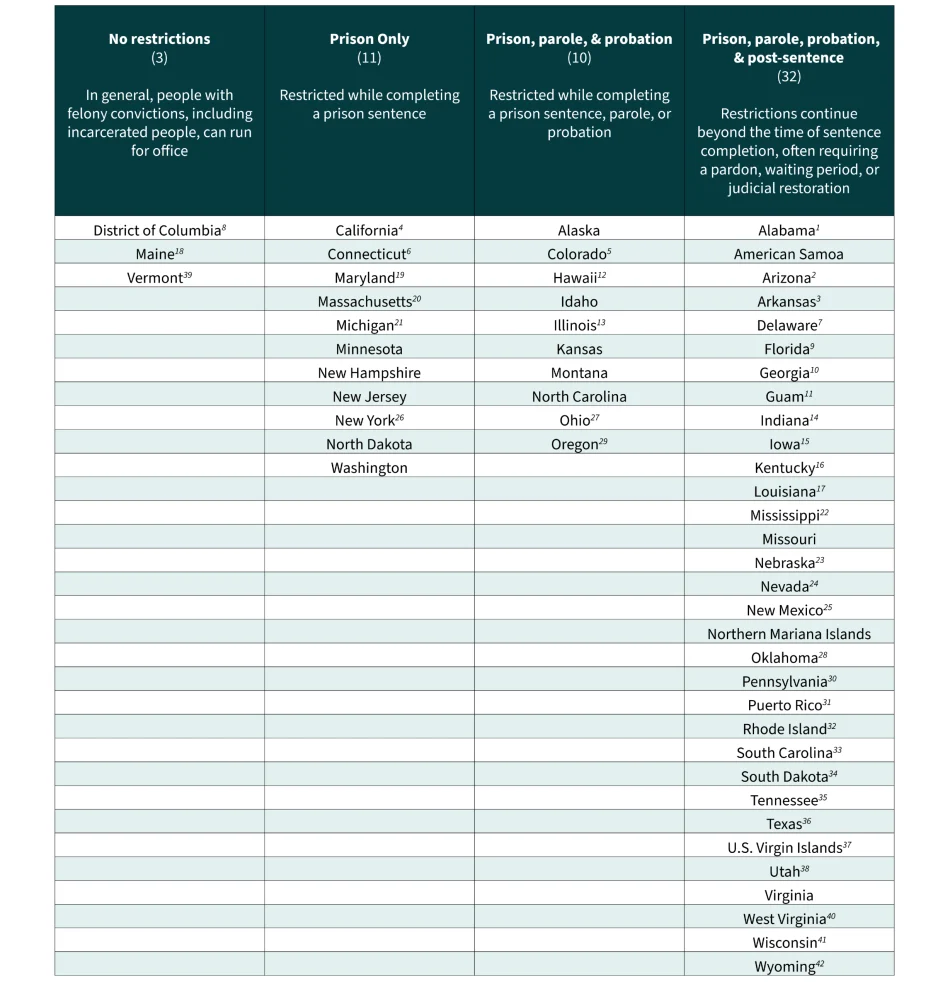
The American democratic system is defined by a paradox: while the U.S. Constitution imposes no restrictions on federal officeholding for individuals with felony convictions, the rules governing state and local elections create a confusing and often exclusionary patchwork of statutes that vary wildly across the country. From the halls of state legislatures in Nevada and Virginia to the local school boards and neighborhood commissions of small towns, formerly incarcerated individuals are increasingly seeking to represent their communities. Yet, these candidates often face systemic legal barriers that remain disconnected from the modern push to restore voting rights to justice-impacted citizens.
The legal landscape for potential candidates is anchored by the Supreme Court’s 1995 decision in U.S. Term Limits, Inc. v. Thornton, which established that states cannot unilaterally add qualifications for federal office beyond those enumerated in the U.S. Constitution. Consequently, individuals with felony convictions—including those currently serving prison sentences—are legally eligible to run for the U.S. Congress, the Senate, and the presidency. History provides notable examples of this constitutional reality, such as Eugene V. Debs, who famously campaigned for president from a prison cell in 1920 under the moniker "Convict 9653," securing nearly a million votes. More recently, figures like Lyndon LaRouche and activist Leonard Peltier have also mounted presidential bids while incarcerated.
However, when the focus shifts from federal to state and local levels, the landscape darkens. Eligibility criteria for these offices are determined by individual state constitutions and municipal charters, resulting in a system where a candidate might be qualified to serve in one jurisdiction but permanently barred in another.
A Case Study in Modern Representation: The Story of Harold Cunningham Jr.
The most stark example of this issue currently resides in the District of Columbia. Harold Cunningham Jr., an Advisory Neighborhood Commissioner (ANC) in DC, is widely considered the only currently incarcerated elected official in the United States. His election in 2025 to represent District 7F—a region that includes the DC Jail and the Correctional Treatment Facility—highlights the potential for incarcerated individuals to serve as conduits between the justice system and the public.
Cunningham’s journey is not an anomaly in the District; he is the fourth incarcerated resident to serve on his commission since 2020. His tenure has been marked by advocacy for jail conditions and legislative reform, specifically the EASE Act, which seeks to allow incarcerated residents to testify before the DC Council. Cunningham argues that his presence in office brings a necessary perspective to the legislative process. "You cannot lock away your problems," Cunningham noted in a recent interview. "Having a position like this is the best thing that can happen in a prison. It brings the administration closer to the people in the jail."
The Dichotomy of Rights: Voting vs. Running for Office
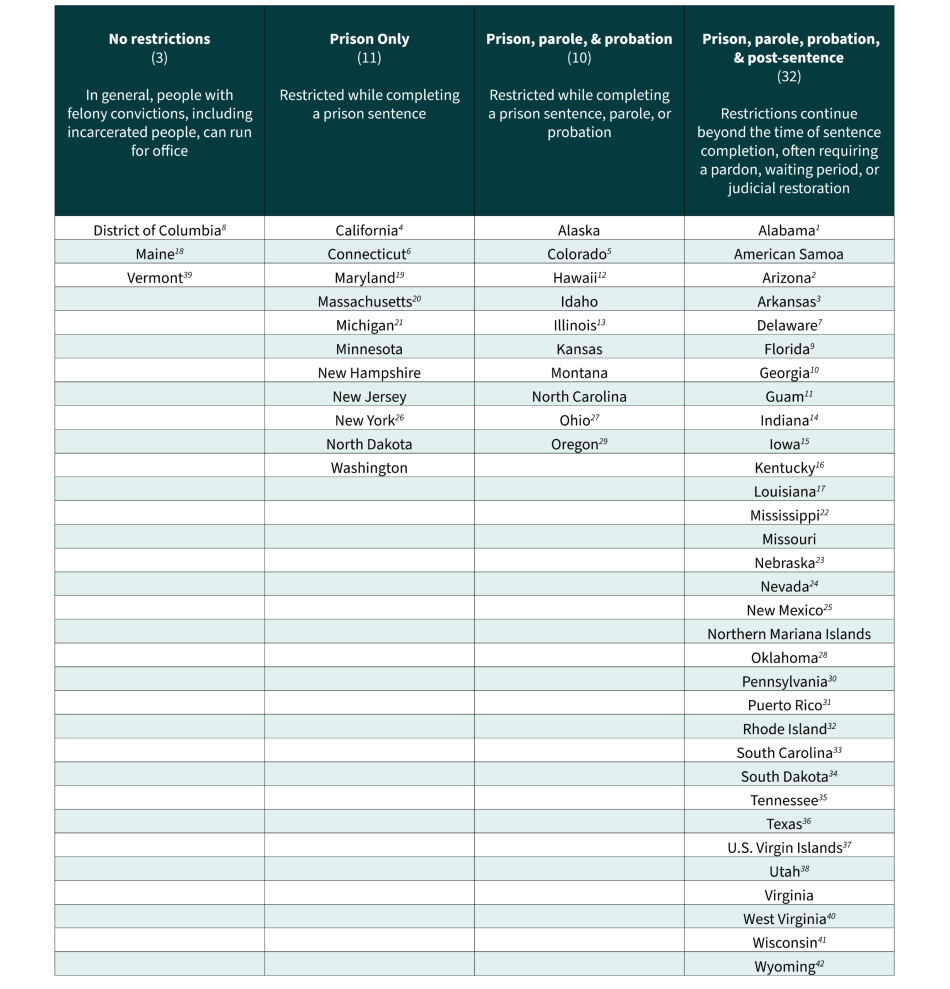
A critical finding in the research conducted by The Sentencing Project is the frequent misalignment between the right to vote and the right to run for office. While the last three decades have seen a significant expansion of voting rights for formerly incarcerated people—with 27 states and the District of Columbia enacting reforms since 1997—these same states often maintain strict, if not permanent, barriers to holding office.
Data indicates that in roughly 25 jurisdictions, the eligibility to run for office mirrors the eligibility to vote. However, in the remaining 31, the two are decoupled. A striking example is Missouri, which recently restored voting rights to many individuals upon completion of their carceral sentences. Despite this, these individuals remain ineligible to run for public office, a restriction that persists regardless of whether they have received a pardon if the original conviction involved a guilty plea.
This discrepancy often leaves candidates and voters in a state of legal limbo. In states like Nebraska, voting rights are restored automatically upon the completion of a sentence, yet obtaining the right to run for office requires the additional, often difficult, step of securing a pardon from the state’s Board of Pardons.
The Mechanics of Exclusion: Bribery, Moral Turpitude, and Public Trust
Many states structure their bans around the concept of "public trust." Statutes often exclude individuals convicted of crimes such as bribery, perjury, embezzlement, or misuse of public funds. While these restrictions are intended to safeguard the integrity of government, the scope of these laws is often overly broad. In Alabama, for example, the disqualification covers an array of "infamous crimes," effectively sweeping in almost all felony-level offenses. Restoration of rights in such jurisdictions often requires an affirmative pardon from a state board, a process that can take years and is subject to the political whims of the executive branch.
In other regions, the waiting periods are punitive. In Nevada, individuals with felony convictions must wait four years after the completion of their entire sentence—including parole and probation—before they are eligible to seek office. In Rhode Island, even a "no contest" plea to a misdemeanor resulting in a sentence of six months or more can trigger a three-year bar from holding office.
Policy Implications and Future Directions
The Sentencing Project and other criminal justice advocacy groups argue that the current system is fundamentally at odds with democratic principles. They advocate for a three-tiered approach to reform:
-
Elimination of Candidacy Bans: The primary recommendation is to remove all categorical bans on candidacy based on conviction status. Proponents argue that the electorate is the best arbiter of a candidate’s fitness for office. By leaving the decision to the voters, the system would shift from a punitive model to one focused on civic participation.
-
Alignment of Rights: If jurisdictions are unwilling to fully repeal bans, they should at least harmonize the standards for voting and candidacy. Reducing the "rights gap" would minimize public confusion and ensure that those who have paid their debt to society can participate in all facets of the democratic process.
-
Administrative Clarity: Currently, the lack of accessible, clear guidance on eligibility serves as a barrier in itself. Many potential candidates are deterred not by the law itself, but by the overwhelming difficulty of determining their own legal status. States should be required to publish clear, plain-language resources for individuals with past convictions to verify their eligibility.
Voices from the Field: Lived Experience as Policy
For officials like Nevada Assemblymember Jovan Jackson and Hopkinsville, Kentucky Councilmember Brittanie Bogard, the value of their service lies in their unique lived experience. Jackson, the first formerly incarcerated member of the Nevada Assembly, has used his platform to focus on removing barriers to employment and housing for those returning from prison. "I’m able to bring a voice to a population that went unheard for decades with mass incarceration," Jackson stated.
Similarly, Councilmember Bogard, who was granted a full pardon by Governor Andy Beshear to facilitate her candidacy, has turned her focus toward helping others navigate the expungement process. Since taking office, she has assisted over 400 individuals in securing the legal relief necessary to reenter the workforce and civic life. "When more people like me sit in these seats, they start respecting us," she observed.
Conclusion: A Call for Democratic Expansion
The history of American politics is replete with instances of individuals running for office from the fringes of society, often from within the very institutions the government built to contain them. As the U.S. continues to grapple with the long-term impacts of mass incarceration, the question of who is allowed to serve becomes increasingly relevant.
The current patchwork of laws creates a system where an individual’s ability to represent their neighbors depends more on their state of residence than their character or qualifications. As states consider the next steps in criminal justice reform, the path to a more inclusive democracy likely involves dismantling the remaining barriers that prevent justice-impacted citizens from taking their place on the ballot. By allowing voters to weigh the merits of every candidate, the U.S. can move closer to the ideal of representative government—one that truly reflects the experiences and perspectives of all its citizens, including those who have walked the long road from prison to public service.