If millennials had not spent so much money on avocado toast, they would all own their dream home by now—right? The reality of the modern American housing market is far more complex than the cultural tropes that suggest fiscal discipline is the sole gatekeeper to property ownership. A comprehensive analysis of Redfin and U.S. Census Bureau data reveals that the barriers to homeownership are rooted not in individual spending habits, but in a profound shift in the macroeconomic landscape that began in the early 2020s. While just over half of millennials currently own their homes, the remainder face a landscape defined by surging home prices and interest rates that have rendered the traditional path to equity significantly more difficult than it was for previous generations.
The Evolution of the Housing Market: A Chronological Overview
To understand the current housing crisis, one must look at the trajectory of the market over the last four decades. In the 1980s, when many baby boomers were entering their prime homebuying years, they faced a daunting economic environment. Interest rates peaked at over 16% in 1981 and remained in the double digits for much of the decade. However, these high rates were offset by significantly lower property values. In today’s inflation-adjusted dollars, the typical U.S. home in the 1980s sold for between $235,000 and $265,000.
By the 2010s, as the oldest millennials reached their 30s, the market had shifted. Borrowing costs had plummeted, with mortgage rates reaching historic lows below 3% by 2021. For elder millennials who purchased homes during this window, the math was favorable. They were able to secure properties at prices ranging from $275,000 to $455,000 while benefiting from exceptionally low monthly debt service costs.
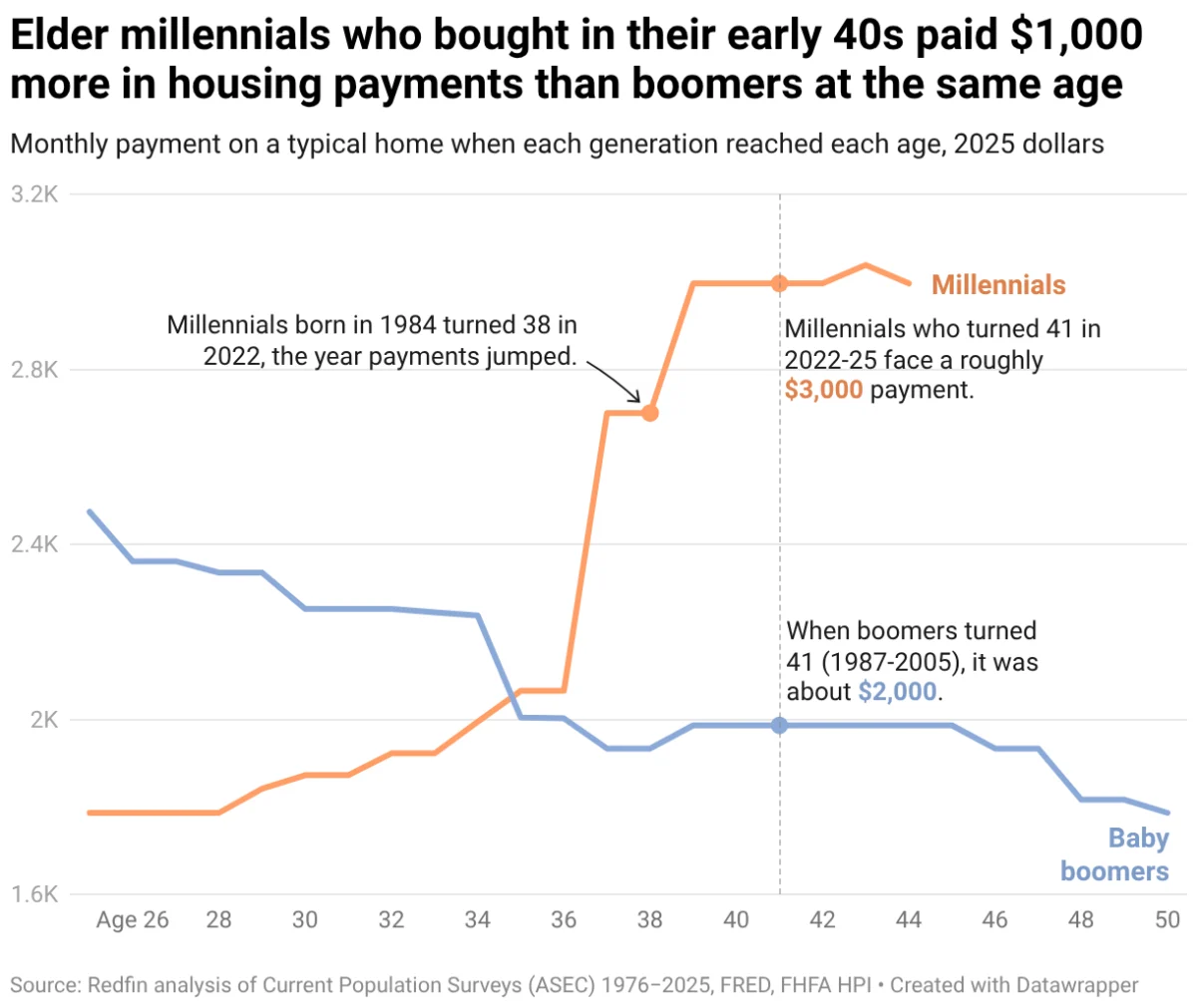
However, the "pandemic frenzy" of 2020 and 2021 fundamentally altered this dynamic. As demand skyrocketed, home prices surged by approximately 40% nationwide. This was followed by a sharp monetary policy shift: in response to inflation, the Federal Reserve began raising interest rates, causing mortgage rates to leap from roughly 3% in 2021 to nearly 7% by late 2022. Unlike previous cycles where high interest rates cooled home prices, this period saw prices remain elevated, creating a "worst-of-both-worlds" scenario for prospective buyers.
Comparative Affordability: Millennials vs. Baby Boomers
When comparing generations, the data indicates that elder millennials actually had an early advantage. At age 30, a typical millennial born in 1984 who purchased a home spent approximately 27% of their household income on housing costs. This fell comfortably within the conventional financial "rule of thumb" that advises against spending more than 30% of income on housing. In contrast, baby boomers at the same age were spending roughly 36% of their income on housing.
The millennial advantage was driven by two primary factors: historically cheap borrowing costs and higher household incomes. Modern households are more likely to feature two earners, a significant change from the 1980s. With 78% of women participating in the workforce today, compared to roughly 60% in 1980, millennial households have managed to maintain higher income levels, often earning $100,000 at age 37, compared to the inflation-adjusted $88,000 earned by boomers at that same life stage.
Yet, this advantage proved fragile. When the same hypothetical millennial reaches age 40 in the current market, their housing costs have surged to approximately 35% of their income. This represents a significant reversal. While baby boomers faced a "tough road" in their early 20s—spending upwards of 60% of their income on housing due to double-digit interest rates—they benefited from a multi-decade period of declining rates. Throughout the 1990s and 2000s, boomers were able to refinance their mortgages repeatedly, lowering their payments as their wages rose. This systematic reduction in debt service allowed them to build substantial home equity, a luxury that has largely eluded those entering the market after 2022.

Economic Pressure Points and Demographic Hurdles
The challenge for modern homebuyers is compounded by the fact that housing is not the only financial pressure they face. Today’s younger generations are contending with significantly higher childcare costs, which often consume a large portion of household income alongside mortgage payments. Furthermore, student loan debt, which was less prevalent among the baby boomer cohort, acts as a drag on the savings capacity of younger adults, making the accumulation of a down payment a much slower process.
For Generation Z, the hurdles are even steeper. Currently in their 20s, Gen Z buyers have faced the most expensive housing market in modern history, with some individuals spending between 40% and 60% of their income just to secure a home. While economists expect these figures to normalize as this generation hits their peak earnings years, the current barrier to entry remains a defining feature of their early adulthood.
Expert Perspectives on Market Normalization
Chen Zhao, Redfin’s head of economic research, notes that the goal for many potential buyers is not necessarily a return to the historic lows of 2021, but rather a return to the relative stability of 2018 or 2019. "Before the pandemic, younger generations actually had it easier than the ones before them," Zhao explains. "But then home prices surged during the pandemic homebuying frenzy and mortgage rates shot up, while incomes kept growing at a normal pace—and the advantage flipped."
The persistence of this trend has created a divide in homeownership satisfaction. A survey conducted by Redfin and Ipsos in May 2026 revealed that 76% of baby boomer homeowners feel they can easily afford their current mortgage payments, largely because many have paid off their loans or refinanced during periods of lower rates. In contrast, only 53% of millennial homeowners report being able to easily afford their payments. This disparity is also reflected in mobility: 43% of millennials cite high home prices as a primary reason for staying put, whereas only 31% of boomers identify price as a barrier to moving.
Broader Implications and Future Outlook
The long-term implications of this generational wealth gap are significant. Because baby boomers were able to leverage refinancing to lower their costs and build equity, they have largely become "rich in real estate," providing a financial safety net that younger generations currently lack. The inability of millennials and Gen Z to mirror this trajectory threatens to widen the wealth gap, as homeownership remains the primary vehicle for middle-class wealth accumulation in the United States.
However, there is some room for optimism. Market data indicates that home prices are beginning to soften or fall in several regions across the country. Should interest rates eventually moderate, the opportunity for a new wave of refinancing may arrive. If the market returns to the levels of affordability seen in 2018, the "lock-in" effect currently keeping many potential buyers on the sidelines may begin to dissipate.
Ultimately, the data suggests that the "avocado toast" narrative is a distraction from the structural shifts in the economy. The transition from a period of declining interest rates—which fueled the wealth accumulation of the baby boomer generation—to the current era of high-interest, high-price volatility has created a distinct set of challenges for younger Americans. Whether the market corrects itself through price adjustments or a return to more sustainable lending environments remains the central question for the future of the American housing sector. As younger generations continue to mature in their careers and reach their peak earning potential, the long-term goal of widespread homeownership will depend heavily on the alignment of income growth with the stabilization of housing costs.