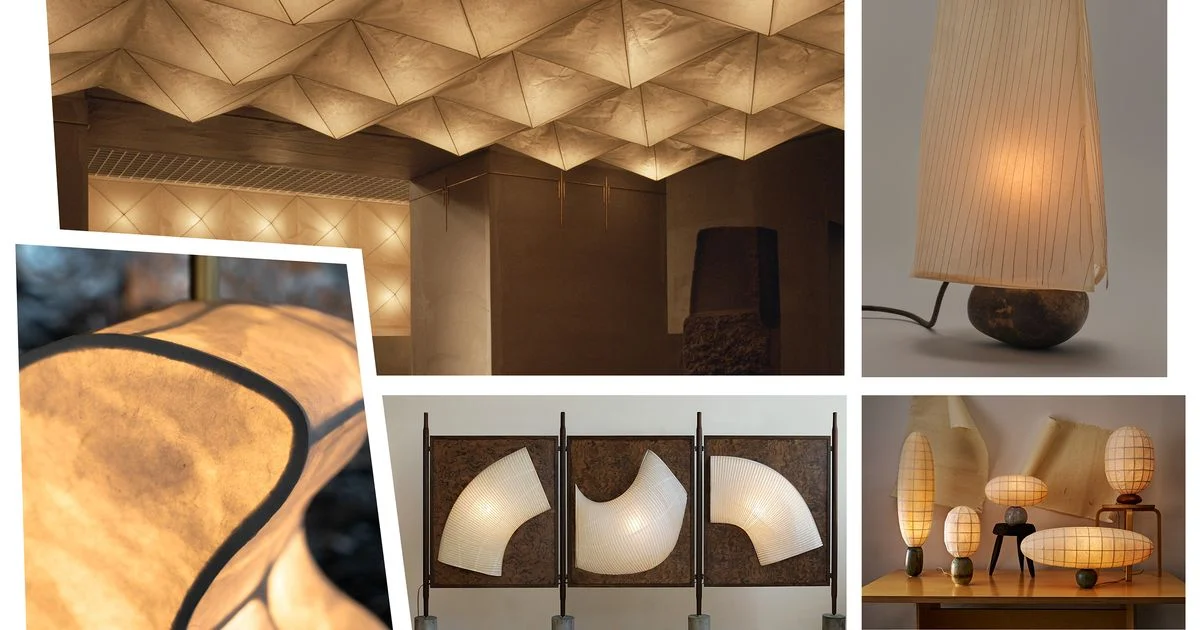
Commuters traversing midtown Manhattan along Park Avenue often find themselves pausing to take in the luminous interior of the Lever House lobby, which glows with more than a dozen hanging paper lanterns known as Akari. Crafted from delicate washi paper and ribbed bamboo, these ethereal sculptures—alongside a curated selection of Isamu Noguchi’s unbuilt models and sculptures placed throughout the ground floor—serve as a striking architectural bridge. They recall the historic relationship between Gordon Bunshaft, the visionary architect of the glassy international-style tower, and Noguchi, whom Bunshaft originally commissioned in the early 1950s to design monumental landscape sculptures for the building’s open-air courtyard.
Though that specific structural commission was ultimately unrealized, it coincided with a pivotal creative pivot for the artist. In 1951, the mayor of Gifu, Japan, approached Noguchi to help revitalize the region’s struggling, centuries-old paper-lantern manufacturing industry. Immersing himself in local craftsmanship, Noguchi partnered with Ozeki & Co., Ltd., a multi-generational, family-owned firm that continues to handcraft authentic Akari lamps to this day. By stripping the traditional lanterns of their commercial lettering and vibrant ceremonial pigments, supporting them on minimalist iron rod frames, and outfitting them with modern electric internal lighting instead of flickering candles or oil, Noguchi transformed a vernacular craft into a spare, geometric, and weightless medium.
To honor the profound legacy of these lighting sculptures 75 years after their initial conceptualization, the Noguchi Museum in Queens recently debuted a comprehensive major exhibition titled No Ordinary Light: Akari at 75, scheduled to remain on view through September 5, 2027. This milestone retrospective provides both a historical reassessment and a timely cultural lens through which to examine a thriving contemporary design movement: a new generation of independent international studios that are looking back to Noguchi’s pioneering philosophy while drastically rethinking the intersections of paper, structure, and illumination.
The Evolution and Legacy of the Akari Phenomenon
During the height of his career, Isamu Noguchi consistently resisted being categorized strictly as an industrial designer, fiercely guarding his primary identity as an avant-garde sculptor. By the late 1940s, his prolific artistic practice already spanned carved stone, biomorphic stage set designs, civic public works, and innovative furniture. Yet, the Akari series—which eventually expanded to encompass more than 200 distinct models—became one of his most accessible, enduring, and universally recognized contributions to material culture.
Noguchi insisted on presenting the Akari lamps on the most prestigious global stages, frequently challenging the rigid boundaries that separated fine art from functional objects. A prominent example occurred in 1986, just two years before the artist’s passing, when he became the first American artist to mount a dedicated solo presentation at the Venice Biennale. Titled "What Is Sculpture?", the exhibition featured Akari lamps prominently suspended throughout two of the national pavilion’s main rooms. The inclusion caused considerable debate among traditional fine-art critics of the era—a controversial curatorial choice that many historians suggest ultimately cost him the coveted Golden Lion prize. Today, the mammoth, architecturally scaled Akari created specifically for that Venice showcase stands as a centerpiece of the current museum retrospective, housed within its own specially designed pine pavilion.
Andrea Claire Studio: Marrying Modern Technology with Hanji Craft
Among the contemporary designers explicitly drawing inspiration from this lineage is Andrea Claire, who currently operates her design studio out of Los Angeles after establishing her roots in Brooklyn in 2011. Reflecting on her formative years as a rising designer, Claire describes the Noguchi Museum as her foundational sanctuary. Fifteen years ago, while conceptualizing her very first chandelier, she visited the museum seeking technical direction.
"I knew what I wanted to do but didn’t yet understand how to do it," Claire recalls. A turning point arrived when she viewed archival video footage documenting the meticulous construction process of the Akari lights. "It clicked," she notes, adding that the video remains mandatory viewing for every new artisan who joins her studio.
In 2020, Claire expanded her material palette to include hanji, a traditional Korean handmade paper renowned for its exceptional durability. "The fact that it was used for over a thousand years in bookmaking spoke to its longevity, which is important in my work," she explains. For her recent collection, Totemic, Claire drew conceptual cues from the organic land art of Andy Goldsworthy and the sculptural simplification of Constantin Brancusi. Moving away from her earlier mobile chandeliers, which evoked the dynamic balance of Alexander Calder, the Totemic series features vertical pendants structured around solid brass stems interspersed with gleaming, diamond-like beads.
Hand-wrapped over custom armatures to entirely conceal the internal light source, the marble-textured papers showcase deliberate, tactile imperfections. While Claire utilizes advanced 3D modeling software for preliminary spatial planning, she maintains that manual fabrication is non-negotiable. "If the work weren’t made by hand in the end, it would lose its depth and the human touch," she asserts.
Kawabi: Architectural Hybrids and Migrant Origins
In New York City, design duo Aaron and Irisa Chan-Kawabi helm the multidisciplinary studio Kawabi. The partners originally met while studying product design at the Parsons School of Design—a path they pursued as a deliberate compromise to satisfy family expectations for a practical career while retaining an outlet for creative expression.
Paper lanterns immediately resonated with the founders on a personal and conceptual level. "Like us, they were migrants from another place, another origin," Irisa observes. Noguchi served as an essential beacon, particularly for his lifelong navigation of a split identity between Japan and the United States. Initial domestic experimentation with paper-shaping techniques eventually led the duo to apprentice directly with master papermakers and wood craftsmen across Japan.
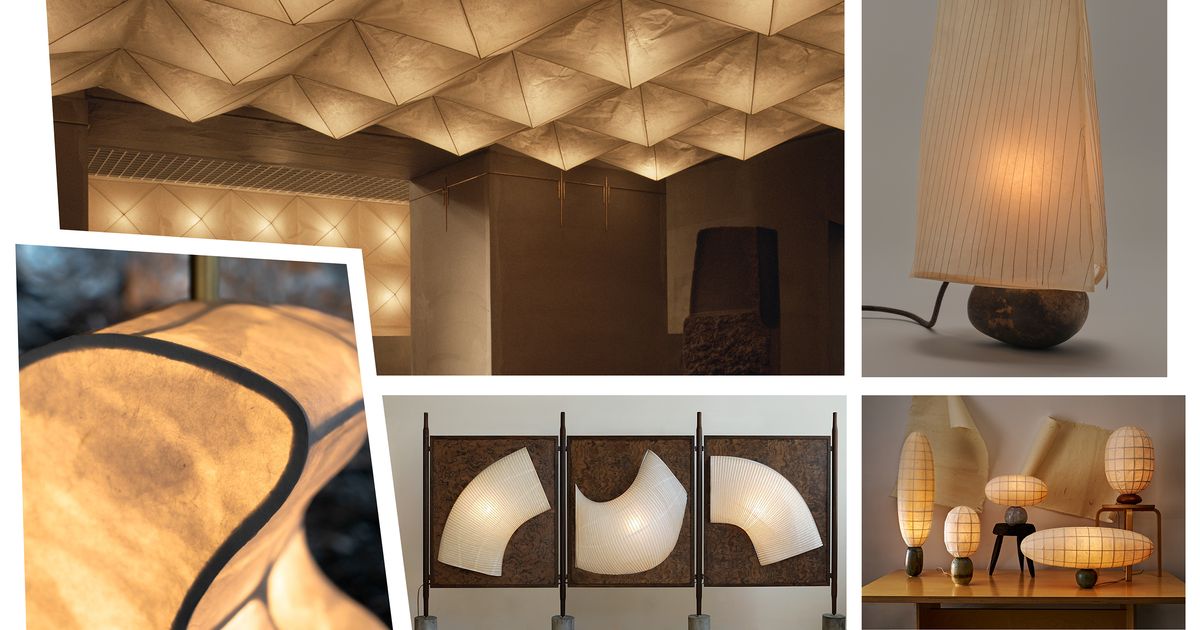
Today, Kawabi’s portfolio centers on what they term "archival forms"—functional hybrids that blur the lines between traditional domestic architecture, sculptural lighting, and historic archetypes. They continue to employ the traditional Japanese construction method utilized by Noguchi, coiling natural reed over collapsible wooden molds before applying successive sheets of paper.
Their recent output includes the Tea Screen Lamp from the Confluence collection, a triptych room divider and light source featuring mulberry-bark paper panels encased in rich walnut burl. Another standout piece, the Relic I Lamp, juxtaposes the delicate, fan-like pleats of traditional paper shades against the anchoring weight of solid concrete bases. Furthermore, their Amica collection—developed in collaboration with ceramicist Christopher Merchant—unites hand-thrown ceramic bases with mulberry-paper shades held rigid by white-oak rims, successfully bridging Eastern fabrication techniques with Western symmetrical design sensibilities.
Vy Voi: Honoring Indigenous Vietnamese Heritage
For Steffany Trần, who releases her sculptural lighting under the moniker Vy Voi, the distinction between art and design remains delightfully porous. "I’ve had designers say my work is art because I am making it myself, while I’ve had artists say my work is clearly design because it is somewhat repeatable," she reflects.
Operating out of New York, Trần began integrating translucent paper volumes into her ceramic practice in 2024. Her material of choice is dó paper, sourced directly from multi-generational family-run workshops in Northern Vietnam, where the delicate medium has been crafted for over eight centuries. After learning traditional Vietnamese lantern construction via FaceTime with a master craftsman in Hoi An, Trần attempted to adapt the techniques to elliptical geometric forms.
"He told me it couldn’t be done," Trần recalls. Undeterred, she initiated an intensive period of trial and error, testing dozens of custom glue formulations, hand-pressure techniques, and internal frame configurations. Her deep respect for the intrinsic qualities of raw materials directly mirrors Noguchi’s philosophy. "There’s a clear respect in the natural state of what [Noguchi] chose to use, and I aim to echo that in my own work too," she states.
Trần’s portfolio draws heavily from everyday domestic references, including the ovoid shapes of root vegetables and seasonal fruits featured in her Rả Cây collection, which appear to sprout organically from glazed porcelain bases. Other pieces reference distinct cultural artifacts, such as Kite In-Flight, inspired by traditional Vietnamese whistling kites, and a series of sconces modeled after the precise triangular geometry of bánh giò rice dumplings wrapped in banana leaves.
Insisting on the complete rejection of mechanized mass production, Trần emphasizes the psychological grounding provided by human labor. "Whether it is bending lampshade frames with wood or brushing on lacquer, there are telltale signs that a human made it that is incredibly grounding during an age of extreme waste and mass production."
Thomas Yang Studio: Rituals of Craft and Geological Permanence
Thomas Yang approaches material exploration through the lens of ancient ritual, actively rejecting the utilitarian mentality that views materials merely as a means to an end. Following his 2024 residency at Colony—where he debuted a home collection rooted in his Taiwanese heritage—Yang has continued to investigate sustainable applications for heavy stone, native timber, and handmade paper.
"It was Noguchi who led me to paper," Yang acknowledges, noting that his initial education in the medium began through archival videos and historical texts during his university studies.
Yang’s 2024 Tian Den series utilizes sheets of Yame Kozo Hadaura paper—a regional variety of mulberry-bark paper produced in Fukuoka Prefecture—seamed together with structural bamboo ribbing and suspended from delicate wooden armatures that sway gently with air currents. In subsequent iterations, Yang applied a protective finish of natural beeswax to paper shades mounted on wooden sconces. "Laminating it with beeswax binds the paper and makes it naturally hydrophobic, adding both robustness and longevity, as wax is a preservative," he explains.
For his Stone series, Yang incorporates ishibadate, a traditional architectural technique wherein wooden columns rest directly atop foundation stones without mechanical anchors. The lamps feature wooden stems dovetailed into the faces of raw river stones harvested from upstate waterways, paired with multi-layered paper shades that diffuse soft, ambient light while leaving internal wiring and frames visibly exposed.
"The more I developed the practice, the more I hoped for the work to be completely ordinary, like a seasoned cooking spoon passed down through generations," Yang reflects, summarizing the ethos shared by this new vanguard of paper-lantern makers. "I hope that an object can speak beyond its form to what has come before, and to how it may shape the conversation going forward."