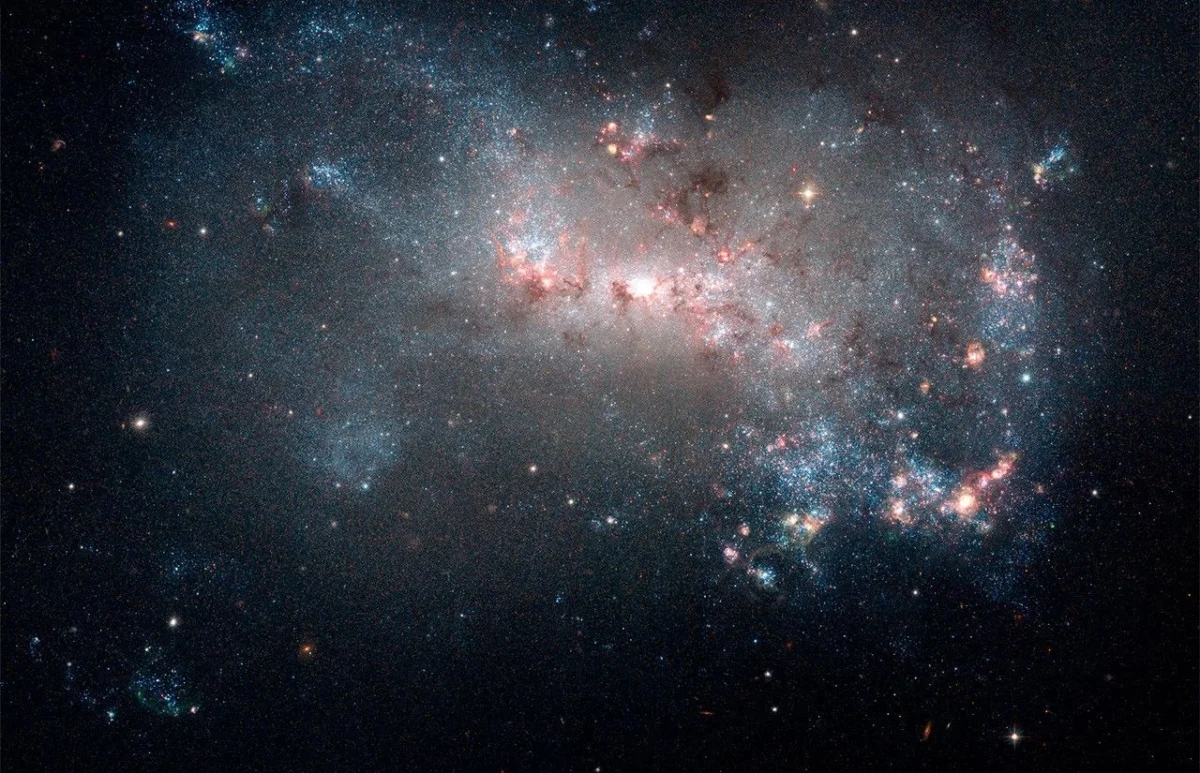
In the vast, sprawling architecture of the cosmos, the most conspicuous structures—the grand spiral galaxies and the massive elliptical giants—often capture the lion’s share of human fascination. However, a closer look at the local universe reveals that the true protagonists of galactic evolution may be the much smaller, often overlooked dwarf galaxies. Recent imagery captured by the Hubble Space Telescope and analyzed by international research teams has brought the irregular dwarf galaxy NGC 4449 into the spotlight, serving as a critical case study in the life cycle of stars and the chemical enrichment of the interstellar medium.
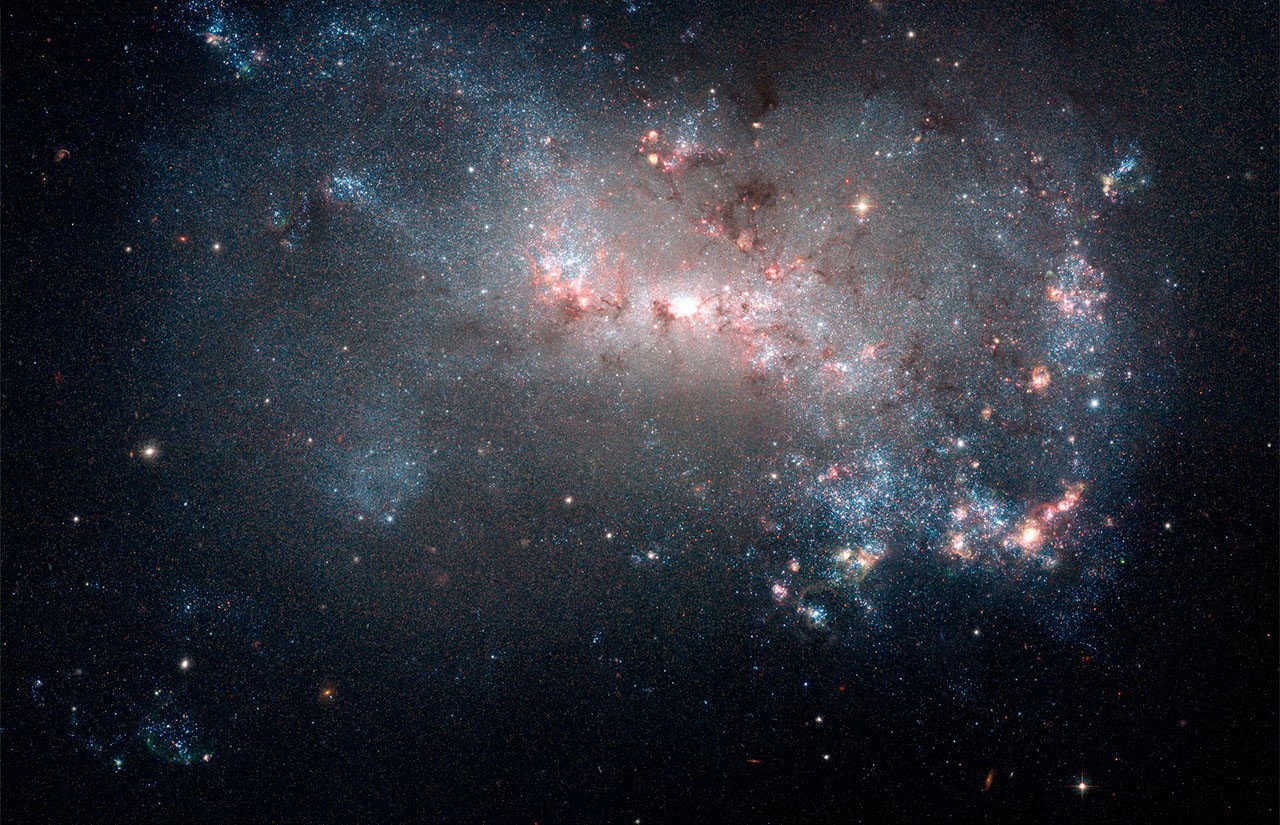
Located approximately 12.5 million light-years away in the constellation Canes Venatici, NGC 4449 is a member of the M94 group of galaxies. While it spans only a fraction of the size of the Milky Way, it is currently experiencing a period of intense, chaotic star formation, marked by its striking bow-tie appearance and vibrant pockets of ionized gas. This galaxy is not merely a static collection of stars; it is a high-energy laboratory that challenges our current understanding of how galaxies manage their internal chemical reservoirs.
The Anatomy of a Dwarf Galaxy
To understand the significance of NGC 4449, one must first appreciate the scale of galactic taxonomy. The Milky Way, a barred spiral galaxy, stretches approximately 100,000 light-years across and plays host to hundreds of billions of stars. In contrast, dwarf galaxies typically contain only a few billion stars and occupy roughly one-tenth of the diameter of the Milky Way. Despite their diminutive stature, dwarf galaxies are the most common type of galaxy in the observable universe, making them essential components of the cosmic web.
NGC 4449 is classified as a Magellanic-type irregular galaxy. Unlike the structured, rotating disks of spiral galaxies, NGC 4449 exhibits a disorganized, "patchy" morphology. The Hubble imagery reveals a stark contrast between its components: the outer reaches are populated by older, blue-white stars, while the central core is ablaze with pinkish, glowing regions of ionized hydrogen gas. These regions represent stellar nurseries where massive, short-lived stars are being born at a rate that far outpaces the average galaxy of its size.
Chronology of Discovery and Observation
The study of NGC 4449 has spanned several decades of observational astronomy, tracking its evolution from a faint smudge in early telescopes to a high-definition subject for modern space observatories.
- Early Cataloging: NGC 4449 was first recorded in the New General Catalogue (NGC) in the late 19th century, though its complex internal structure remained largely obscured by the limitations of ground-based optical telescopes of the era.
- The Hubble Era: With the deployment of the Hubble Space Telescope, astronomers gained the unprecedented resolution required to map individual star clusters within the galaxy. Throughout the 2000s and 2010s, multiple observation cycles targeted NGC 4449 to study its starburst activity.
- The Oxygen Anomaly: In the mid-2010s, spectroscopic analysis conducted by researchers—including those involved in the Hubble Heritage projects—revealed a persistent discrepancy. The galaxy contained significantly less oxygen than current astrophysical models predicted for a system with such a high rate of star formation.
- Present Day: Modern data integration continues to use NGC 4449 as a benchmark for understanding how "galactic winds" influence the chemical composition of dwarf galaxies, providing a clearer picture of how heavy elements escape into the intergalactic medium.
The Missing Oxygen Mystery
The central scientific question regarding NGC 4449 concerns its chemical deficiency. During the process of stellar evolution, stars act as cosmic fusion reactors, forging heavier elements—such as carbon, nitrogen, and oxygen—from hydrogen and helium. When massive stars reach the end of their life cycles, they explode as supernovae, dispersing these heavy elements into the surrounding space.
In a closed system, one would expect the concentration of these heavy elements to remain relatively stable or increase steadily as star formation continues. However, NGC 4449 exhibits an "oxygen deficit." The data suggests that the starburst activity is so intense that the combined energy of stellar winds—high-velocity streams of particles emitted by massive stars—and the force of multiple simultaneous supernovae are essentially "blowing out" the heavy elements from the galaxy.
This finding has profound implications for how we view the role of dwarf galaxies in the history of the universe. Rather than being isolated islands of matter, these galaxies function as "chemical engines" that distribute the building blocks of life throughout the wider cosmic environment. By expelling oxygen and other metals into the intergalactic medium, NGC 4449 and its peers contribute to the enrichment of the space between galaxies, seeding the universe with the materials necessary for the formation of future planetary systems.
Official Perspectives and Scientific Impact
The research team, led by contributors including A. Aloisi (STScI/ESA) and supported by the Hubble Heritage project, emphasizes that NGC 4449 is a prototype for "starbursting" dwarf galaxies. According to statements from the Space Telescope Science Institute (STScI), the high star-formation rate in NGC 4449 is likely stimulated by the accretion of smaller satellite galaxies or the interaction with the surrounding intergalactic gas.
"The study of these small systems is vital," noted an astrophysicist associated with the NASA Science Activation program. "When we look at the evolution of the early universe, we are essentially looking at a landscape dominated by these dwarf systems. By understanding the outflows of NGC 4449, we are better equipped to understand the chemical evolution of the cosmos during its formative stages."
The implications extend beyond mere cataloging. By confirming that dwarf galaxies can effectively vent their chemical contents, researchers have refined models regarding the "metallicity" of the intergalactic medium. This suggests that the distribution of heavy elements is much more uniform than previously hypothesized, as dwarf galaxies act as active, persistent distributors rather than passive containers.
Broader Implications for Galactic Evolution
The visual data provided by Hubble, highlighting the deep pink hues of the H II regions (ionized hydrogen) and the dark, intricate streaks of cosmic dust, serves as a testament to the dynamic nature of these small systems. While the Milky Way is often perceived as a stable, mature entity, NGC 4449 provides a look into a more volatile, creative phase of galactic life.
The phenomenon of galactic winds is a critical area of ongoing research. As galaxies grow, they must balance the gravitational pull that keeps gas contained with the explosive energy that drives it outward. In a massive galaxy like the Milky Way, gravity is usually sufficient to retain the majority of the chemical products of supernovae. In a dwarf galaxy, the gravitational potential is weaker, making these objects highly susceptible to mass loss.
This "leaky" behavior means that dwarf galaxies are instrumental in "polluting" the universe with the chemical signatures of life. Without the mechanism observed in NGC 4449, the intergalactic space would be significantly more pristine, and the subsequent generations of stars and planets might lack the raw materials required to develop complex chemical structures.
Looking Toward the Future
As astronomers continue to analyze the data from the Hubble archives and prepare for future observations with next-generation observatories, NGC 4449 remains a cornerstone of galactic studies. The ongoing mission to catalog the diversity of the universe—a primary objective of the Astronomy Picture of the Day initiative—ensures that the public remains informed about these small but mighty participants in our universe’s history.
The study of such galaxies serves as a reminder that size is not a prerequisite for significance. In the vast, silent theater of space, the most unassuming actors are often the ones driving the most important plot points in the narrative of the cosmos. As we look at the bow-tie shape of NGC 4449, we are not just seeing a collection of stars; we are witnessing a fundamental, ongoing process that has shaped, and continues to shape, the chemical landscape of our universe. Whether through the dispersion of heavy elements or the raw, unbridled energy of its star-forming regions, NGC 4449 remains a vital object of study for any serious inquiry into the nature of galactic existence.