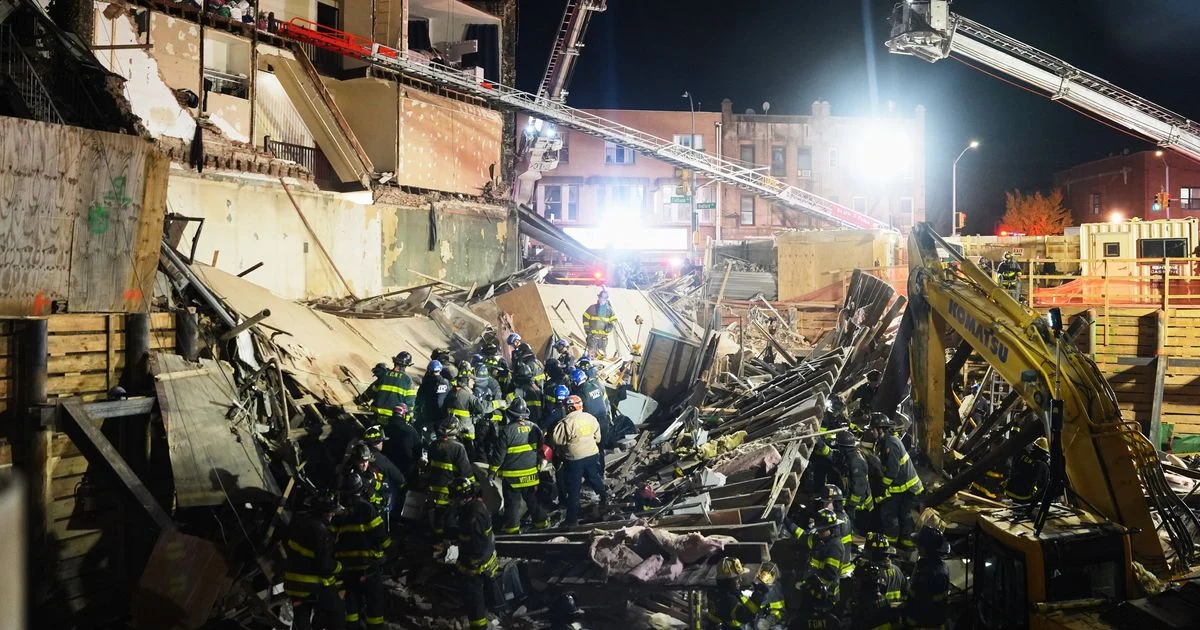
Rescue and recovery operations concluded on Thursday afternoon at 1321 Flatbush Avenue in Brooklyn, following a devastating structural collapse that left eight people dead and numerous others injured. New York City Fire Department (FDNY) officials confirmed that search efforts had ended after verifying no additional victims remained trapped beneath the rubble. In the wake of the tragedy, city and state authorities, including the Brooklyn District Attorney’s office, the New York City Department of Investigation (DOI), and the Department of Buildings (DOB), have launched a comprehensive criminal inquiry to determine the precise catalysts of the disaster.
The incident has sent shockwaves through the Flatbush community, reigniting intense debates regarding construction oversight, structural integrity, and the safety of tenants living adjacent to active, high-density development sites across New York City.
Chronology of the Disaster
The catastrophic event unfolded late Wednesday afternoon. At approximately 4:00 p.m. on November 13, 2026, the three-story structure at 1321 Flatbush Avenue suddenly gave way. The building—which housed a ground-floor medical-uniforms store and a three-bedroom residential apartment above—slid directly into an open, active construction pit located immediately adjacent at 2625 Bedford Avenue.
Residents in the immediate vicinity reported hearing a massive explosion-like sound followed by an immediate shroud of heavy grey dust and mist. Novella Spence, a 51-year-old resident living across the street, recalled being alerted by her child’s terrified cries before witnessing the catastrophic failure. The structural collapse cleanly sheared away the party wall shared with the neighboring building at 1323 Flatbush Avenue. This left an eerie, dollhouse-like cross-section visible from the street, where domestic items—such as rows of jackets hanging neatly inside a ripped-open closet—remained completely undisturbed while the rest of the physical infrastructure vanished.
Emergency services were rapidly mobilized. Within minutes, roughly 250 fire and emergency medical service personnel descended on the neighborhood. By 7:00 p.m., emergency vehicles lined Flatbush Avenue from Foster Avenue past Newkirk Avenue. First responders battled persistent rainfall and hazardous debris fields throughout the night and into Thursday, utilizing heavy machinery, including grapplers, to carefully dismantle chunks of concrete and twisted metal to search for survivors.
Casualties and Emergency Response
During a press briefing on Thursday, Mayor Zohran Mamdani confirmed the grim casualty figures: eight individuals lost their lives in the collapse, including two children and two construction workers. Additionally, 18 people sustained injuries ranging from minor to severe.
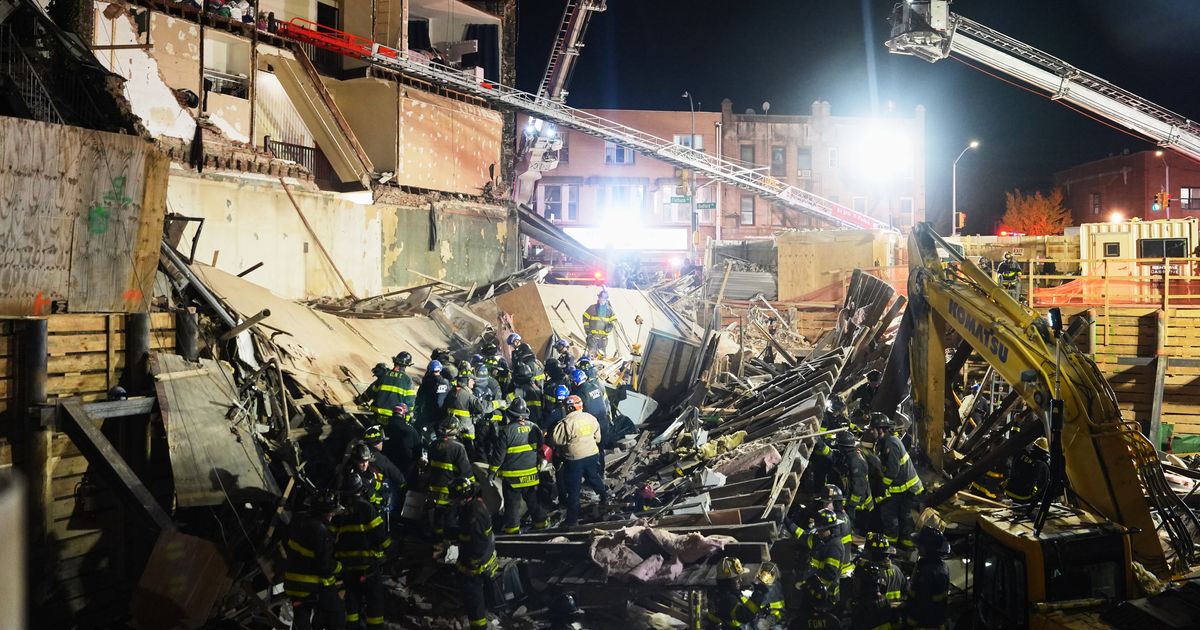
The injured included four firefighters who were hurt while executing high-risk rescue maneuvers and stabilizing the volatile site. Fire Commissioner Lillian Bonsignore praised the tireless efforts of the multi-agency response team, which included specialized units and mutual-aid volunteers from neighboring jurisdictions like the New Rochelle Fire Department.
“We see that we are in the middle of a rainstorm, but that will not stop our operations here,” Commissioner Bonsignore stated during Thursday’s press conference. “We promise with everything we have we will not stop working until everyone is rescued or recovered.”
By Thursday afternoon, the search-and-rescue phase transitioned officially into a recovery and investigation phase, with officials confirming that no further individuals were unaccounted for in the debris.
Construction Background and Zoning Context
Initial assessments by structural engineers and municipal investigators point heavily toward the active construction project at 2625 Bedford Avenue as the primary catalyst for the disaster.
Public property records indicate that the Bedford Avenue parcel—previously occupied by a low-slung building housing an adult-day-care service—was acquired in 2024 for $4 million by entities linked to real-estate developers Judy Swimer and Faigy Fischman, with Robert Fischman listed as an owner on building permits through W6 Facility X, LLC. Developers had secured initial permits to erect a three-story structure and were actively pursuing approvals to expand the project into a nine-story mixed-use building.
However, historical municipal data highlights significant red flags regarding safety and compliance at the site. In April, the primary contractor was cited and slapped with a stop-work order after initiating unauthorized demolition activities prior to obtaining requisite clearances. Work resumed only after the company satisfied a $10,000 fine issued by the city.
Local residents and housing advocates have since voiced intense frustration regarding the rapid, aggressive pace of real estate development juxtaposed against aging neighborhood infrastructure. Many pointed out that the surrounding buildings date back decades and require meticulous engineering safeguards that may have been compromised by deep excavation work next door.

Landlord History and Pre-Existing Building Violations
Compounding the tragedy are troubling revelations regarding the ownership and maintenance history of the collapsed residential building itself. New York City real estate records show that the deed for 1321 Flatbush Avenue was transferred in 2024 to Isolag Realty Corp, an entity signed by Olufemi Falade.
Prior to its collapse, municipal databases reveal the apartment building was plagued by severe neglect, carrying 98 open housing violations flagged by the Department of Housing Preservation and Development (HPD). These infractions included hazardous electrical wiring, severe vermin infestations, and defective smoke detectors.
Falade’s history as a residential landlord has previously drawn sharp judicial scrutiny. In 2006, a New York judge sentenced Falade to 12 days in jail following an egregious accumulation of more than 650 housing code violations across multiple properties he managed. At the time, tenants testified about buckling walls, collapsing ceilings, and prolonged winters spent without heat or hot water—earning Falade notorious media coverage as a textbook "slumlord." Housing watchdogs are now examining whether years of structural neglect and deferred maintenance left 1321 Flatbush Avenue exceptionally vulnerable to external destabilization from the adjacent excavation site.
Broader Implications and Ongoing Investigation
The disaster has prompted an aggressive municipal crackdown on development practices citywide. Mayor Mamdani announced that the DOB, alongside the NYPD and the Department of Investigation, has initiated a sweeping review of construction sites tied to the primary developers and contractors involved at 2625 Bedford Avenue. City records indicate that entities connected to the Bedford Avenue project are linked to approximately 100 active construction sites across the five boroughs, all of which are now subject to immediate safety audits.
Furthermore, the DOB has issued immediate vacate orders for neighboring properties along Flatbush Avenue—specifically numbers 1323, 1325, and 1327—displacing numerous families while structural engineers test the stability of adjoining foundations.
As the criminal investigation intensifies, federal, state, and local agencies face mounting pressure from community leaders and bereaved families to establish strict accountability. The joint inquiry will ultimately seek to establish whether corner-cutting, regulatory oversight failures, or active code violations directly precipitated the loss of eight lives, setting the stage for what is expected to be a landmark legal battle over urban safety in New York City.