The intersection of Silicon Valley’s hyper-growth culture and federal intelligence concerns took center stage during this week’s episode of Saturday Night Live, which featured a scathing cold open focusing on the vulnerabilities of the modern tech executive class. The sketch, anchored by host John Mulaney, functioned as a satirical interrogation of the industry’s most influential figures, highlighting a recent and profound shift in the public perception of tech leadership—from visionary architects of the future to potential national security liabilities.
The satirical segment arrived during a period of intense scrutiny for the technology sector, particularly following the forced departure of Nvidia CEO Jensen Huang. Huang’s ouster, triggered by the revelation of an illicit relationship with a suspected Chinese intelligence operative, has reverberated across global markets. For a company that has served as the primary engine for the artificial intelligence boom, the loss of its central leadership figure has introduced a level of volatility that investors and policy makers are only beginning to quantify.
A Who’s Who of Silicon Valley Satire
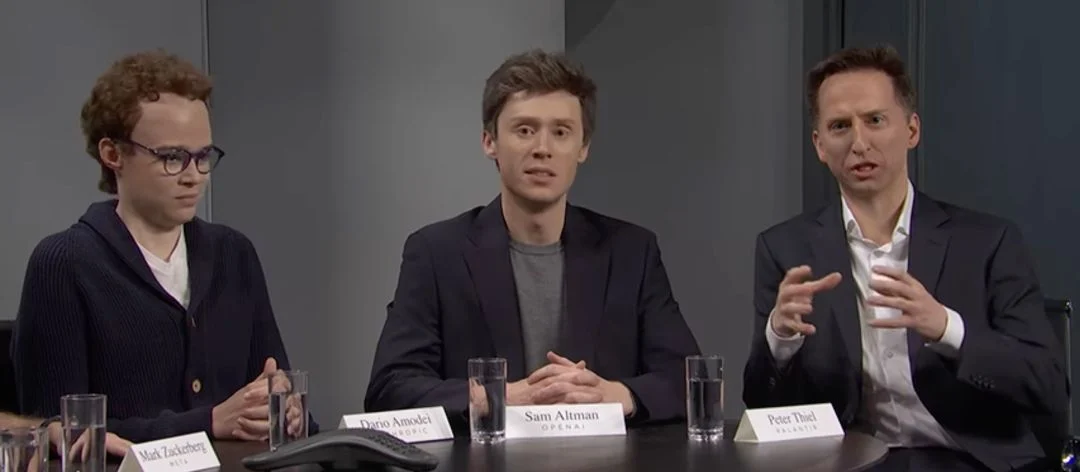
The sketch brought together a quintessential assembly of modern tech power, utilizing the SNL cast to mirror the public personas of industry titans. James Austin Johnson portrayed Peter Thiel with his characteristic intensity, while Ben Marshall captured the stoic, measured delivery of OpenAI’s Sam Altman. Jane Wickline’s depiction of Anthropic’s Dario Amodei, Jeremy Culhane’s take on Elon Musk, and Andrew Dismukes’ portrayal of Mark Zuckerberg rounded out the lineup. In a surprising turn, former cast member Bowen Yang returned to the stage to portray the disgraced Jensen Huang, grounding the sketch in the week’s most significant real-world business news.
The comedic premise centered on a CIA briefing room where a beleaguered intelligence officer, played by Mulaney, attempted to provide basic counter-intelligence training to the group. The humor leaned heavily on the contrast between the immense, world-altering power these individuals wield and their perceived social and political naiveté.
The Chronology of a Crisis: From Innovation to Investigation
The events depicted in the sketch are not entirely removed from the actual operational difficulties currently plaguing the American technology infrastructure. The past week has been defined by a series of cascading failures that underscore the precarious nature of the nation’s reliance on a concentrated group of providers.
On Thursday, November 13, 2026, a widespread outage affecting Microsoft Outlook paralyzed corporate communications globally, highlighting the systemic risks associated with cloud computing consolidation. Less than 24 hours later, the United States transportation network faced a severe disruption as the Department of Transportation reported a nationwide grounding of flights. Officials attributed the failure to a "routine equipment upgrade," a justification that drew sharp criticism from infrastructure experts who questioned the robustness of the underlying software systems.
These technical failures, combined with the geopolitical complications surrounding Nvidia, have created a perfect storm for Silicon Valley. The industry, which has long marketed itself as the vanguard of progress, is now facing questions regarding its ability to manage the critical systems upon which the American economy depends.
Analyzing the National Security Implications
The vulnerability of tech executives to foreign espionage is not merely a trope for comedy; it is a subject of genuine concern within the federal government. The Department of Justice and various intelligence agencies have, over the last two years, increased their outreach to private sector leaders, warning of the methods used by adversarial state actors to gain access to proprietary intellectual property.
"The threat landscape has evolved," says Dr. Elena Rossi, a senior fellow at the Center for Strategic and International Studies. "We are no longer looking just at traditional corporate espionage. We are looking at the systematic targeting of the personal lives of individuals who hold the keys to the next decade of American industrial capability."
The implications of the Huang departure are far-reaching. Nvidia’s stock performance has historically been a bellwether for the semiconductor and AI sectors. With the leadership vacuum at the top, the uncertainty surrounding the company’s future roadmap—specifically regarding its expansion into the Chinese market—has led to a cooling in venture capital investment for AI-related startups. According to recent market analysis, funding in the AI sector saw a 14% contraction in the 48 hours following the news of Huang’s resignation, as investors moved toward a "wait-and-see" posture.
The Satirical Response: A Mirror to Power
The SNL sketch successfully distilled the current tension between the tech elite and the public. When the fictional Peter Thiel character insisted that tech tycoons deserve respect for their contributions to the nation, Mulaney’s character deftly dismantled the argument by listing the recent series of infrastructure failures.
The dialogue, while comedic, struck a chord regarding the rapid ascension of these figures. Mulaney’s observation—that the world has never seen a demographic as "pale and strange" as the current tech leadership rise to such absolute levels of wealth and power—reflects a growing cultural fatigue with the "move fast and break things" philosophy that has dominated the industry for two decades.
Market Impact and Official Reactions
While the sketch served as entertainment, the underlying facts remain a point of contention for market analysts. Nvidia has not yet appointed a permanent successor, and board members have maintained a wall of silence regarding the specific nature of the intelligence shared with the Chinese government.
In a brief statement released on Friday, a spokesperson for the National Security Council declined to comment on specific corporate personnel matters but reiterated the importance of "heightened vigilance" for those operating in the critical technology sector. Meanwhile, Microsoft’s engineering teams continue to issue patches for the Outlook outage, with the company’s stock price seeing moderate fluctuations as institutional investors assess the long-term impact on their service-level agreements.
Broader Context: The Erosion of Tech Exceptionalism
The current climate represents a departure from the mid-2010s, a period defined by the perceived inevitability of tech-led prosperity. Today, that narrative is being replaced by one of accountability. The failures at Microsoft and the Department of Transportation, coupled with the scandal at Nvidia, have forced a reassessment of the "tech-first" policy approach.
Industry analysts point to three key areas of future risk:
- Infrastructure Fragility: The reliance on single-point-of-failure cloud architectures.
- Key-Person Risk: The outsized influence of individual CEOs whose personal conduct can impact national security.
- Regulatory Oversight: The likelihood of increased government intervention in the hiring and security clearance protocols of private tech firms.
As the industry grapples with these challenges, the satirical commentary provided by Saturday Night Live serves as a cultural marker of how quickly the tide can turn. The "gods" of Silicon Valley are now subject to the same public ridicule and investigative scrutiny that have long been reserved for politicians and high-ranking government officials.
Ultimately, the week’s events demonstrate that while the technology developed by these firms continues to define modern life, the human element—with its inherent unpredictability and vulnerability—remains the industry’s greatest variable. Whether through a failure of an email server or a failure of personal judgment, the consequences are no longer isolated to the boardrooms of Palo Alto; they are now felt in the terminals of airports and the inboxes of businesses across the globe.
As the tech sector looks toward the remainder of the quarter, the primary challenge will be to restore the trust that has been eroded by these recent events. Whether this can be achieved through internal restructuring or if it will require a more fundamental change in leadership culture remains the central question for the industry’s future.