The traditional homebuying process has long been defined by a narrow set of metrics: square footage, the number of bedrooms and bathrooms, the year of construction, and the local school district’s performance. However, as of 2026, Redfin has fundamentally expanded the scope of property information available to prospective buyers. By integrating advanced data sets—including granular sunlight exposure, historical weather patterns, and local childcare availability—the real estate platform is attempting to bridge the gap between static property specifications and the lived experience of homeownership. This evolution marks a significant shift in the digital real estate industry, moving away from simple transactional data toward a comprehensive lifestyle-focused search model.
The Evolution of the Property Listing
For decades, the real estate industry operated on an information asymmetry model. A buyer might see a pristine kitchen in a listing photo, but they would have no way of knowing if that kitchen would be plunged into darkness by 2:00 PM due to a neighbor’s extension or a nearby grove of trees. Furthermore, while environmental concerns have become a primary driver for home selection, accurate, neighborhood-specific climate data remained fragmented or inaccessible to the average consumer.
The 2026 updates represent a coordinated effort by Redfin to consolidate these disparate data streams into a single interface. The platform’s strategy appears to be twofold: reducing the "buyer’s remorse" that often follows a move and increasing the efficiency of the discovery phase of the home search. By providing objective data on sunlight, climate history, and community amenities, Redfin is enabling users to filter properties based on lifestyle requirements long before they schedule an in-person tour.

Sunscore: A New Standard for Natural Light
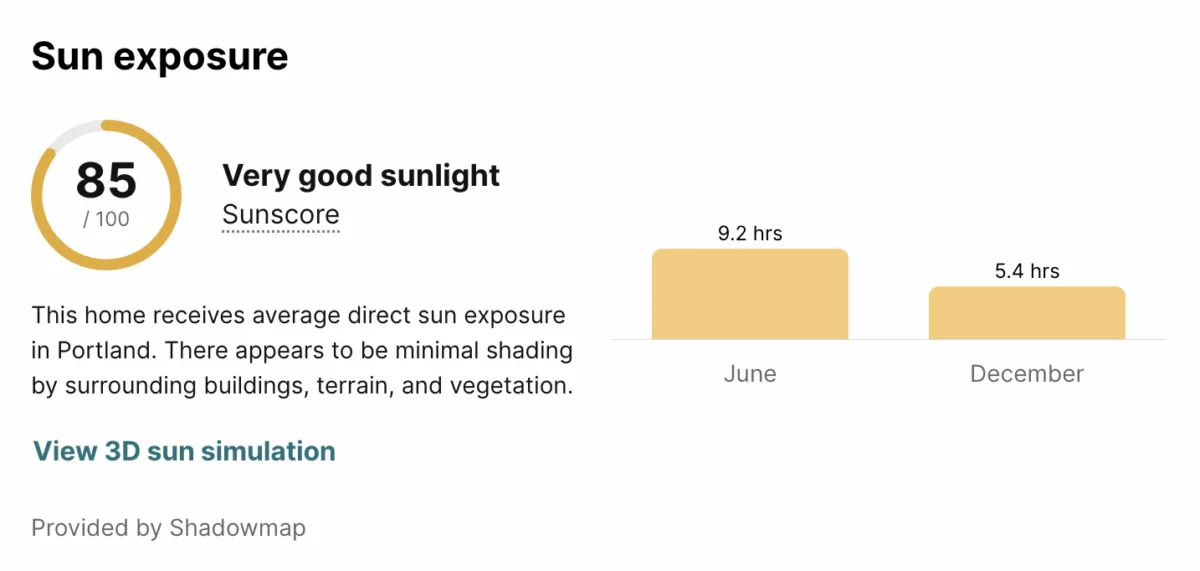
Natural light has historically been treated as an aesthetic preference rather than a quantifiable asset. Yet, internal research conducted by Redfin in 2026 indicates that sunlight is a high-priority factor for a significant majority of the market. According to the company’s data, nearly 70% of respondents reported that the quality of natural light in a home directly correlates to their overall satisfaction with their living situation. More importantly, 11% of buyers categorized sunlight as a "non-negotiable" requirement.
To address this, Redfin launched "Sunscore," a property-level rating system ranging from 0 to 100. Developed in collaboration with Shadowmap—a specialized sunlight analysis platform—the tool utilizes sophisticated 3D modeling. This software does not simply look at a property’s orientation; it factors in the physical structure of the house, the topography of the land, the height and density of surrounding vegetation, and the positioning of adjacent buildings.
The Sunscore is calculated by tracking the sun’s trajectory throughout the day across all four seasons. A home that receives a high score (90–100) is one that maintains consistent exposure, while a low score (0–50) indicates significant shading. This feature has profound implications for energy efficiency. Homes with superior sunlight exposure are often more suitable for the installation of photovoltaic solar panels, potentially lowering long-term utility costs and increasing the property’s long-term sustainability profile.
Climate and Weather Data Integration
The decision to include historical weather data, initiated in mid-2026, acknowledges the increasing role that climate volatility plays in residential real estate. A survey conducted by Redfin in partnership with Ipsos revealed that 22% of Americans relocating to a different state cited "better weather" as their primary motivation, outranking traditional motivators such as cost of living, career advancement, and proximity to extended family. Additionally, 21% of prospective movers indicated that their decision-making process was being actively shaped by concerns regarding natural disasters and long-term climate change.

By partnering with The Weather Company—the data provider behind The Weather Channel and weather.com—Redfin has integrated historical climate information directly into the listing page for every property on its platform. This data provides ZIP code-level averages for precipitation, temperature extremes, and seasonal volatility.
The analytical value of this information is clear: it allows buyers to discern between the pleasant weather of a single touring day and the multi-year climate realities of a region. For a buyer moving from a temperate climate to a more extreme environment, this data provides a realistic expectation of what they might encounter regarding heating and cooling requirements, lawn maintenance, and potential seasonal weather disruptions.
Childcare Access as a Primary Metric
For families with young children, the search for a home has always been inextricably linked to school district quality. However, the period between infancy and the start of formal schooling often presents a significant challenge for working parents. Recognizing this gap, Redfin has become the first major real estate portal to incorporate comprehensive childcare and early education data, partnering with the marketplace platform Winnie.
This integration provides users with direct access to information regarding nearby daycares and preschools. Crucially, the data points include details that are essential for planning, such as provider type, age ranges served, and, in many cases, availability indicators. By surfacing this information, Redfin is acknowledging that "location" means more than just the physical house; it refers to the entire support infrastructure of the surrounding neighborhood. For a working parent, the presence of a high-quality, accessible daycare facility within a few miles can be as critical to the viability of a home purchase as the number of square feet.

Expanded Location Intelligence
Beyond sunlight, weather, and childcare, Redfin has overhauled its "Location Scores" to better reflect the modern neighborhood experience. While the platform has long provided Walk, Bike, and Transit scores, it has now expanded these metrics through a partnership with Local Logic.
These updated scores capture a neighborhood’s "vibe" and utility through more nuanced data points. These include:
- Wellness Access: The proximity of fitness centers, parks, and health-oriented retail.
- Noise Levels: Analysis of traffic density and proximity to industrial zones or major transit arteries.
- Convenience Index: The ease of accessing daily necessities such as groceries, pharmacies, and essential services.
This data, aggregated from millions of location-based signals, provides an objective assessment of a property’s environment. It helps move the conversation beyond the home’s interior and into the broader ecosystem of the neighborhood.
Analytical Implications for the Real Estate Market
The integration of these advanced data sets suggests a broader industry trend toward "high-fidelity" real estate listings. As the industry moves further into the digital-first era, the platforms that provide the most accurate, context-rich information will likely capture the highest level of consumer trust.

From a market analysis perspective, this transparency could lead to more efficient pricing. When buyers have access to detailed sunlight, weather, and amenity data, they can make more informed offers that reflect the true utility of the property. For sellers, this means that features previously invisible—such as a property’s excellent solar potential or its proximity to top-tier childcare—can now be explicitly highlighted as value-add components.
Furthermore, this shift represents a maturation of the "PropTech" sector. By moving from simple inventory management to providing sophisticated environmental and community-level analytics, companies like Redfin are positioning themselves as consultants rather than mere conduits for information. The use of "conversational search" tools, which allow users to query these databases in natural language, further underscores the industry’s commitment to simplifying a notoriously complex process.
A Look Ahead
As 2026 progresses, the impact of these features will be measured by user engagement and the success rates of property searches. While the traditional markers of real estate will remain, the depth of information now available allows for a more personalized search experience. Buyers are no longer limited to what they can see in a gallery of photographs; they now have the tools to investigate the long-term viability of a home’s environment.
Whether it is a family searching for a daycare-friendly neighborhood, an environmentally conscious buyer looking for optimal sun exposure for solar panels, or a retiree moving to a location with specific weather patterns, the integration of these data points provides a much-needed layer of clarity. In an increasingly competitive and complex housing market, the ability to make data-backed decisions is becoming the most valuable asset a buyer can possess. As Redfin continues to evolve its platform, the expectation for comprehensive, objective, and actionable data is likely to become the new industry standard, forcing competitors to follow suit or risk obsolescence in an increasingly informed marketplace.