
Ricky Matthews: A Meteorologist’s Dive into the High-G World of the Blue Angels
The rumble of the F/A-18 Super Hornet is a primal force, a vibration that resonates not just through the airframe but deep within the chest cavity. For meteorologist Ricky Matthews, this visceral experience, far removed from the detached observation of atmospheric phenomena, represented a rare and exhilarating immersion into a world governed by forces far more immediate and intense than wind shear or radar returns. His ride-along with the iconic Blue Angels, the U.S. Navy’s flight demonstration squadron, offered a unique perspective on the interplay of physics, human skill, and the very air that Matthews dedicates his professional life to understanding. This wasn’t just a chance to witness aerial acrobatics; it was an opportunity to experience, firsthand, the extreme meteorological and physiological conditions that these elite pilots navigate with breathtaking precision.
Matthews, a familiar face on local news broadcasts, is accustomed to dissecting weather patterns, forecasting storms, and explaining the subtle nuances of atmospheric pressure and temperature. His work typically involves data, models, and visual representations on a screen. The Blue Angels ride-along, however, was a complete paradigm shift. Strapped into the back seat of a two-seat F/A-18, the familiar abstract concepts of aerodynamics and atmospheric density would be transformed into tangible, overwhelming sensations. The G-force, that invisible hand pressing down on the body during rapid acceleration and tight turns, is a direct manifestation of Newton’s laws of motion, a principle Matthews has undoubtedly explained countless times. But to feel it, to have his vision tunnel and his body feel impossibly heavy, provided an entirely new dimension to his understanding. This personal encounter with extreme G-forces offered a profound, albeit brief, insight into the physiological limits of human endurance and the sheer mental fortitude required to perform at such a high level.
The mission profile for a Blue Angels demonstration is a masterclass in controlled chaos, a meticulously choreographed ballet performed at speeds that defy ordinary perception. Matthews’ ride was designed to showcase a representative portion of their performance, allowing him to experience a series of maneuvers that are as awe-inspiring as they are demanding. From the thunderous takeoff, where the twin engines unleash their full fury, to the mind-bending inversions and tight formations, every segment of the flight was a test of engineering and pilot prowess. For a meteorologist, the most pertinent aspect of this experience would be the interaction between the aircraft and the atmosphere. Even at altitudes within the troposphere where most demonstrations occur, atmospheric conditions can play a significant role. Wind speed and direction, atmospheric density (influenced by temperature and altitude), and even the presence of subtle atmospheric waves could, in theory, subtly affect the aircraft’s performance. While the Blue Angels pilots are trained to compensate for virtually any foreseeable atmospheric variation, Matthews’ keen eye would undoubtedly be observing how the aircraft reacted to the air, how their flight path was subtly shaped by the invisible currents.
The concept of air density is fundamental to meteorology. It directly impacts lift, drag, and the overall performance of any airborne vehicle. For the F/A-18 Super Hornet, a heavier-than-air machine designed for supersonic flight, precise control of airflow over its wings and control surfaces is paramount. Matthews, who routinely analyzes isobar charts depicting pressure systems that influence air density, would have been acutely aware of the underlying atmospheric conditions. During their high-G maneuvers, the aircraft is effectively fighting against the inertia of its own mass and the resistance of the air. The greater the air density, the more effective the control surfaces become, but also the greater the forces exerted on the airframe and pilot. Conversely, in thinner air at higher altitudes, more speed and power are required to achieve the same level of aerodynamic control. His experience would have been a vivid illustration of these principles, transforming abstract scientific concepts into raw, physical sensations.
The sonic boom, another characteristic of supersonic flight, is a phenomenon born from the displacement of air molecules. As an aircraft breaches the sound barrier, it creates a shockwave that travels outwards. Matthews, whose understanding of sound propagation is rooted in the physics of wave mechanics, would have experienced this firsthand as a deafening roar and a palpable shockwave. This auditory and sensory assault is a direct consequence of the aircraft’s interaction with the atmosphere at extreme velocities. The efficiency with which this shockwave is generated is, again, influenced by atmospheric conditions such as temperature and humidity, which affect the speed of sound itself.
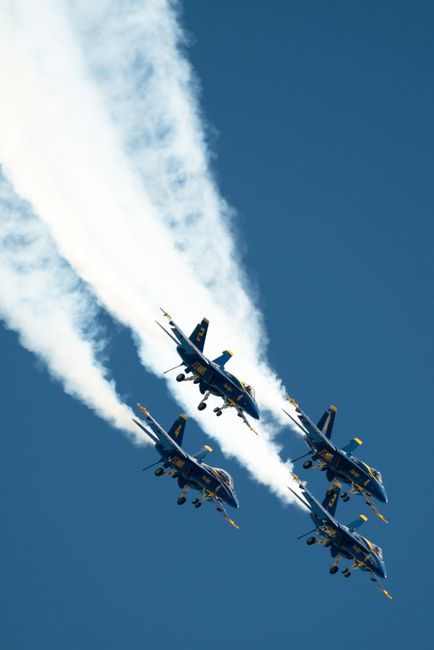
The formation flying executed by the Blue Angels is a marvel of precision and coordination, demanding an almost telepathic connection between the pilots and their machines. The tight spacing between the aircraft, often mere feet apart, requires an extraordinary understanding of their relative positions and velocities. While not directly a meteorological phenomenon, the concept of maintaining precise relative positions in three-dimensional space highlights the complex interplay of forces. A sudden gust of wind, a subtle updraft, or even the wake turbulence from another aircraft could theoretically disrupt these formations. The pilots’ ability to instantaneously adjust their controls, compensating for these external influences, is a testament to their training and the responsiveness of the aircraft. Matthews, a meteorologist who studies the forces that can create turbulence, would have been observing the aircraft’s ability to maintain formation despite these potential atmospheric disturbances.
Beyond the physics of flight, Matthews’ ride offered a profound insight into the human element of extreme performance. The physiological toll of sustained G-forces is immense. Pilots experience blood being pulled away from the brain, leading to tunnel vision and, in extreme cases, G-induced loss of consciousness (G-LOC). The Blue Angels pilots employ sophisticated breathing techniques and specialized G-suits to combat these effects. Matthews’ experience would have been a personal immersion into this physiological battle. Feeling the crushing weight of multiple Gs would have provided him with an unparalleled appreciation for the physical and mental resilience of these aviators. This understanding transcends theoretical knowledge, becoming a deeply personal and visceral realization of human capability under duress.
The precise control surfaces of the F/A-18 Super Hornet, such as the ailerons, elevators, and rudder, are the instruments through which the pilots manipulate the aircraft’s interaction with the air. These surfaces, by altering airflow, generate the forces necessary for maneuvering. Matthews, who understands how pressure gradients drive atmospheric circulation, would recognize the analogous principle at play. The pilots are essentially creating localized pressure differences around the aircraft to achieve their desired movements. The effectiveness of these surfaces is directly dependent on the density and speed of the air flowing over them. During high-speed, low-altitude maneuvers, the air is denser, providing more “grip” for the control surfaces, allowing for more aggressive and precise control. Matthews’ experience would have been a tangible demonstration of this aerodynamic principle.
The roar of the engines is not merely a sound; it’s a powerful expulsion of hot gases, a direct application of thrust that propels the aircraft forward. This thrust, a force that directly opposes drag, is fundamental to achieving and maintaining flight. For Matthews, who understands the energy transfer inherent in meteorological processes, the raw power of the jet engines would have been a striking contrast to the subtle energy exchanges he typically analyzes. The efficient conversion of fuel into kinetic energy, driving the aircraft through the atmosphere at incredible speeds, is a feat of engineering that directly interacts with the atmospheric environment.
The concept of lift, the upward force that counteracts gravity, is central to both meteorology (as it pertains to atmospheric convection) and aviation. For the F/A-18, lift is generated by the shape of its wings and the angle of attack, which forces air to move faster over the top surface than the bottom, creating lower pressure above and higher pressure below. Matthews, who has likely explained Bernoulli’s principle countless times, would have felt the tangible result of this principle in action. The sensation of being pushed upwards, of the aircraft defying gravity, is the direct consequence of this aerodynamic phenomenon. During high-G maneuvers, the wing is subjected to immense forces, and its ability to generate sufficient lift to counter these forces and maintain altitude is a testament to its design and the pilot’s skill.
The inherent dangers of aviation, even in a controlled environment like a demonstration flight, are always present. For a meteorologist, understanding the potential impact of unexpected weather events would be a constant background consideration. While the Blue Angels operate under strict weather protocols and rarely fly in suboptimal conditions, the possibility of encountering unforeseen atmospheric turbulence or wind shear would always be a factor. Matthews’ presence onboard, and his professional background, would have undoubtedly led him to consider these variables, even if they were not overtly apparent during his flight.
His experience with the Blue Angels was more than just a thrill ride; it was a profound educational journey. It bridged the gap between the abstract world of atmospheric science and the tangible reality of high-performance flight. By experiencing the forces and sensations that pilots endure, Matthews gained a deeper, more visceral understanding of the physics that govern both the sky above and the machines that traverse it. The roar of the engines, the crushing weight of G-forces, and the breathtaking precision of formation flying are all manifestations of the fundamental laws of physics, laws that Matthews dedicates his career to unraveling in the context of our planet’s atmosphere. His ride-along with the Blue Angels was a rare opportunity to witness these laws in their most dynamic and awe-inspiring application. The visual spectacle of the demonstration is matched only by the incredible engineering and human resilience that makes it possible, all set against the ever-present, ever-influential backdrop of the Earth’s atmosphere. This immersive experience provided a unique lens through which to view the complex and interconnected forces that shape our world, both on the ground and in the sky.
