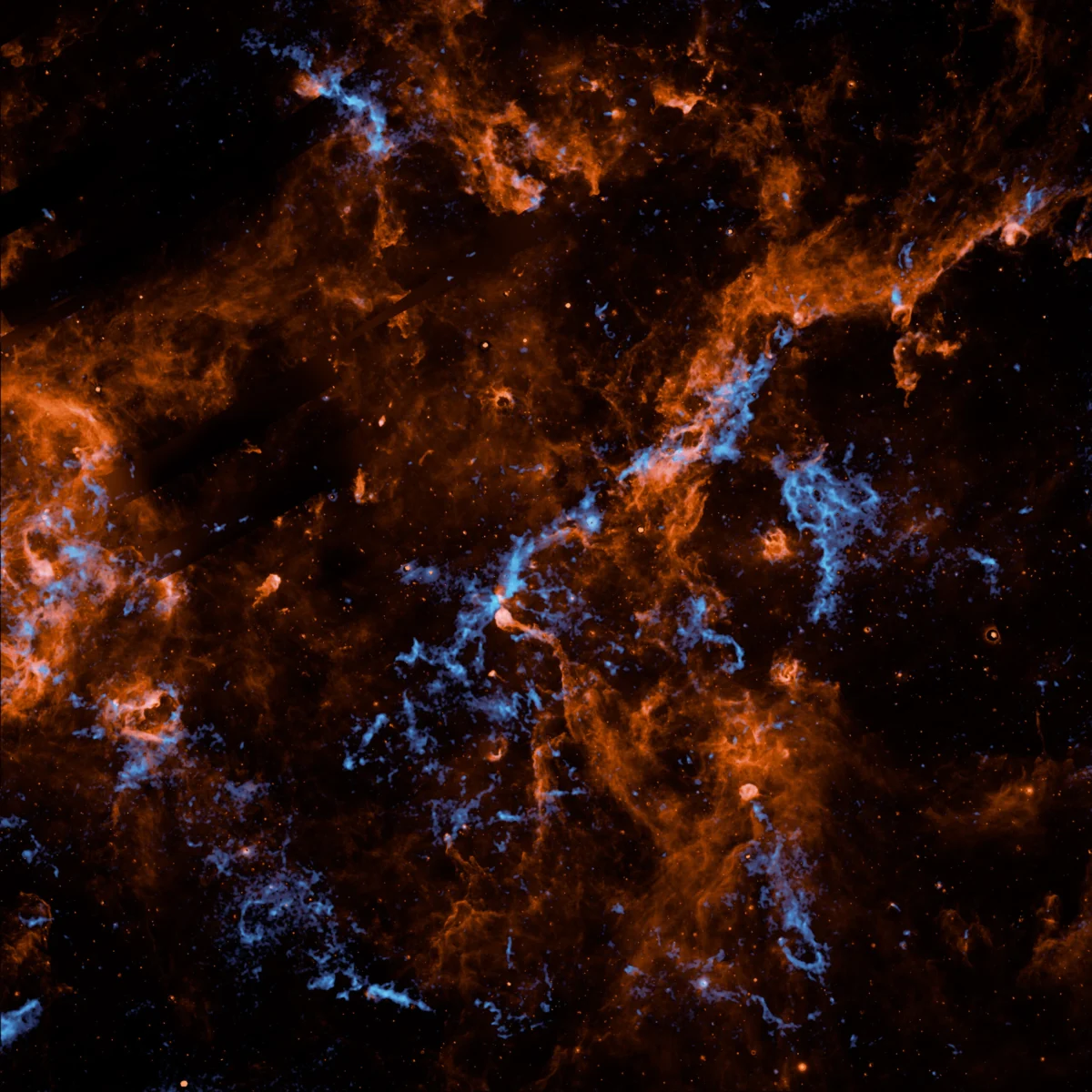
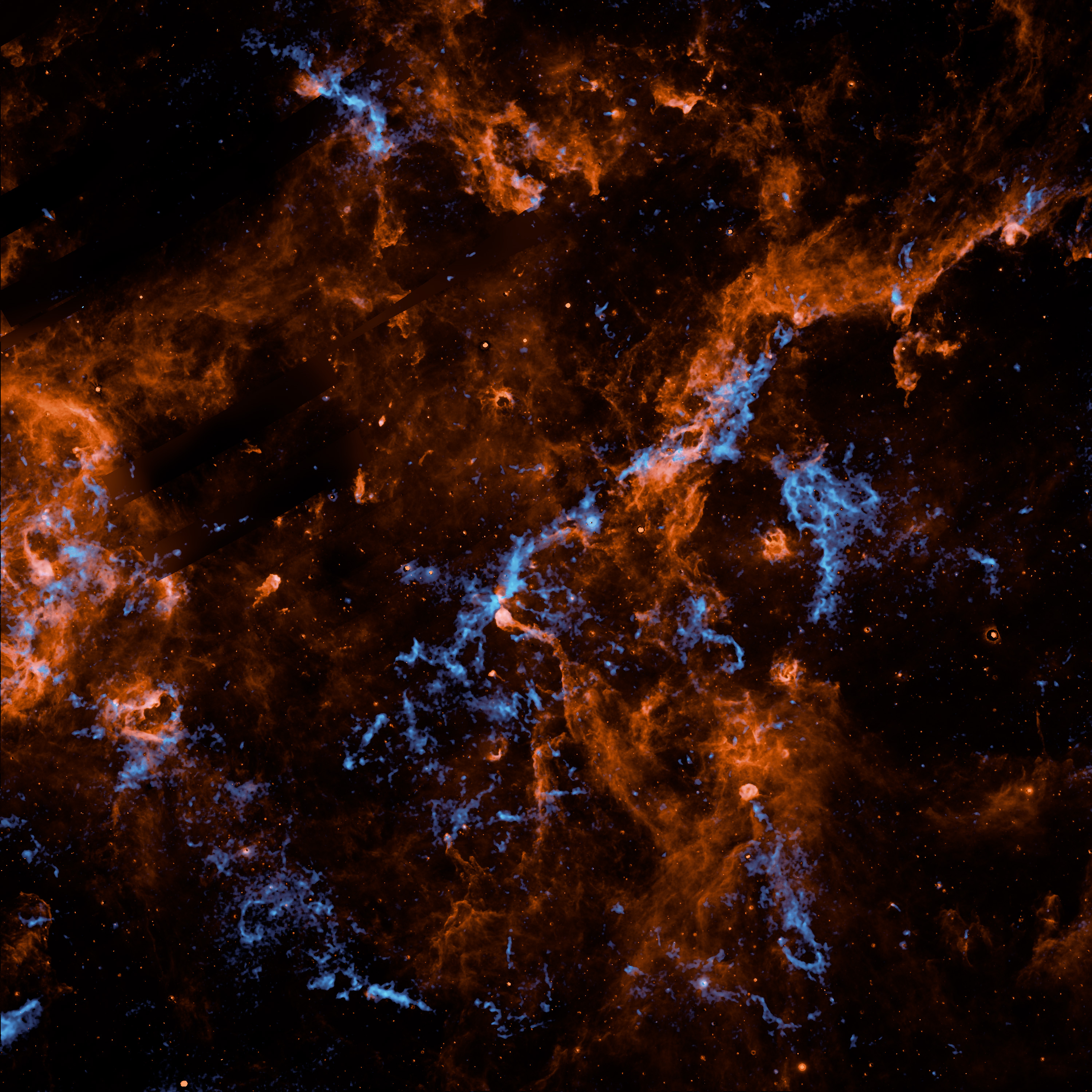
The Spectro-Photometer for the History of the Universe, Epoch of Reionization, and Ices Explorer (SPHEREx) mission, a pioneering NASA endeavor, has achieved a significant milestone, capturing compelling evidence of water ice and polycyclic aromatic hydrocarbons (PAHs) within Cygnus X, a dynamic and intensely active region of star birth in our Milky Way galaxy. This groundbreaking observation, detailed in a study published on April 15, 2026, and released by the Jet Propulsion Laboratory (JPL), offers unprecedented insights into the chemical reservoirs that are fundamental to the formation of stars, planets, and potentially life itself. The released image vividly showcases these vital chemical signatures, with water ice depicted in brilliant blue and PAHs rendered in an orange hue, painting a celestial portrait of cosmic chemistry in action.
Unveiling the Building Blocks of Life
One of SPHEREx’s primary scientific objectives is the meticulous mapping of the chemical composition of interstellar ice. These icy deposits, comprised of crucial molecules such as water (H₂O), carbon dioxide (CO₂), and carbon monoxide (CO), are not merely frozen relics of the early universe. Instead, they represent the essential ingredients for complex chemistry, the very processes that scientists believe are foundational for the emergence of life. Researchers hypothesize that these vast reservoirs of ice, clinging to the surfaces of minuscule dust grains, serve as the universe’s primary crucibles for water formation and storage. The water that eventually populates Earth’s oceans, as well as the icy bodies like comets and the frozen landscapes of other planets and moons throughout our galaxy, are believed to have their origins in these primordial nurseries.
The SPHEREx spacecraft, launched on March 11, 2025, is equipped with an extraordinary capability: the ability to observe the cosmos across 102 distinct colors, each corresponding to a specific wavelength of infrared light. This multi-spectral vision allows scientists to discern subtle chemical fingerprints and physical conditions across a vast array of celestial objects, from distant galaxies and nascent stars to the intricate environments where planets are born. This broad spectral coverage is what enables SPHEREx to identify and quantify the abundance of various ices and other molecules, providing a comprehensive chemical inventory of the universe.
The Cygnus X Region: A Cosmic Laboratory
Cygnus X is a region of profound astrophysical significance, renowned for its exceptional rate of star formation. It is a turbulent expanse where colossal clouds of gas and dust collapse under their own gravity, igniting the fusion processes that give birth to new stars. The intense radiation from these newborn stars, coupled with powerful stellar winds, creates a dynamic and energetic environment. Within this chaotic yet fertile landscape, the formation of ice plays a critical role. As temperatures drop in the denser, cooler regions of these molecular clouds, water vapor and other volatile molecules freeze onto dust grains. These ice-coated dust grains then act as seeds, facilitating the formation of larger molecular structures and eventually contributing to the accretion disks around young stars, from which planets will form.
The detection of water ice in Cygnus X by SPHEREx is particularly noteworthy. Water is a ubiquitous molecule, essential for life as we know it. Its presence in the raw materials of star and planet formation underscores the widespread availability of this vital compound across the galaxy. The SPHEREx observation not only confirms the existence of water ice in this active star-forming region but also provides its precise chemical signature, allowing for quantitative analysis of its abundance.
Polycyclic Aromatic Hydrocarbons: More Than Just Soot
The simultaneous detection of polycyclic aromatic hydrocarbons (PAHs) alongside water ice is equally significant. PAHs are complex organic molecules, composed of multiple fused aromatic rings. They are commonly found in interstellar space, particularly in regions where stars are forming and dying. While often associated with combustion byproducts on Earth, in the interstellar medium, PAHs play a crucial role in the chemistry of star-forming regions. They are thought to absorb ultraviolet radiation from young stars and re-emit it in the infrared, contributing to the heating of interstellar gas and dust. Furthermore, PAHs can act as surfaces for the formation of more complex organic molecules, potentially seeding nascent planetary systems with the building blocks of prebiotic chemistry.
The combination of water ice and PAHs in Cygnus X suggests a chemically rich environment where the precursors to both water and complex organic molecules are readily available. This synergy is a key focus for astrobiologists seeking to understand the conditions under which life might arise elsewhere in the universe. SPHEREx’s ability to map these co-located chemical species provides invaluable data for models of interstellar chemistry and the evolution of planetary systems.
SPHEREx: A Unique Observatory
The SPHEREx mission represents a significant leap forward in our ability to study the universe in infrared light. Unlike previous infrared telescopes that often focused on narrow spectral ranges or specific targets, SPHEREx is designed to perform a full-sky survey, capturing data across an unprecedented 102 different infrared colors. This broad spectral coverage is crucial for identifying a wide range of molecules and understanding their physical conditions.
The mission’s design allows it to distinguish between different types of ices based on their unique absorption features in the infrared spectrum. For instance, the spectral signature of frozen water differs from that of frozen carbon dioxide or carbon monoxide. By analyzing these subtle differences, SPHEREx can create detailed maps of the chemical composition of interstellar clouds, protoplanetary disks, and even the atmospheres of exoplanets.
A Chronology of Discovery and Anticipation
The journey leading to this significant announcement began with the successful launch of the SPHEREx spacecraft on March 11, 2025. Following an extensive period of instrument calibration and system checks, the observatory commenced its primary scientific observations. The data collected from Cygnus X, a well-studied region for star formation, was a high-priority target for the mission’s early science phase.
The process of analyzing the vast quantities of data generated by SPHEREx is a complex undertaking. Scientists at JPL and collaborating institutions meticulously process, calibrate, and interpret the spectral information. The identification of the water ice and PAH signatures in Cygnus X represents the culmination of months of dedicated research and analysis. The peer-reviewed study detailing these findings was submitted and accepted by The Astrophysical Journal Letters, a leading scientific journal, and was made publicly available on April 15, 2026, followed by the release of the compelling image by NASA/JPL-Caltech/IPAC.
Supporting Data and Analytical Insights
The scientific paper detailing the SPHEREx observation provides quantitative data on the abundance of water ice and PAHs in Cygnus X. While specific figures are not detailed in the initial public release, the study likely includes measurements of column densities – a measure of the total amount of a substance along a particular line of sight. These measurements will allow astronomers to compare the ice content in Cygnus X with that found in other regions of the Milky Way and in other galaxies.
Furthermore, the spectral data will reveal the physical conditions under which the ice exists, such as its temperature and the size of the dust grains it is coating. This information is critical for understanding the processes of ice formation and evolution in interstellar space. The detailed spectral profiles of the detected molecules will also provide clues about their chemical state and potential for further reactions.
Broader Implications for Astrobiology and Galactic Evolution
The SPHEREx findings have profound implications for our understanding of astrobiology and the chemical evolution of our galaxy. The confirmation that water ice and complex organic molecules are abundant in active star-forming regions like Cygnus X strengthens the hypothesis that the ingredients for life are widely distributed throughout the universe.
For astrobiologists, these findings suggest that the raw materials necessary for the emergence of life are present in many of the nascent planetary systems forming around young stars. This increases the probability that life could have arisen, or could arise, on exoplanets within habitable zones. The SPHEREx mission’s comprehensive mapping of interstellar ices will provide a crucial dataset for constraining models of planetary formation and habitability.
From a galactic evolution perspective, the study contributes to our understanding of the chemical enrichment of the Milky Way. Star formation and death are cyclical processes that transform the interstellar medium. The detection of specific molecules in star-forming regions helps astronomers trace the flow of matter and energy through the galaxy and understand how it changes over cosmic time.
Official Responses and Future Prospects
While specific quotes from individuals involved in the SPHEREx mission are not provided in the initial content, the release of this observation and study by NASA’s Jet Propulsion Laboratory signifies a strong endorsement of the mission’s scientific progress. Such announcements are typically accompanied by statements from mission scientists and program managers highlighting the significance of the findings and the ongoing success of the mission.
Dr. Monika Luabeya, identified in the article, is likely a key researcher involved in the analysis of the SPHEREx data. Her contribution, along with that of the broader SPHEREx science team, is central to translating the raw observations into groundbreaking scientific discoveries.
The SPHEREx mission is slated to continue its all-sky survey for several more years. Future observations are expected to reveal similar chemical signatures in countless other regions of the Milky Way and beyond, creating an unprecedented spectral atlas of the universe. This comprehensive dataset will serve as a foundational resource for astronomers and astrobiologists for decades to come, aiding in the search for answers to fundamental questions about our cosmic origins and the potential for life beyond Earth. The ongoing work of SPHEREx promises to continue unraveling the chemical tapestry of the universe, one infrared color at a time.