Despite a robust labor market, cooling inflation, and rising real wages, President Joe Biden continues to face an uphill battle in convincing American voters of his economic stewardship as the 2024 election cycle approaches. While key economic indicators have shown significant improvement from the peaks of inflation in 2022, public perception of the economy and the President’s handling of it remains stubbornly low, posing a critical challenge for his reelection campaign.
The Evolving Economic Landscape: From Crisis to Recovery
The economic narrative under President Biden has been one of dramatic shifts. Upon entering office in January 2021, Biden inherited an economy grappling with the profound and unprecedented disruptions caused by the COVID-19 pandemic. Supply chains were snarled, consumer demand was volatile due to lockdowns and stimulus measures, and businesses struggled with uncertainty. This unique environment set the stage for a period of intense economic volatility.
Initially, the economy experienced a strong rebound fueled by pent-up demand and significant government spending, including the American Rescue Plan. However, this recovery was quickly accompanied by soaring inflation. By June 2022, the Consumer Price Index (CPI) reached a staggering 9.1 percent year-over-year, marking the largest increase in over 40 years. Concurrently, average gasoline prices surpassed $5 per gallon, placing a direct and visible strain on household budgets. The second quarter of 2022 also saw a slight contraction in gross domestic product (GDP) by 0.6 percent, fueling recession fears. This period of economic distress was clearly reflected in public opinion, with a July 2022 Quinnipiac University poll revealing that only 28 percent of Americans approved of Biden’s handling of the economy.
Current Economic Indicators: A Picture of Resilience
Fast forward to recent months, and the economic landscape has undergone a remarkable transformation. Many indicators now paint a significantly rosier picture, suggesting that the economy might be achieving the long-sought "soft landing" – a scenario where inflation is brought under control without triggering a recession and mass unemployment.
One of the most compelling signs of economic health is the labor market. Unemployment has remained remarkably low, hovering around 3.8 percent, a level not seen consistently in decades. This strong job market has empowered workers, contributing to a period where real wages are finally rising faster than inflation, meaning that the purchasing power of average Americans is increasing. This reverses a trend where wage gains were consistently outpaced by rising costs.
Inflation, the primary economic concern for much of 2021 and 2022, has cooled considerably. The annual inflation rate has fallen to just over 3 percent, a significant decrease from its 2022 peak, moving closer to the Federal Reserve’s target of 2 percent. This deceleration is largely attributed to aggressive interest rate hikes by the Federal Reserve, aimed at dampening demand, alongside easing supply chain pressures. Consumer spending has also remained robust, indicating continued confidence and financial capacity among households.
Beyond these broad metrics, specific policy initiatives under the Biden administration have begun to show tangible results. The Inflation Reduction Act (IRA), signed into law in August 2022, has been cited as a key driver for a surge in investment in domestic manufacturing, particularly in sectors related to clean energy and advanced technology. This has led to the creation of new jobs and facilities across the country, a point the White House has been eager to highlight as evidence of "Bidenomics" at work.
Furthermore, surveys indicate an improvement in consumer financial well-being. A recent Ipsos poll found that 54 percent of Americans now report having enough money to cover an unplanned expense, a notable increase from 40 percent the previous year. Fewer individuals also report struggling to make ends meet after paying their bills, suggesting a slight alleviation of financial pressure for many.
The "Bidenomics" Disconnect: Why Public Perception Lags

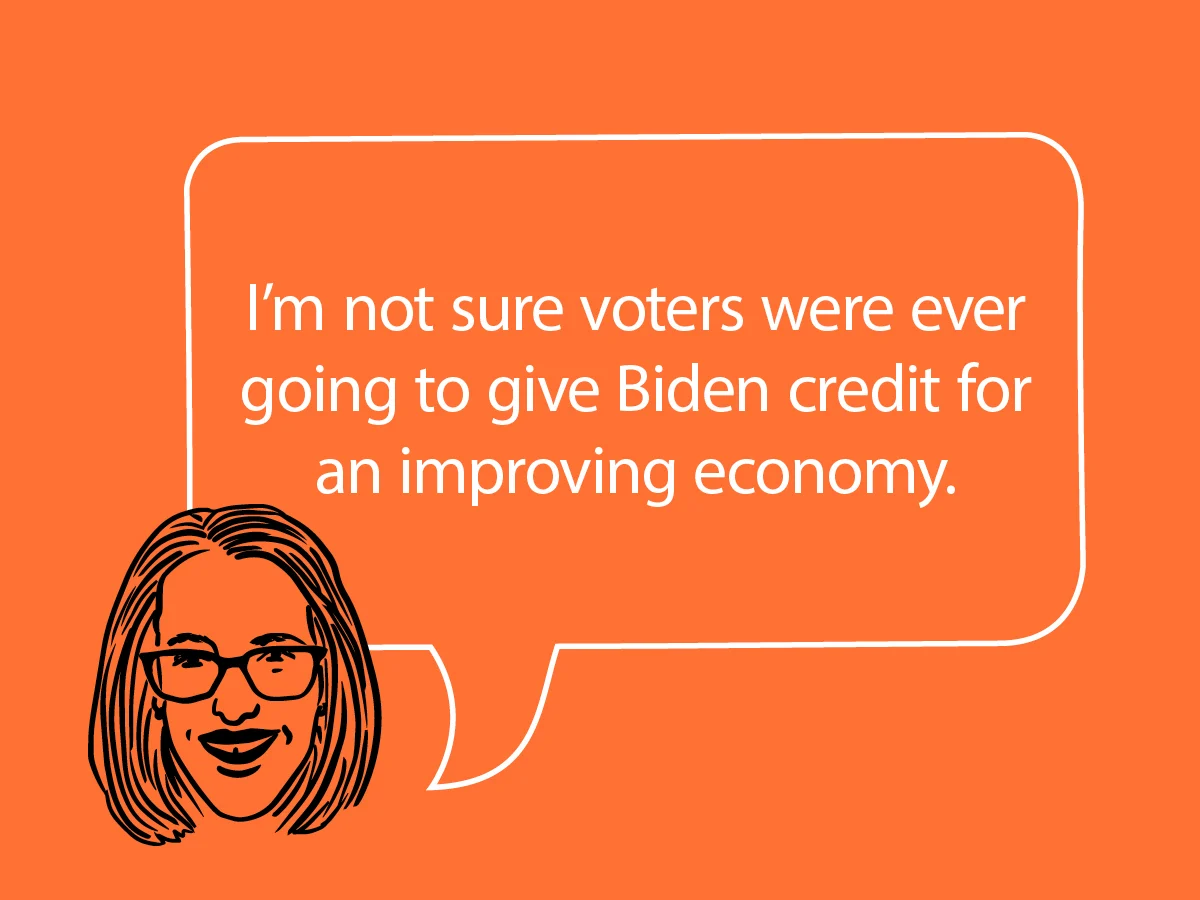
Despite these demonstrable improvements, President Biden’s approval ratings on the economy have seen only a modest uptick, rising to 36 percent in a recent Quinnipiac poll. This persistent gap between positive economic data and negative public sentiment presents a central conundrum for the administration. Several factors contribute to this disconnect:
-
The "New Normal" of Higher Prices: While the rate of inflation has slowed, the cumulative effect of price increases over the past two years means that many goods and services remain significantly more expensive than they were pre-pandemic. A gallon of milk, a tank of gas, or a weekly grocery bill still carries a higher price tag than in 2019. Voters, particularly those managing tight household budgets, tend to have long-term memories when it comes to prices. Even if their wages are increasing, the psychological impact of permanently higher costs can outweigh the benefits of slowing inflation. As G. Elliott Morris, editorial director of data analytics, noted, "If you take a longer view, for a lot of families, things are just permanently more expensive now."
-
Delayed Impact of Policy: Many of the Biden administration’s economic policies, such as investments in infrastructure and manufacturing through the Bipartisan Infrastructure Law and the IRA, are designed for long-term impact. Their benefits, while significant, materialize slowly and are often not immediately felt or easily attributed by the average consumer. This contrasts with more immediate relief measures, making it harder for voters to connect improvements directly to "Bidenomics."
-
Inherited Economic Challenges: The unique "weird economy" that Biden inherited – characterized by the aftermath of a global pandemic, unprecedented shutdowns, and subsequent supply chain disruptions – created a challenging starting point. The inflation surge, while exacerbated by demand, also had roots in these global factors. Voters may attribute the initial economic turmoil to the incumbent, making it difficult for him to "wash off" the "stink of the bad economy," as suggested by Amelia Thomson-DeVeaux, senior reporter.
-
Partisan Lenses: Economic perceptions are often filtered through partisan allegiances. Civiqs tracking poll data indicates that Democrats are significantly more likely to view the economy favorably (63 percent) than a year ago (53 percent). However, this partisan alignment does not translate into broad national approval for Biden’s economic management, especially among independent voters and Republicans, who remain largely critical.
-
Focus on Specific Hardships: For many Americans, "the economy" is not an abstract concept of GDP growth or inflation rates, but rather a very personal experience tied to specific costs. Rising mortgage rates and high interest rates on credit cards or car loans continue to be significant burdens. The Federal Reserve’s ongoing consideration of further rate hikes adds to this uncertainty. The personal savings rate, while showing some recent improvement, remains historically low for many households, further limiting their financial flexibility. The looming restart of student loan repayments in October, after a multi-year pause, is expected to reduce disposable income for millions of Americans, potentially dampening consumer spending and adding another layer of financial stress.
The Political Calculus for 2024: A Double-Edged Sword
Historically, the state of the economy is a powerful predictor of presidential election outcomes. Incumbent presidents typically benefit when economic conditions are perceived as positive leading up to an election. Voters tend to make retrospective evaluations, looking back a couple of years to assess the incumbent’s performance.
For President Biden, this historical precedent presents a complex situation. On one hand, the significant improvement in key economic indicators, particularly the cooling of inflation and a robust job market, is a substantial win. While he may not be receiving direct credit for these improvements in his approval ratings, the alternative – a souring economy or a full-blown recession – would undoubtedly be catastrophic for his reelection chances. Avoiding a major economic downturn and steering the economy towards stability can be seen as a defensive victory, mitigating a potentially devastating liability.
As G. Elliott Morris pointed out, "The good news for Biden on this front is twofold: First, voters tend to start making these retrospective evaluations closer to the election. And second, that they look only a couple years in the past. That means there is time for things to get even better for him, and for him to be rewarded." This suggests that if the positive trends continue and solidify closer to November 2024, public perception might eventually catch up with the economic realities.
However, the bad news remains that economic conditions are inherently dynamic and unpredictable. External shocks, such as geopolitical events or unforeseen domestic challenges, could quickly reverse positive trends. The ongoing debate within the Federal Reserve regarding future interest rate decisions, heavily dependent on incoming inflation data, also adds an element of uncertainty.
Ultimately, the Biden administration faces the challenge of not only sustaining positive economic momentum but also effectively communicating its impact to a skeptical public. Transforming the perception of "Bidenomics" from a liability into an asset will require persistent effort, hoping that the tangible benefits of a stable, growing economy eventually resonate with voters beyond the immediate memory of past price hikes. For now, the President’s economic narrative remains a delicate balance between undeniable progress and a stubborn public perception gap that could prove pivotal in the upcoming election.