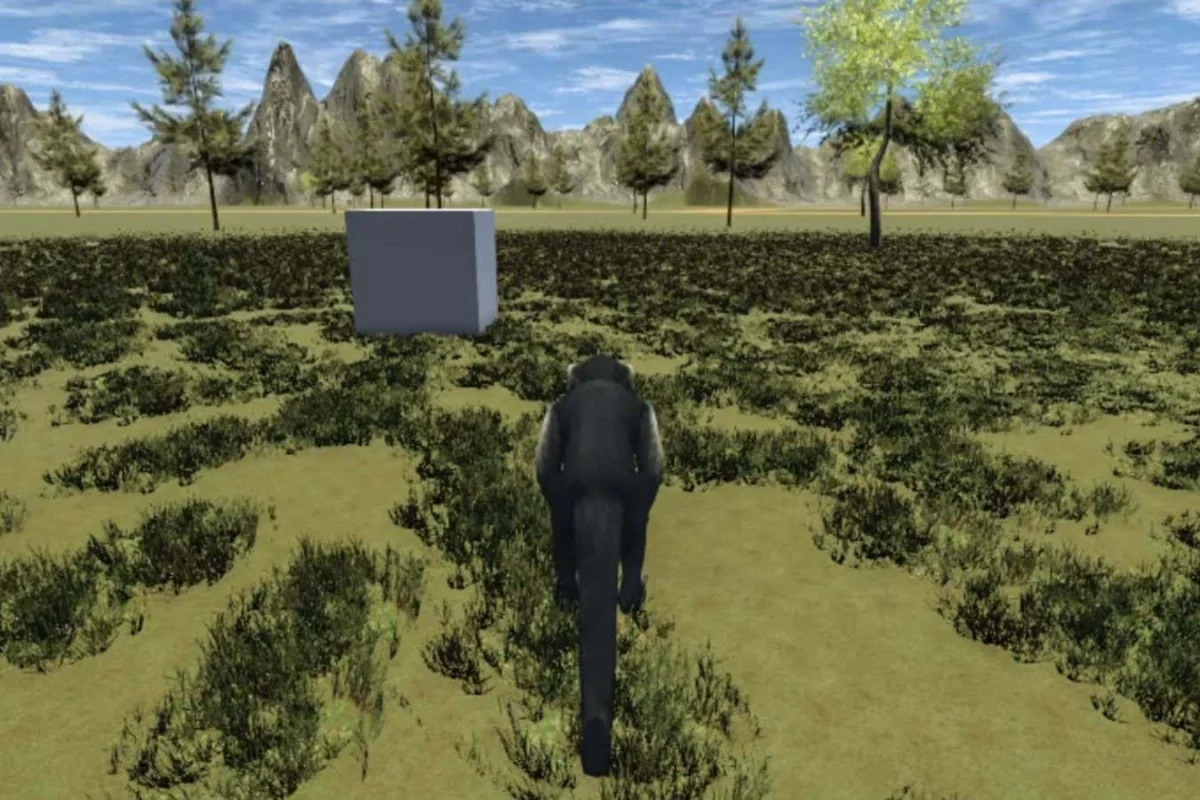
In a significant leap forward for neurotechnology, researchers have successfully demonstrated that monkeys can navigate complex virtual environments solely through their thoughts, utilizing advanced brain-computer interfaces (BCIs). This groundbreaking work, led by Peter Janssen at KU Leuven in Belgium, holds immense promise for restoring mobility and interactive capabilities to individuals with severe paralysis, potentially enabling them to explore digital realms or control assistive devices with unprecedented intuitiveness.
The Dawn of Thought-Controlled Virtual Exploration
The experiments involved three rhesus macaque monkeys, each implanted with three BCIs. These sophisticated devices, comprising a total of 96 electrodes each, were strategically placed within key areas of the brain associated with motor control and planning: the primary motor cortex, and crucially, the dorsal and ventral premotor cortices. While the primary motor cortex has been a common target in BCI research, the inclusion of the premotor areas is believed to tap into higher-level, more abstract representations of movement planning, offering a potentially more intuitive control pathway. Electrical signals detected by these electrodes were then processed by an artificial intelligence (AI) model, which translated the monkeys’ neural activity into commands for controlling avatars within a virtual reality (VR) environment displayed on a 3D monitor.
The monkeys were initially trained to control a sphere moving across a virtual landscape from a fixed viewpoint. This foundational task allowed researchers to establish a baseline understanding of how the BCIs translated neural signals into directed movement. Subsequently, the complexity of the virtual environments and control schemes increased. The primates were then tasked with controlling animated monkey avatars from a third-person perspective, mirroring the immersive experience of modern video games. In more advanced stages of the research, the monkeys demonstrated the ability to navigate through virtual buildings, initiating actions such as opening doors and seamlessly moving between rooms, showcasing a sophisticated level of environmental interaction driven purely by neural intent.
A More Intuitive Approach to Neural Control
Traditional BCI research, particularly in human trials, has often relied on users consciously imagining specific physical movements, such as the subtle twitch of a finger or the clenching of a fist, to control cursors or robotic limbs. Janssen and his team hypothesize that by targeting the premotor cortices, their BCI system accesses a more abstract and direct neural representation of intended movement. This approach bypasses the need for users to meticulously map specific physical actions to virtual commands, a process that can be cognitively demanding and often leads to a feeling of disconnectedness.
"We cannot ask these monkeys, of course, but we just think that it’s a more intuitive way of controlling a computer, basically," stated Janssen. He elaborated on the current frustrations often experienced by users of existing BCIs, likening the sensation to "trying to move your ears" – an unnatural and sometimes arduous endeavor that can require weeks or months of dedicated training to master. The success in monkeys suggests a potential paradigm shift towards BCIs that feel more akin to natural motor control, reducing the learning curve and enhancing the overall user experience.
Future Prospects for Human Application
Janssen expressed optimism that this approach could be directly applicable to humans, particularly those living with paralysis. The ability to intuitively navigate virtual worlds could offer significant therapeutic and recreational benefits, providing a novel avenue for cognitive engagement and emotional well-being. Furthermore, the potential to translate this intuitive control to real-world assistive technologies, such as electric wheelchairs, could dramatically improve the independence and quality of life for individuals with mobility impairments.
However, Janssen cautioned that widespread human application is still some time away. "There’s a bit of work necessary to know exactly where to implant a human because a lot of these areas are not very well known in humans, where they are exactly," he explained. The precise anatomical mapping of these higher-level motor planning areas in the human brain requires further investigation. Nevertheless, he believes that once these anatomical considerations are addressed, the transition to human trials should be feasible, and potentially even simpler, given the capacity for verbal instruction and feedback with human participants. "But once we figure that out, it should be possible. It should actually be easier because you can explain to the human what they are supposed to do."
Expert Acclaim and Broader Implications
The work has garnered praise from experts in the field. Andrew Jackson, a researcher at Newcastle University in the UK, highlighted the remarkable adaptability of the BCI system. He noted that the monkeys’ ability to control movement from various viewpoints and across different virtual contexts with consistency is particularly impressive. Jackson suggests that the BCI might be tapping into the brain’s abstract representations of movement, allowing for flexible adaptation to diverse scenarios, much like how human gamers intuitively adapt to different control schemes in various video games using a familiar controller.
"I’ve got a bunch of different buttons I can press, and in different games I have to work out the specific mapping between those different buttons and and the particular game. But it’s a pretty easy thing to do because there’s only so many combinations I need to try," Jackson explained, drawing a parallel to human gaming experiences. He further elaborated, "If the new game actually involved me putting down the controller, going over and opening my fridge or something, then it would be much harder." This analogy underscores the potential of the monkey study to unlock a more fundamental level of motor control abstraction.
A Timeline of Progress in BCIs
This research builds upon a growing body of work in BCI technology aimed at restoring lost function. Several trials involving simpler BCIs in humans have already yielded promising results. For instance, a man with paralysis was previously able to pilot a virtual drone through a challenging obstacle course by simply thinking about finger movements, with an AI model interpreting his neural signals. In another notable development, individuals have been able to generate text by imagining handwriting, with their brain signals converted into written words by a computer system.
The field has also seen significant investment and media attention, notably from companies like Neuralink, co-founded by Elon Musk. In 2024, Neuralink announced the successful implantation of its BCI in a human patient, enabling them to control a computer cursor with their thoughts. However, subsequent reports indicated challenges with electrode thread migration, with approximately 85% shifting within a month, significantly impacting the patient’s control capabilities. This underscores the ongoing technical hurdles and the critical importance of robust and stable implant designs, areas where Janssen’s research, with its focus on multiple, distributed implants, may offer valuable insights.
The Road Ahead: Challenges and Opportunities
The current research represents a significant stride, but considerable challenges remain before such advanced BCIs can be widely implemented in humans. Beyond the anatomical mapping of motor planning areas, ongoing research is essential to refine AI algorithms for even more precise signal interpretation, develop long-term stable and biocompatible implants, and ensure the ethical development and deployment of these powerful technologies.
The implications of this research extend beyond immediate clinical applications. The ability to decode abstract movement intentions from the brain could revolutionize human-computer interaction, open new frontiers in virtual and augmented reality, and provide deeper insights into the fundamental workings of the brain. As researchers continue to push the boundaries of what is possible with neurotechnology, the vision of individuals regaining lost abilities and engaging with the world in new ways through the power of their minds moves closer to reality. The success of these monkeys in navigating virtual worlds serves as a compelling testament to the transformative potential of brain-computer interfaces.