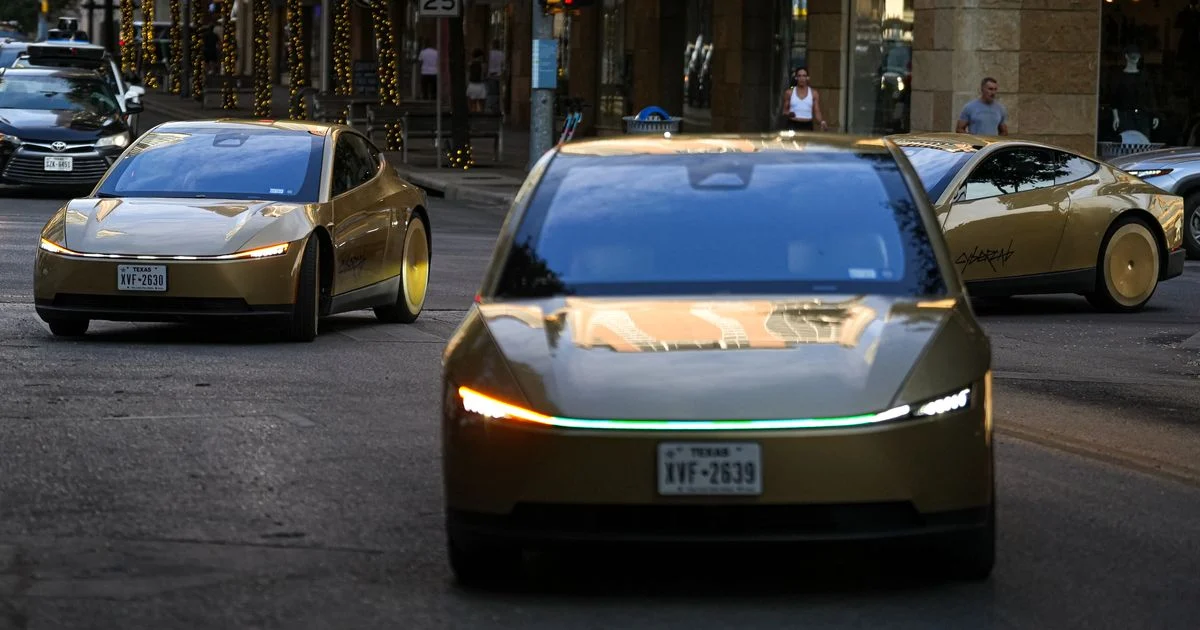
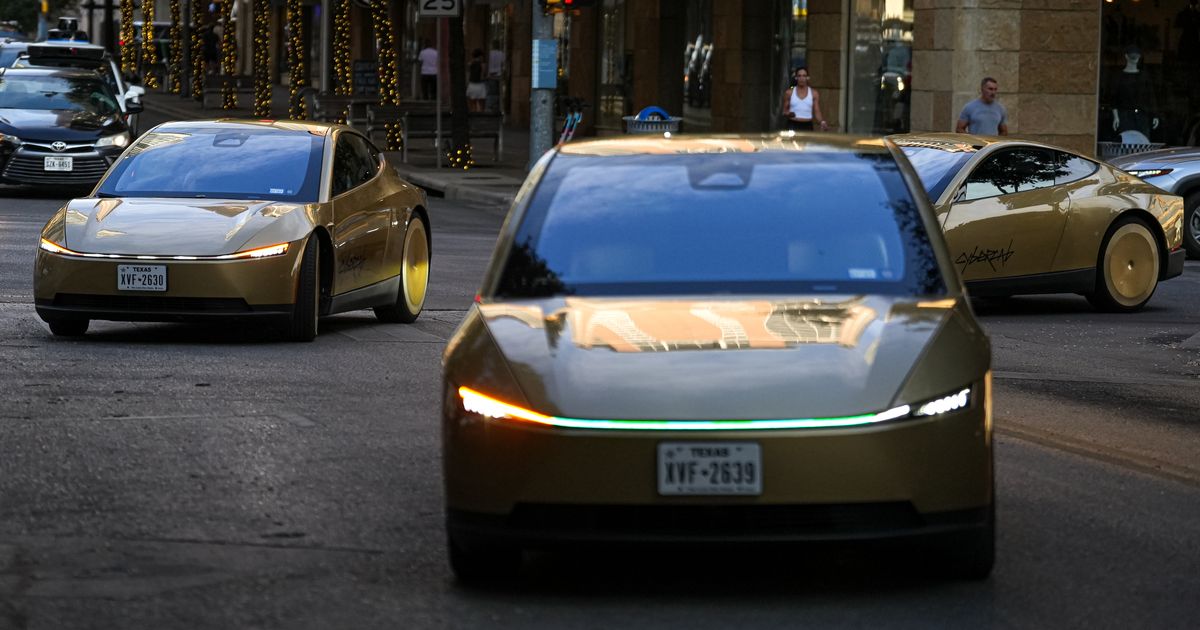
The quiet introduction of Tesla’s highly anticipated Cybercabs onto major metropolitan thoroughfares has sparked considerable public fascination, yet a closer inspection reveals a stark contrast between corporate marketing and operational reality. While Elon Musk’s long-promised vision of a Blade Runner–esque, autonomous future has successfully captured the public imagination—with brassy gold Cybercabs recently spotted parked near medical centers and weaving through dense traffic in cities like New York—the vehicles currently operating on public streets are significantly less futuristic than advertised.
Far from the fully driverless, steering-wheel-free pods cruising through controlled test environments in states like Texas and Florida, the Cybercabs making appearances in more congested urban centers are operating under strict manual and regulatory limitations. Rather than signaling an immediate, frictionless transition to autonomous transit, the rollout highlights a complex web of legal hurdles, regulatory investigations, and a deliberate strategy by Tesla to test the waters before facing the full weight of municipal compliance.
The Reality Behind the Steering Wheel
For gearheads and technology enthusiasts, spotting a Tesla Cybercab on the Cross Island Expressway or gridlocked in midtown traffic has become a localized sport. These sleek, two-seater vehicles certainly look the part of a next-generation robotaxi. However, appearances can be deceiving.
According to spokespersons from the New York City Department of Transportation (DOT), the Cybercabs deployed for local observation are equipped with traditional steering wheels, as well as functional gas and brake pedals. Photographic and eyewitness evidence corroborates these findings; recent sightings by local journalists have clearly captured human test drivers sitting behind the wheel, maintaining active control of the vehicle.
This human oversight is not merely a precautionary measure by the manufacturer, but a strict legal necessity. State laws across major metropolitan areas explicitly require a licensed human operator to keep at least one hand on the steering wheel of any motor vehicle operating on public roads.
Missy Cummings, director of George Mason University’s Center for Robotics and Automation, suggests that these supervised tests serve a dual purpose for the automaker. By introducing the safety-driven, manually controlled versions of the Cybercab first, Tesla aims to gently acclimate both local populations and hesitant lawmakers to the vehicle’s presence.
"Tesla first brings the safety-driven ones there to acclimate everyone, and then they hope to bring in the other ones," Cummings explains.
However, introducing fully autonomous iterations to streets known for their congestion and unpredictable traffic patterns could spell disaster. Cummings warns that fully driverless configurations present severe risks, particularly regarding emergency response operations. Without human drivers or standardized manual overrides, first responders would face immense difficulties moving stalled or abandoned robotaxis out of the path of emergency vehicles during critical incidents. "This is a nightmare for first responders," she notes, questioning the logic of permitting such vehicles on densely populated city streets.
Compounding these operational concerns, early hardware evaluations have revealed potential reliability issues. While reports indicate the presence of hidden manual controls—such as joysticks or secondary screen inputs allowing a human to steer, honk, or reverse—testers have noted that these failsafes do not always function seamlessly. Furthermore, federal regulators are taking notice; the National Highway Traffic Safety Administration (NHTSA) recently opened an active investigation into whether the removal of standard physical steering wheels and brake pedals in certain Cybercab configurations violates existing federal motor vehicle safety standards.
Circumventing Red Tape and Regulatory Gray Areas
The subtle emergence of Tesla’s test fleet also highlights a stark contrast in how different autonomous vehicle developers interact with municipal authorities. When rival autonomous vehicle companies, such as Alphabet’s Waymo, sought to test their self-driving Jaguars in boroughs like Manhattan and Brooklyn, they were required to undergo a rigorous permitting process with both city and state transportation departments. (Waymo’s testing program faced temporary setbacks when those permits lapsed, requiring formal renewals before resuming operations.)
Tesla, conversely, has largely sidestepped this extensive municipal red tape. The automaker has maintained that its current vehicles are not operating as fully autonomous robotaxis within these specific jurisdictions, categorizing them instead under an "advanced driver assistance system." This classification allows Tesla to bypass the stringent permitting processes required for driverless testing, operating under the legal umbrella of traditional driver-assist technology akin to what is already available in standard consumer Teslas.

Yet, this dual-messaging strategy has drawn sharp criticism from legal and regulatory experts. Matt Wansley, a law professor at Cardozo School of Law who specializes in artificial intelligence and automated driving regulation, notes that this ambiguity is a core component of Tesla’s broader regulatory playbook.
"It’s clear that the intent of Tesla is to build an automated driving system," Wansley observes. "They just don’t want to say that because it would trigger all these regulatory requirements that they don’t want to deal with."
While marketing materials and consumer demonstrations in states like Texas position the Cybercab as a fully driverless chauffeur service—hailed via smartphone app and operating without human intervention—the company adopts a far more conservative posture when engaging with regional regulators. By walking the fine line between an advanced driver-assistance system and a fully realized autonomous vehicle, Tesla avoids immediate regulatory penalties while quietly harvesting invaluable real-world data on complex urban driving environments.
Chronology of the Cybercab Rollout
- October 2024: Elon Musk officially unveils the Tesla Cybercab concept, promising a futuristic, steering-wheel-free robotaxi fleet intended to disrupt urban transportation.
- Spring 2026: Autonomous vehicle testing programs from competitors like Waymo face permit expirations and regulatory pauses in major northeastern markets, highlighting the strict oversight governing driverless technology.
- Late July 2026: Brassy gold Tesla Cybercabs are first spotted by pedestrians and car spotters near medical centers and major roadways in dense urban centers like New York City, sparking widespread public interest and media coverage.
- September 4, 2026: The National Highway Traffic Safety Administration (NHTSA) launches an official investigation into Tesla regarding safety compliance, specifically questioning whether the omission of traditional physical controls violates federal standards.
- Mid-September 2026: Industry analysts and legal scholars highlight the discrepancy between Tesla’s consumer-facing marketing—which promotes fully autonomous ride-hailing services in select southern markets—and its cautious, human-supervised testing framework deployed in regulated northeastern cities.
Broader Implications for Urban Mobility
The ongoing deployment of Tesla’s Cybercabs underscores a pivotal friction point between Silicon Valley’s "move fast and break things" ethos and the deliberate, safety-first governance of municipal infrastructure. As autonomous vehicle technology matures, cities are increasingly forced to grapple with the legal, logistical, and safety implications of integrating robotic fleets into legacy streetscapes.
For New York and other dense urban centers, the immediate concern is not merely technological novelty, but accountability. Without clear federal and state frameworks governing vehicles that straddle the line between human-driven safety measures and automated ambitions, municipalities risk losing control over their own public rights-of-way.
Whether Tesla’s stealth testing strategy will successfully pave the way for fully driverless fleets remains an open question. For now, however, the Cybercabs navigating metropolitan streets are a reminder that the future of transportation is arriving not with a sudden, autonomous revolution, but through incremental, heavily supervised—and often legally ambiguous—steps.