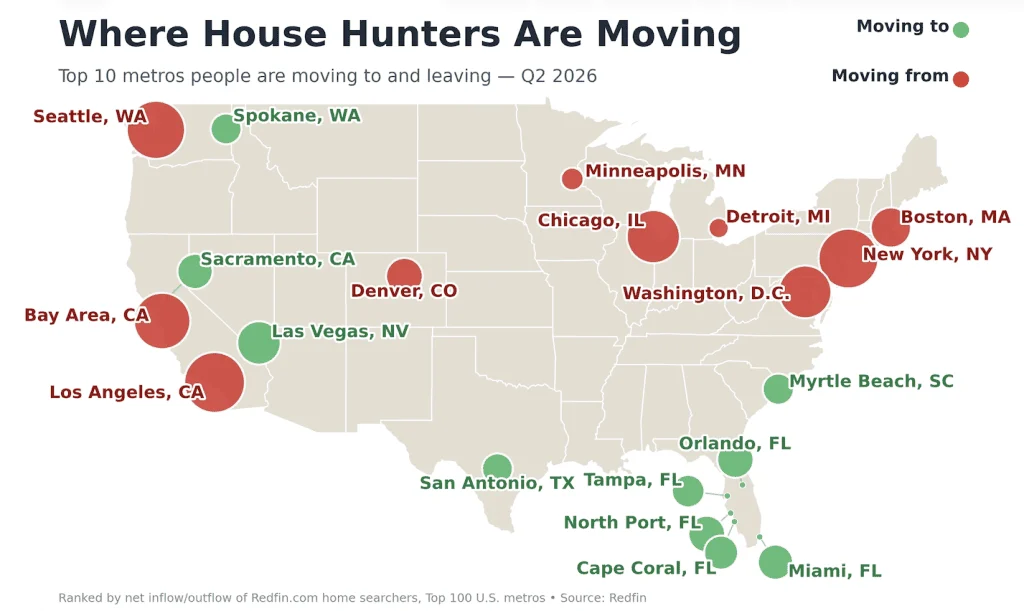
The landscape of the American housing market is undergoing a structural shift, as data from the second quarter of 2026 reveals a pronounced migration pattern: house hunters are increasingly abandoning the nation’s most expensive coastal metropolitan areas in favor of more affordable, climate-friendly destinations in the Sun Belt. According to the latest analysis from Redfin, this trend is reaching new heights, with nearly one in five potential homebuyers looking to move to a new metro area, the highest second-quarter share recorded since the firm began tracking this metric in 2021.
Las Vegas has emerged as the premier destination for these migrants, securing the top spot for net inflow. The city, which offers a stark financial contrast to the coastal hubs that serve as its primary sources of new residents, is emblematic of a broader national trend where affordability dictates the movement of the American workforce. Following Las Vegas, the Florida market continues to dominate, with North Port, Orlando, and Miami rounding out the top four most desirable destinations for those looking to relocate.
The Economics of Relocation: Affordability as the Primary Driver
While pleasant weather remains a secondary draw for those moving toward the South and Southwest, the primary catalyst for this mass relocation is the stark difference in housing costs. In an era where mortgage rates and overall inflation have pressured household budgets, the gap between the cost of living in legacy coastal cities and emerging Sun Belt metros has become impossible to ignore for many middle-class families.
Consider the data: The typical home in Las Vegas is valued at approximately $447,000. In contrast, Los Angeles—the primary origin city for those moving into the Las Vegas metro area—boasts a median home price of roughly $922,000. This $475,000 price disparity acts as a powerful economic incentive, allowing families to upgrade their living conditions, secure more square footage, and potentially lower their monthly tax burdens by moving just a few hours away or across the country.
This phenomenon is replicated across the nation. In the Northeast, those exiting New York City—where the median home price hovers around $832,000—are increasingly setting their sights on Philadelphia. In the City of Brotherly Love, the typical home price sits at a much more accessible $309,000. This drastic reduction in the cost of entry is a cornerstone of the current migration wave, enabling households to pivot from renting in high-cost environments to ownership in developing urban centers.
The Decline of the Coastal Powerhouses
While the Sun Belt thrives, the nation’s largest job hubs are witnessing a sustained net outflow of residents. Los Angeles, New York, and Seattle currently lead the nation in net outflow, meaning they are losing more potential homebuyers than they are attracting. The trend extends beyond these three, with the San Francisco Bay Area, Chicago, and Washington, D.C., also appearing at the top of the list for departures.
The exodus from these regions is not a sudden development but rather a culmination of long-standing socioeconomic pressures. Since 2021, these cities have grappled with a combination of high housing costs, dense urban living challenges, and a shift in the corporate landscape. The widespread adoption of remote and hybrid work models has acted as an accelerant, liberating workers from the requirement to live within commuting distance of corporate headquarters in expensive urban centers. As the physical tether to the office has loosened, the rationale for paying a premium to reside in a high-cost coastal city has diminished for many professionals.
A Chronology of the Shift
The current state of the market is best understood by looking back at the trajectory since the onset of the pandemic. In 2021, the initial surge of migration was characterized by a sudden, frantic search for more space as lockdowns forced a reevaluation of home utility. As 2022 and 2023 progressed, the market saw a cooling period as interest rates climbed, which briefly stifled mobility. However, by 2025, a new equilibrium began to form.
The second quarter of 2026 marks a significant milestone in this timeline. The fact that 18.7% of house hunters are looking to relocate—a figure that surpasses the 18.1% observed in the second quarter of 2025—indicates that the desire for mobility has become a permanent fixture of the housing market. While the total number of home sales remains historically low due to inventory constraints and financing costs, the intent to relocate has remained remarkably resilient.

State-Level Trends: Florida’s Unmatched Appeal
At the state level, the dominance of Florida is striking. The Sunshine State attracted a higher net inflow of Redfin users in the second quarter of 2026 than Arizona, South Carolina, and Tennessee combined. This massive influx is transforming the demographic and economic makeup of the state, placing additional pressure on local infrastructure and housing supply.
California, meanwhile, remains the state with the highest net outflow, with a volume of departing residents nearly double that of New York. This suggests that the cost-of-living crisis in the Golden State is impacting a broader demographic than the more localized issues seen in other regions. Illinois, Washington, and Massachusetts follow in the rankings of states losing population, signaling a continued migration away from the industrial and tech-heavy corridors of the North and West.
Analytical Perspectives on Market Implications
The implications of this migration are twofold. For destination cities, the influx of capital and human talent provides an immediate economic boost, driving local business growth and tax revenue. However, it also introduces the risk of "affordability creep." As more people move to cities like Las Vegas, Orlando, or Sacramento, the increased demand for housing inevitably puts upward pressure on prices, potentially pricing out long-term residents and reducing the very affordability that attracted the new arrivals in the first place.
For the origin cities, the departure of a large portion of the workforce presents a challenge to the municipal tax base. When high-earning professionals and middle-class families leave, cities may face future budget deficits, forcing local governments to reconsider how they deliver services and manage infrastructure maintenance.
It is also vital to note that these figures represent search activity and intent rather than finalized home purchases. A significant portion of this data may include individuals investigating secondary or vacation properties, or those scouting for investment opportunities. Additionally, because the overall pool of active homebuyers is smaller than in the peak pandemic years, the volume of moves remains lower than it was in 2021 and 2022. The market is not necessarily seeing a higher number of people moving, but rather a higher proportion of the active, smaller pool of buyers choosing to relocate.
Methodology and Data Limitations
The analysis provided by Redfin is based on user search behavior across more than 100 metropolitan areas in the United States. A "migrant" is defined as a user who views at least 20 for-sale or for-rent properties in a destination metro area within a single month. This methodology allows researchers to distinguish between casual browsing and serious intent to relocate.
If a user exhibits search behavior across multiple regions, their activity is proportionally allocated to ensure the data accurately reflects the diversification of search interest. While this methodology is robust, it does not account for individuals who move without using online real estate platforms or those who relocate for reasons outside of the housing market, such as corporate transfers or military deployments. Despite these limitations, the data remains one of the most reliable proxies for tracking the internal movement of the American population in real-time.
Looking Ahead
As the second half of 2026 begins, the trend of internal migration appears unlikely to reverse. Unless there is a dramatic change in the economic landscape—such as a significant decline in housing costs in coastal hubs or a widespread return-to-office mandate that effectively ends remote work—house hunters will continue to prioritize affordability.
The American dream of homeownership is being rewritten in real-time. For many, that dream is no longer tied to the traditional economic centers of the East and West coasts but is instead being realized in the sprawling, sun-drenched metros of the South and West. As families continue to vote with their feet, the geographic distribution of wealth, talent, and economic power in the United States will continue to evolve, signaling a new chapter in the nation’s social and economic history.