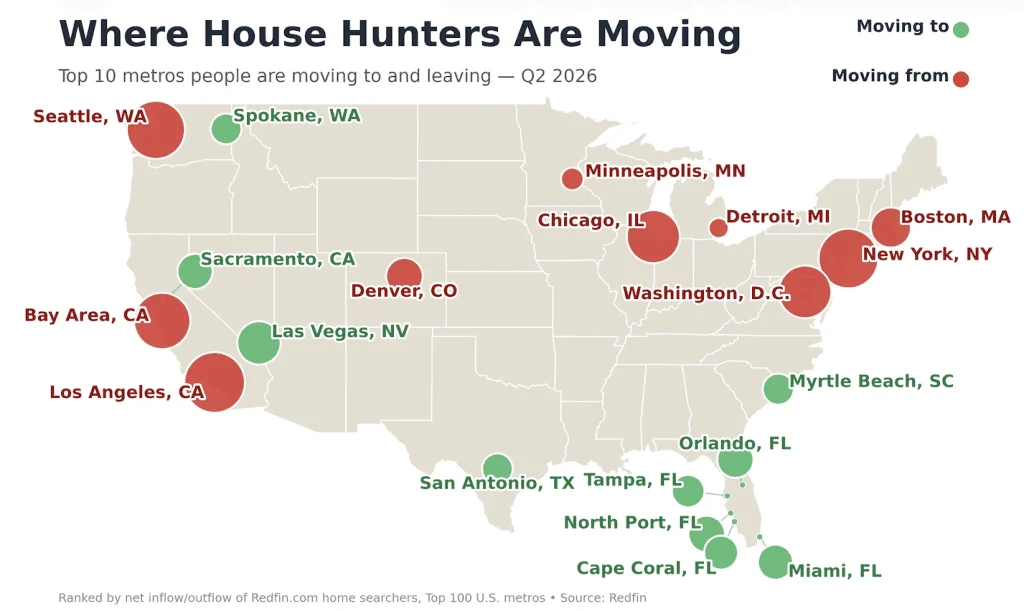
The landscape of the American housing market is undergoing a profound structural shift as prospective homeowners increasingly prioritize affordability over proximity to traditional corporate hubs. According to recent migration data from the second quarter of 2026, the United States is witnessing a sustained exodus from high-cost coastal metropolises toward the more temperate and economically accessible regions of the Sun Belt. Las Vegas has officially ascended to the top of the list for net migration, signaling a growing preference for markets where housing costs remain decoupled from the extreme valuations seen in cities like New York and San Francisco.
This trend is quantified by Redfin’s latest analysis, which tracks the movement of potential homebuyers and renters searching outside their home metro areas. The data reveals that 18.7% of all house hunters in the U.S. were actively looking to relocate to a different metro area during the second quarter of 2026. This figure represents the highest second-quarter share of home searchers on record since the organization began tracking this metric in 2021, underscoring a persistent desire for geographic mobility in the post-pandemic era.
The Rise of the Sun Belt as an Economic Haven
The dominance of the Sun Belt—a region stretching across the southern tier of the United States—is stark. Of the top ten most popular destinations for domestic migrants, nine are located within this belt. Las Vegas leads the pack with a net inflow of 9,581 residents. The primary driver behind this surge is the vast disparity in median home prices. In Las Vegas, the typical home sells for approximately $447,000. For individuals originating from Los Angeles, where the median price sits at $922,000, moving to Nevada represents not merely a change of scenery, but a massive recalibration of their personal balance sheets.
Florida continues to act as a magnet for domestic migration, claiming four of the top ten spots for metro areas: North Port, Orlando, Miami, and Cape Coral. When aggregated at the state level, the preference for the Sunshine State is even more pronounced. In the second quarter of 2026, Florida saw a net inflow of 38,922 house hunters. To put this in perspective, Florida’s total net inflow of potential residents exceeded the combined totals of Arizona, South Carolina, and Tennessee—the next three most popular states—by a significant margin.
Economists note that while climate and lifestyle amenities play a role in these migration patterns, the primary engine remains affordability. As interest rates and general inflation have kept homeownership costs elevated, households are increasingly viewing relocation as a necessary strategy to achieve the American dream of homeownership. The ability to work remotely or in a hybrid capacity has provided the flexibility required to sever the tie between high-paying jobs and high-cost-of-living urban centers.
The Erosion of Coastal Dominance
While the Sun Belt thrives, the nation’s traditional economic powerhouses are facing a mounting challenge in retaining their populations. Los Angeles, New York, and Seattle currently hold the titles for the highest net outflows in the country. Los Angeles, in particular, recorded a net loss of 28,652 searchers, with many looking toward Las Vegas, San Diego, and beyond to escape the prohibitive costs of Southern California.
New York is experiencing a similar trend, with a net outflow of 27,143 searchers. The contrast in housing affordability between the Big Apple and its primary out-migration destinations is illustrative of the broader national phenomenon. While a typical home in New York City is valued at $832,000, those leaving the city frequently set their sights on Philadelphia, where the median home price is approximately $309,000. This $500,000 difference serves as a powerful incentive for families and young professionals to relocate.
This trend is not limited to the coasts. Midwestern hubs like Chicago and Detroit, along with major employment centers in the Pacific Northwest and the Mountain West, are also seeing significant outflows. San Jose, California, which has long been the epicenter of the tech industry, reported a net outflow of 22,353, highlighting that even the most affluent residents are beginning to re-evaluate the sustainability of living in markets where the cost of entry has become increasingly exclusionary.

A Chronology of Changing Preferences
The current migration shift did not occur in a vacuum; it is the culmination of trends that accelerated during the 2020 pandemic. In 2021, as offices shuttered and lockdowns mandated a shift to digital workflows, the "anywhere worker" became a fixture of the labor market. This period saw an initial surge in moves to secondary cities and suburban areas.
By 2023, as the market attempted to normalize, the focus shifted from pure necessity to economic survival. The high-inflation environment of 2024 and 2025 further solidified the trend, as the cost of mortgage payments skyrocketed. By the second quarter of 2026, the movement had shifted from a temporary reaction to a systemic lifestyle choice. The consistent upward trend in the percentage of house hunters looking to move—rising from 18.1% in 2025 to 18.7% in 2026—suggests that this behavior is becoming baked into the standard life cycle of the modern American worker.
Implications for Urban Policy and Infrastructure
The rapid influx of new residents into secondary markets and Sun Belt cities presents both opportunities and challenges for local governments. Cities like Orlando, San Antonio, and Spokane are now grappling with the strains of rapid population growth, which include rising demand for public infrastructure, increased traffic congestion, and the potential for housing supply shortages.
When large numbers of high-earners from major coastal cities move into smaller markets, they often bring higher purchasing power, which can lead to rapid price appreciation. This "migration-induced inflation" can threaten the very affordability that attracted these new residents in the first place. Urban planners in these top-destination cities are now facing the pressure to accelerate residential zoning reform and expand public transportation to accommodate the influx without alienating long-term residents.
Conversely, the cities experiencing significant net outflows are facing a different set of fiscal challenges. A shrinking tax base in cities like New York and San Francisco could potentially lead to budgetary shortfalls for essential services, forcing city officials to consider new strategies for revitalizing urban cores. This might include converting underutilized office space into residential units or incentivizing the return of talent through tax initiatives, though the effectiveness of these measures remains to be seen.
Statistical Context and Methodology
The data provided by Redfin is based on the behavior of users who view at least 20 for-sale or for-rent homes in a destination metro area within a single month. This threshold is specifically designed to filter out casual browsers and focus on individuals with a serious intent to move.
It is important to note that this data also accounts for those looking to purchase vacation or investment properties. While the vast majority of these moves are primary residence-driven, the investment component remains a factor, particularly in markets like Miami and Myrtle Beach. Furthermore, while the share of house hunters moving is at a record high, the total volume of home sales remains historically low compared to the 2021-2022 period. This means that while the propensity to relocate is increasing, the overall pool of buyers is smaller, which may act as a buffer against even more aggressive price spikes in destination markets.
As the second half of 2026 approaches, the real estate industry is bracing for a continued period of adjustment. The movement of Americans away from the coasts is no longer a fleeting anomaly; it is a fundamental reconfiguration of the U.S. housing market. Whether this trend continues to accelerate or eventually plateaus depends heavily on interest rate policies, the evolution of remote work mandates, and the ability of the nation’s secondary cities to absorb the incoming population while maintaining the quality of life that made them popular in the first place.