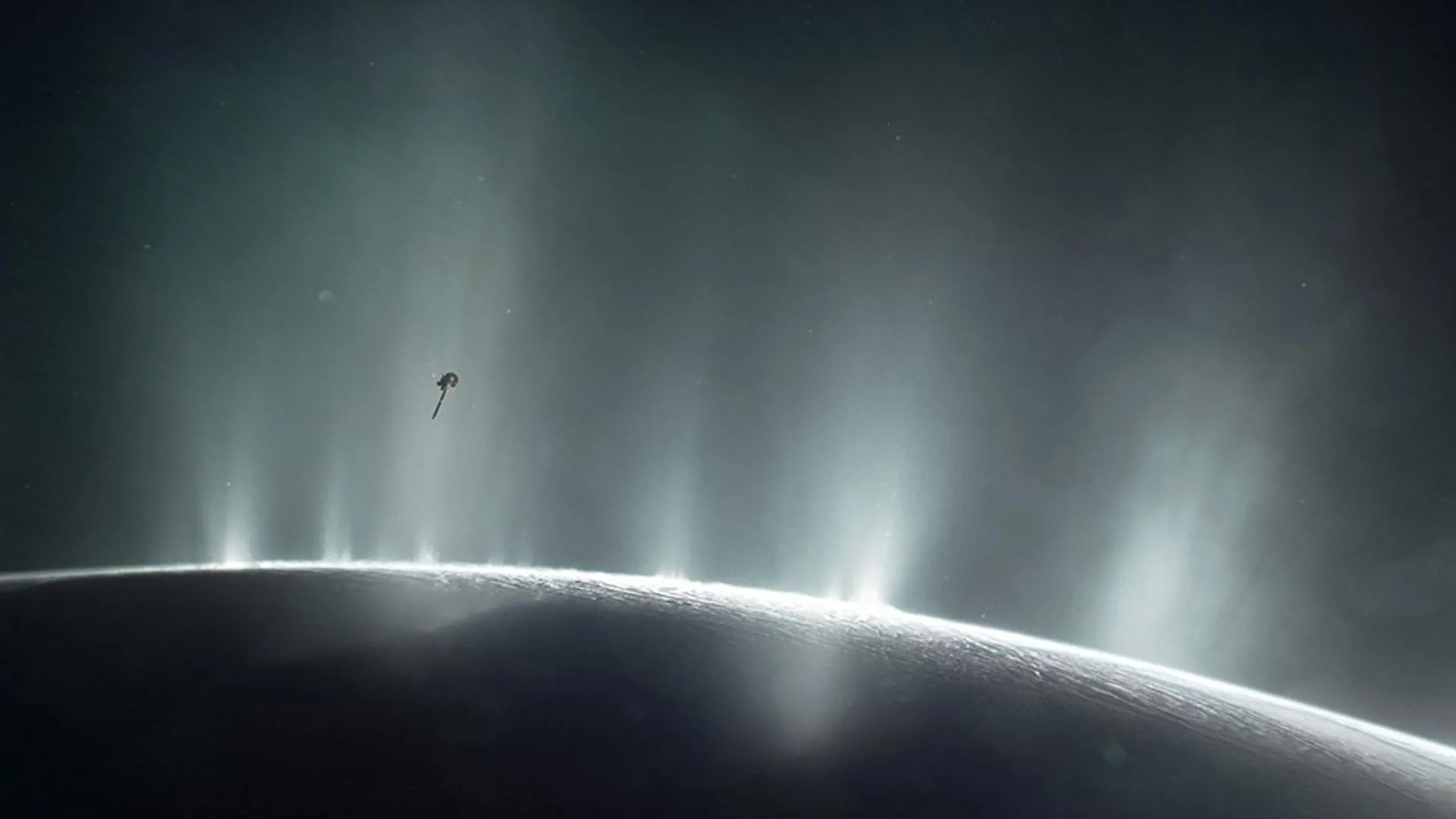
Saturn’s moon Enceladus is covered in ice, but beneath that frozen shell lies a global ocean. Near the moon’s south pole, fractures in the crust release water vapor and ice particles into space. Those particles give scientists an unusual way to study an alien ocean without having to drill through kilometers of ice. An international team of researchers, including scientists from the Earth-Life Science Institute (ELSI) at the Institute of Science Tokyo, has now unlocked a pivotal mystery regarding the origin of these particles, fundamentally changing our understanding of how ocean water transitions into the ice grains detected in deep space.
The Cassini Legacy: An Unexpected Chemical Puzzle
Between 2004 and 2017, NASA’s Cassini spacecraft conducted a series of daring flybys through the plumes of Enceladus. The Cosmic Dust Analyzer (CDA) onboard the craft was designed to capture and characterize the composition of individual ice particles found within Saturn’s E-ring—a diffuse ring of dust and ice sustained by the ongoing eruptions from the moon’s southern hemisphere.
During these years, the CDA collected mass spectra from 961 salt-rich grains, classified by researchers as "Type 3" particles. Under standard assumptions, scientists expected these grains to reflect a homogenized sample of the sub-surface ocean. If the ocean were a well-mixed, uniform body of water, the salt signatures within these grains should have been largely consistent. Instead, the data revealed a striking degree of chemical heterogeneity.
The grains were not uniform. Some were dominated by sodium chloride, while others exhibited significant concentrations of carbonates, phosphates, or potassium chloride. Most perplexing was the observation that chloride and carbonate ions rarely appeared together in the same sodium-rich particle. This chemical divergence posed a significant challenge: how can a single, enclosed global ocean produce such vastly different particulate signatures?
Replicating the Alien Ocean in the Laboratory
To reconcile the Cassini data with the physical reality of the ocean, a research team led by Professor Yasuhito Sekine at ELSI embarked on a series of controlled laboratory experiments. The goal was to simulate the conditions of an oceanic plume as it transitions from the liquid depths to the frozen vacuum of space.
The researchers synthesized droplets containing the major salt constituents hypothesized to exist in the Enceladus ocean. These droplets, ranging in size from tens to hundreds of micrometers, were subjected to varying cooling rates to observe the crystallization process. The findings were definitive: the speed of freezing is the primary driver of chemical partitioning.
When droplets were frozen rapidly, the chemical ingredients remained relatively well-mixed. However, when the droplets underwent slow freezing—at a rate of approximately 10 Kelvin per minute or less—the salts effectively separated into distinct regions within the solidifying structure. As the water transformed into ice, the solutes were pushed into concentrated pockets, creating a mosaic of chemical compositions within a single frozen sphere.
"What surprised us was that the diversity seen by Cassini could emerge from droplets originating from essentially the same ocean water," stated Professor Sekine. "Our experiments show that when relatively large ocean droplets freeze slowly, different salts can separate within them. If those frozen droplets are later broken apart, they can produce much smaller ice grains, each with very different chemical compositions."
Reimagining the Sub-Surface Vent System
These experimental results have necessitated a revision of the prevailing models regarding the transport of water from the Enceladus ocean to the surface. Previously, the scientific community largely operated under the assumption that seawater spray from the moon’s geysers froze almost instantaneously and was ejected into space with minimal residence time in the icy crust.
The new findings suggest a more complex, "slow-path" journey. It is now theorized that ocean spray forms larger droplets deep within the subsurface vent system. These droplets traverse the fractures of the icy crust at a measured pace, undergoing a gradual freezing process that allows for the separation of salts.
As these droplets approach the surface, they are subjected to increasing gas pressure and velocity. Upon reaching the narrower channels near the surface exit points, these frozen or partially frozen droplets likely collide with the walls of the icy vents at high speeds. These collisions cause the droplets to fragment, scattering the previously segregated salt regions into a variety of distinct, smaller ice grains. These fragments are then expelled into space, where they eventually enter the E-ring, preserving the chemical signature of their specific, separated origin point.
The "Natural Laboratory" Effect
The process identified by the ELSI team holds profound implications for future planetary exploration. One of the greatest challenges in space science is the detection of organic molecules or complex compounds that exist in highly dilute concentrations within an alien environment.
By naturally separating and concentrating these compounds through the freezing and fracturing process, Enceladus effectively performs "sample preparation" that would typically require sophisticated laboratory equipment on Earth. This mechanism suggests that future spacecraft—such as the proposed Enceladus Orbilander or other flyby missions—might find it significantly easier to detect trace substances than previously estimated. The concentration of organic compounds into specific ice grains could amplify the signal of potential biomarkers, making the detection of signs of life a more viable objective.
Implications for Prebiotic Chemistry
Beyond the mechanics of grain formation, the study offers new insights into the potential for prebiotic chemistry within the moon’s interior. As ice crystals form during the slow-freezing process, small, highly concentrated pockets of liquid brine are often trapped between the crystals.
In the field of astrobiology, the concentration of chemicals is a critical prerequisite for the emergence of life. On a primordial Earth, the challenge of concentrating dilute organic molecules to facilitate complex chemical reactions is a central debate. Enceladus appears to facilitate this concentration naturally. Because much of the ejected material from the plumes falls back onto the surface, this cycle of freezing, concentrating, and recycling could create a perpetual "chemical reactor" environment.
Conclusion: A New Framework for Exploration
The research conducted by the ELSI team, in conjunction with the retrospective analysis of the Cassini data, provides a robust physical explanation for the chemical diversity observed in Saturn’s E-ring. By moving away from the assumption of rapid, uniform freezing, scientists have gained a clearer window into the dynamic environment beneath the icy shell of Enceladus.
This work serves as a critical bridge between remote sensing data and the fundamental chemical processes that govern planetary habitability. As space agencies continue to plan for the next generation of outer solar system exploration, the understanding that Enceladus functions as a natural, self-concentrating laboratory will undoubtedly shape the instrumentation and mission profiles designed to search for life beyond Earth. The moon’s plumes are not merely random jets of water; they are messengers from a complex, active, and potentially habitable world, now better understood through the lens of controlled laboratory physics.