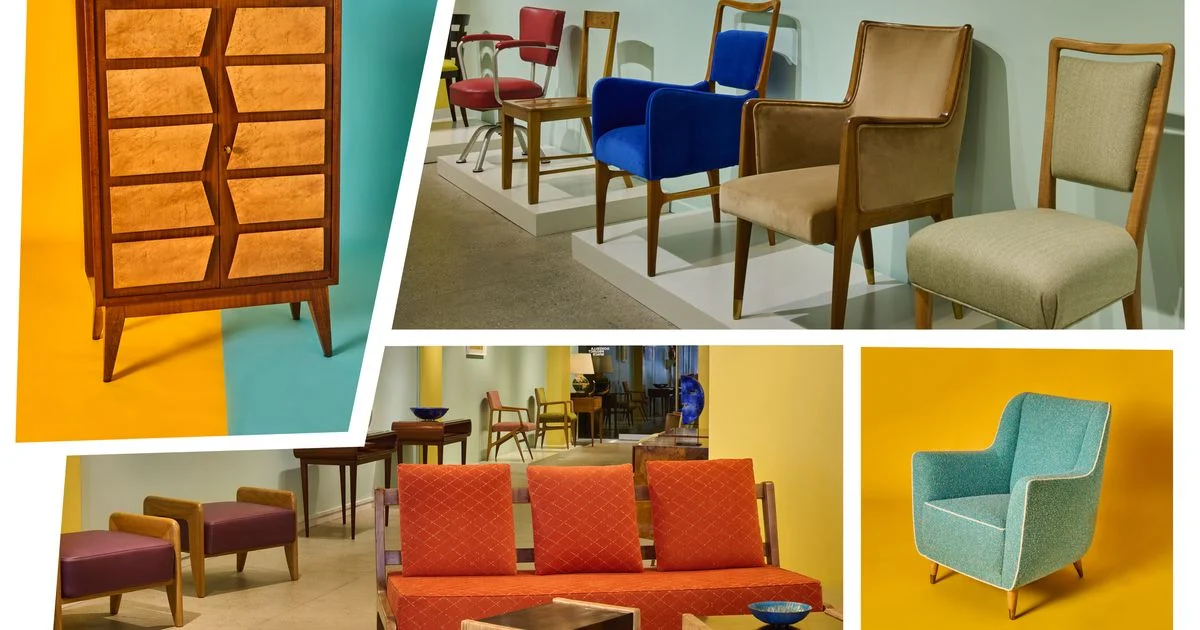
Six decades of relentless creativity, visionary spatial engineering, and boundary-pushing furniture design are currently on display in New York City, shedding light on an extraordinary chapter of mid-century Italian modernism. "Designing Optimism," a comprehensive retrospective hosted at the Donzella Project Space, brings together nearly 80 rare works by the legendary architect, designer, and editor Gio Ponti. Many of the featured items have not been exhibited publicly in over two decades, offering both scholars and design aficionados a rare, immersive look into an evolving artistic philosophy that steadfastly rejected ideological dogmas.
Unlike many of his European contemporaries who struggled under the rigid architectural doctrines of the Bauhaus movement from the 1920s through the end of World War II, Ponti maintained a unique independence. Operating with boundless curiosity, he drew inspiration from the historical layers of Mediterranean design to construct futuristic visions, effectively looking backward to propel his work forward. This refusal to adhere to a singular aesthetic resulted in a remarkably diverse portfolio. During the austere, belt-tightening years immediately following World War II, Ponti engineered highly utilitarian, stripped-back shelving units. Decades later, the exact same designer conceived ornate, luxurious lounge chairs for high-end international hotels. This continuous cycle of reinvention established him as one of the 20th century’s most influential polymaths.
The Exhaustive Pursuit of Lost Works
Bringing "Designing Optimism" to life was no small feat. The exhibition is the culmination of years of meticulous, boots-on-the-ground research and sourcing by gallerist Paul Donzella and historian Brian Kish. Kish, who has spent three decades studying Ponti’s archives, artifacts, and personal papers—and who co-authored a massive, definitive monograph on the designer for Taschen—leveraged deeply established networks to unearth lost pieces.
Over the three-year development phase of the exhibition, Donzella scoured international auctions and partnered with private collectors to secure key items, while Kish pursued more idiosyncratic avenues. Notably, Kish coordinated with an elderly French nobleman who possessed unique connections to Vatican-adjacent charities, unearthing pieces that had long vanished from the public eye.
"I knew no matter how big the collection we could gather, there would always be key pieces that were left out just because there’s so much," Donzella noted regarding the sheer scale of Ponti’s output. "Regardless, there’s a good mix between pieces that are minimal and those that show his more decorative leanings."
Because Ponti’s last comprehensive global retrospective took place in 2001, and with the newest piece in the current exhibition having debuted over half a century ago, the Donzella exhibition serves as a vital bridge, introducing the maestro’s enduring legacy to an entirely new generation of designers, collectors, and historians.
A Chronological Evolution of Form and Function
Born into a prominent Milanese family, Ponti was initially steered toward the rigorous path of engineering before being permitted to study architecture. However, his aspirations always gravitated toward the fine arts. "He always wanted to be a painter, and that fine-art sensibility never left," Kish observed.
Ponti’s workflow was fueled by an astonishing velocity and legendary stamina, famously operating on just five hours of sleep a night. This relentless drive generated ideas across every imaginable scale, ranging from diamond-faceted cutlery to towering architectural monoliths—such as Milan’s emblematic Torre Branca—and street lamps that were later re-engineered for domestic interiors.
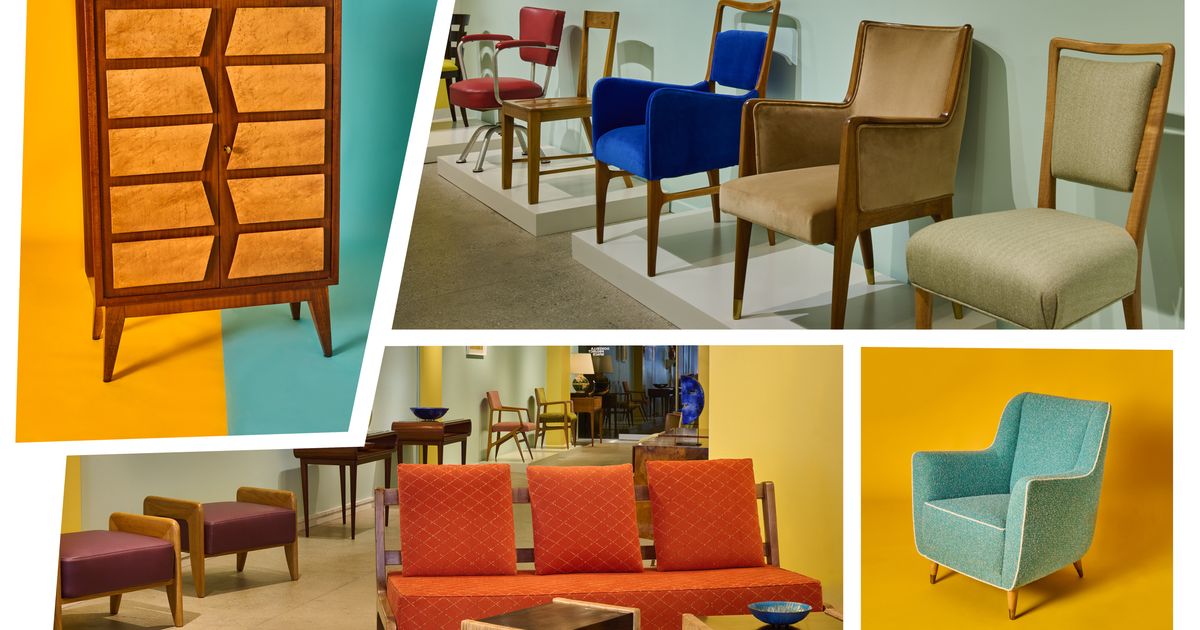
Rather than boxing Ponti’s career into neat historical categories, the exhibition loosely groups his furniture chronologically, revealing subtle, organic evolutions across three distinct periods:
- The 1920s and 1930s: Grounded in neoclassical motifs, Ponti experimented with unexpected material pairings. During this foundational era, he began refining his signature curved edges, transforming rigid Art Deco geometry into softer, more organic silhouettes.
- The 1940s and 1950s: Embracing Italy’s post-war economic miracle, Ponti adapted his craft to meet the demands of advanced industrial manufacturing. Despite economic hardships, he insisted that objects should bring emotional delight, trimming simple post-war cabinets with zigzag patterns as visual symbols of future prosperity.
- The 1960s and 1970s: Fueled by bespoke architectural commissions, this era produced some of Ponti’s most innovative and hyper-functional pieces. These late-career works showcased a master entirely unintimidated by formal boundaries, pushing sculptural tension to its absolute limits.
Rejecting Hierarchies: Materials and the Pursuit of Weightlessness
Throughout his prolific career, Ponti consistently dismissed the rigid boundaries separating "high" art from "low" commercial design. He seamlessly integrated industrial materials like Formica with luxurious burled walnut, as evidenced by a rare 1950 display cabinet featured in the exhibition, which incorporates lithograph-transferred Fornasetti prints of Venice. Similarly, in his 1940 Diavolo tables, he paired bamboo caning—then widely dismissed as cheap—with rare, highly prized African padauk wood.
This democratic approach to design allowed Ponti to move effortlessly between multimillion-dollar luxury commissions and accessible, mass-market furnishings intended for returning World War II veterans. All the while, he maintained a rigorous schedule as an influential design editor, utilizing media platforms to critically examine and inform his own spatial research.
As his career progressed into its later decades, Kish notes that "Ponti moved toward weightlessness." This evolution is starkly illustrated by the 1964 insect-like lounge chairs he designed for the Parco dei Principi hotels in Rome and Sorrento. Featuring ultrathin legs and curved seat shells that create an illusion of floating, these chairs represent an avant-garde tension that challenged traditional domestic spaces. "There might be an avant-garde tension that makes them difficult to live with domestically," Donzella remarked, "but they reveal that he was still pushing formal boundaries in his 70s."
The Legacy of the Superleggera and Modern Implications
Even Ponti’s failures offered profound lessons in design innovation. The curators chose to exhibit a rare 1950 prototype of his famous 699 Superleggera chair. Built using an intricate combination of carved wood and complex brass hardware, the prototype proved too difficult and costly to manufacture en masse, prompting Ponti to strip it down into the iconic, featherlight 3.75-pound chair that defined mid-century modernism.
The Superleggera became so commercially and culturally successful that its original producer, Cassina, was eventually forced to take out legal warning advertisements in Domus—the very magazine Ponti founded three decades prior—to combat widespread copyright infringement and knockoffs.
For contemporary design historians, Ponti’s willingness to experiment, fail, and iterate stands in stark contrast to today’s risk-averse creative landscape, where minor stylistic divergences are frequently penalized. "Designing Optimism" arrives at a pivotal moment, serving as the vanguard for a series of international retrospectives and the forthcoming establishment of a permanent home for Ponti’s archives in Milan.
As contemporary designers navigate an increasingly homogenized market, the exhibition delivers a timeless, vital directive borrowed directly from Ponti’s enduring ethos: the unwavering necessity of refusing conformity.
“Designing Optimism” remains on view through December 22 at the Donzella Project Space in New York City.