British actress Kirby Howell-Baptiste has cemented her reputation as one of contemporary cinema’s most dynamic character actors following her scene-stealing performance in Club Kid, the hedonistic coming-of-age comedy-drama written, directed by, and starring Jordan Firstman. Though her screen time in the feature is strictly limited, Howell-Baptiste’s portrayal of the chaotic, boundary-free party girl Edison serves as the narrative catalyst that propels the entire film into motion. The movie, which emerged as a major critical and commercial darling on the international film festival circuit, has catapulted its cast into the global spotlight, even as Howell-Baptiste herself navigated the initial rollout completely unaware of the explosive industry buzz surrounding the project.
Main Facts and Narrative Catalyst
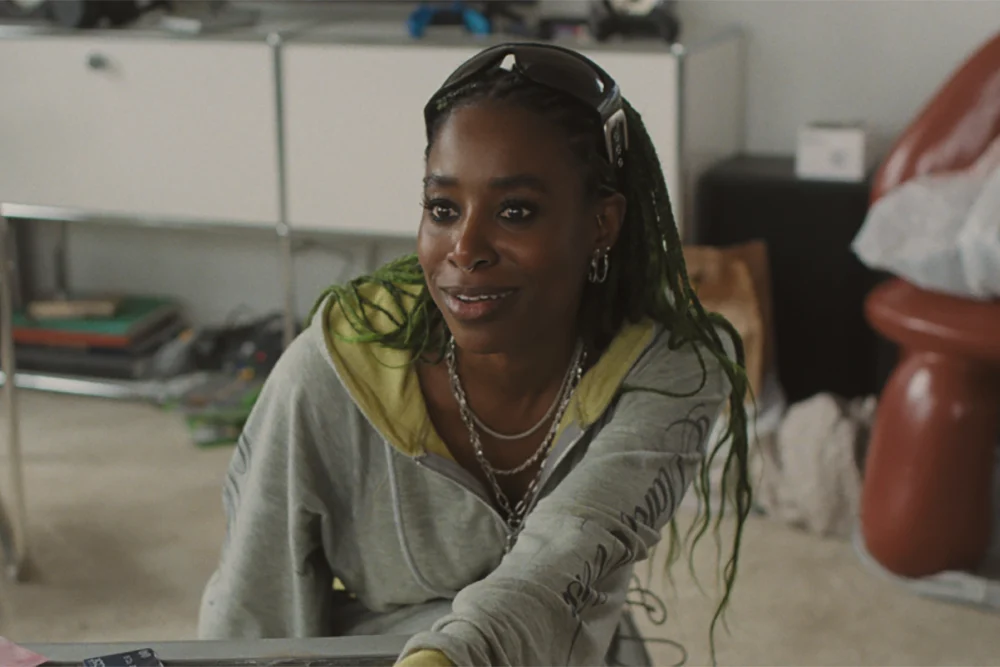
Club Kid centers on Peter, played by Firstman, a hard-partying New York City nightclub promoter who is suddenly forced to confront adult responsibilities and emotional accountability. The film’s structural turning point occurs roughly twenty-five percent into the narrative, when Howell-Baptiste’s character, Edison, breaches Peter’s apartment unannounced. Adorned with green braids and oversized sunglasses, Edison wanders through the living space as if it were her own, exhibiting the classic traits of an individual whose cognitive faculties and social etiquette have been severely eroded by a lifetime of excessive substance abuse.
In a masterclass of deadpan, unapologetic delivery, Edison casually drops a pair of life-altering bombshells: she reveals that Peter is the father of a ten-year-old boy named Arlo, played by Reggie Absolom, and announces that she has brought the child over from the United Kingdom to live with Peter permanently. When a startled Peter protests that he is gay and has never slept with a woman, Edison dismisses his objections. She recounts a hazy encounter a decade prior at one of Peter’s club nights, where Peter—heavily intoxicated on a cocktail of ketamine, cocaine, and GHB—conceived the child with her friend, Leonine.
The gravity of the scene deepens when Edison casually mentions, while rummaging through the kitchen for illicit substances and inquiring if Peter would like to "do a bump" of cocaine, that Leonine recently died by suicide following a prolonged struggle with mental health issues and rehabilitation facilities. Despite the tragic subject matter, Edison’s relentless energy and casual insensitivity transform the sequence into a tonal tightrope walk, perfectly encapsulating the chaotic lifestyle of the underground party scene.
Production and Chronology of the Project
The journey of Club Kid from concept to global distribution spans a carefully calculated timeline of auditions, secretive filming schedules, and festival acquisitions. The project initially took shape in mid-2025, when casting director Carmen Cuba brought Howell-Baptiste aboard. Operating largely outside the sphere of social media and having missed Firstman’s viral breakout during the COVID-19 pandemic, Howell-Baptiste relied entirely on the strength of the script and Cuba’s discerning artistic reputation.
Production commenced in the fall of 2025 in New York City. Operating in relative isolation, Howell-Baptiste shot her primary apartment sequence alongside Firstman and young actor Reggie Absolom, supplemented by a brief flashback scene depicting Edison and Leonine’s initial meeting with Peter in a London nightclub. Because she was not involved in the subsequent sequences detailing Peter’s frantic search for Edison across various city house parties, Howell-Baptiste filmed her entire contribution within a compressed timeframe, remaining largely unaware of how her character’s absence would loom over the remainder of the picture.
Following her wrap on the production, Howell-Baptiste transitioned immediately to other high-profile acting commitments, including filming the third season of the British television drama Sherwood. Months later, a direct message from Firstman informed her that Club Kid had secured an official selection at the prestigious Cannes Film Festival. What followed was an unprecedented market breakout.

Supporting Data and Industry Impact
The trajectory of Club Kid shifted from an independent venture to a major commercial asset during its debut at Cannes in May 2026. The film sparked an intense, multi-studio bidding war fueled by ecstatic reviews and word-of-mouth praise from industry insiders. Ultimately, independent powerhouse A24 secured the worldwide distribution rights for a staggering $17 million, positioning the project as one of the most lucrative acquisitions of the festival season.
Despite the intense media storm, Howell-Baptiste remained blissfully detached from the commercial frenzy. Joking that she "lives under a rock," she only learned of the film’s multi-million-dollar acquisition and subsequent selection at the Toronto International Film Festival through casual text messages from her manager and a makeup artist on a separate set. She finally experienced the collective reaction of an audience during the movie’s high-profile premiere at the BFI London Film Festival, taking the stage at the Royal Festival Hall alongside Firstman and Absolom to witness firsthand the laughter and emotional resonance the film elicited.
Creative Choices and Improvised Nuances
Behind the chaotic exterior of Edison lies a carefully constructed performance shaped by specific directorial notes and transatlantic cultural nuances. Firstman’s primary directive for Howell-Baptiste was vocal: he wanted the character to speak with a distinctively hoarse, raspy British cadence, simulating someone who had spent consecutive days awake without rest. To achieve this, the London-born actress channeled the signature vocal textures of former Spice Girl Mel B.
Furthermore, the character’s dialogue features a blend of scripted text and spontaneous improvisation. During the pivotal apartment sequence, Howell-Baptiste ad-libbed the British slang term "tops herself" when describing Leonine’s death. This word choice created an amusing behind-the-scenes linguistic misunderstanding on set, given that the film was authored by a gay man immersed in queer culture, where the term "top" carries an entirely different sexual connotation.
Upon realizing the potential confusion, Howell-Baptiste offered to re-record or alter the line, but Firstman insisted it remain in the final cut. The resulting line successfully heightened the cultural dissonance for American audiences, reinforcing the bewildering, destabilizing nature of Edison’s persona.
Broader Implications for Queer Cinema and Comedy
Club Kid arrives at a critical juncture for contemporary queer cinema, successfully bridging the gap between authentic representations of underground hedonism and mainstream comedic appeal. By blending high-stakes emotional trauma—such as sudden fatherhood and grief—with the absurd, boundary-less reality of modern club culture, Firstman has crafted a narrative that resonates far beyond traditional LGBTQ+ demographics.
The film’s reception at Cannes and subsequent acquisition by A24 signal a growing appetite for stories that refuse to sanitize the complexities of queer nightlife or suburban friction. Characters like Edison, though extreme, serve a vital narrative function by disrupting the protagonist’s comfort zone and forcing an accelerated maturation process. As Club Kid continues its theatrical and streaming rollout, the project stands as a testament to the power of precise casting, cross-cultural humor, and the unpredictable magic of independent filmmaking.