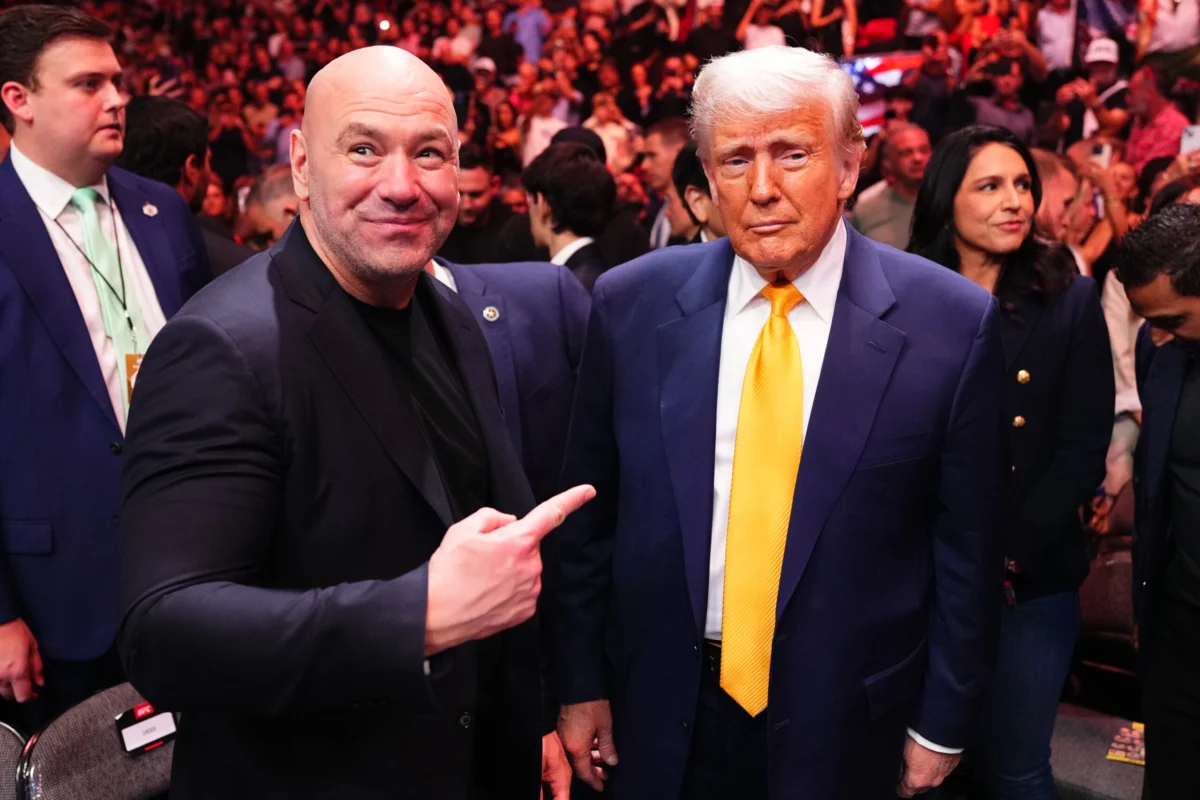
In a surprising and unorthodox development that blurs the lines between American politics, sports entertainment, and media culture, President Donald Trump has publicly offered the position of White House Press Secretary to Ultimate Fighting Championship (UFC) President and CEO Dana White. The announcement, made via Truth Social on a Saturday afternoon, follows a period of significant volatility and high turnover within the West Wing’s communications department, notably punctuated by the historic departure of Katie Zacharia after a tenure lasting merely five days.
The proposal has ignited widespread discussion across Washington and the sports world alike, raising questions about the future of White House press briefings, the administration’s media strategy, and the seriousness of the executive offer. As of publication, neither the White House nor representatives for the UFC have formally confirmed whether discussions between Trump and White are actively underway or if the offer will be accepted.
The Truth Social Announcement and the Proposed "Roster"
The announcement materialized on President Trump’s official Truth Social account, where the commander-in-chief utilized characteristic hyperbole and combat sports terminology to pitch the job to his longtime ally.
“I am pleased to announce that the Great Dana White, a violent Fighter and Warrior, has been offered the job of Press Secretary of the United States,” Trump wrote on the platform.
True to Trump’s penchant for showmanship, the offer extended beyond White himself. The president humorously—and perhaps symbolically—requested that the MMA executive bring along a formidable contingent of international combat sports legends to bolster the communications team. Trump explicitly named Islam Makhachev, Khabib Nurmagomedov, Justin Gaethje, Daniel Cormier, Amanda Nunes, and Kayla Harris as desirable additions to the administration’s defensive lineup.
“We need these people to defend us against the Lunatic Left,” Trump continued in his post. “Dana will be a Press Secretary like none other. Dana, please take the job!”
The inclusion of elite mixed martial arts fighters—some of whom hail from regions outside the United States, such as Dagestan and Brazil—underscores the blending of pop culture, sports iconography, and political theater that has frequently characterized Trump’s public persona and administrative appointments.
A Timeline of West Wing Communications Turmoil
The vacancy that prompted Trump’s unconventional recruitment drive stems from a period of unprecedented instability within the Office of the Press Secretary. The communications office has experienced multiple leadership shifts, creating a vacuum at the podium responsible for articulating the administration’s daily agenda to the American public.
The most recent disruption occurred in October, when Katie Zacharia was ousted from the role after serving for a mere five days. Zacharia’s brief tenure stands as the shortest in modern American history for a White House press secretary, eclipsing previous short-lived appointments and sending shockwaves through Washington’s political reporting circles.
Zacharia had assumed the position succeeding Karoline Leavitt, who managed the demanding communications portfolio from January 20, 2025, through August 27. Leavitt, who made history as the youngest person to ever hold the press secretary position at age 27, ultimately announced her departure in October to transition to the private sector as a contributor for the Fox News Channel. The rapid succession of spokespersons has left media analysts and political strategists scrutinizing the internal dynamics of the West Wing’s press operation.
Prior to the formal offer to Dana White, the administration’s search for a steady communications voice had already yielded unorthodox public casting ideas. Just a week prior to the Truth Social post, during an impromptu media interview, Trump was questioned about whether Grammy-winning recording artist and cultural figure Nikki Minaj might be considered for the role. Trump responded favorably to the suggestion, stating, “That’s a good idea. I think I’ll have to think about that… I’m going to think about that. How about you? You’d be pretty good, too.” While that exchange was widely interpreted as off-the-cuff banter, the subsequent formal offer to Dana White indicates that the administration is casting a remarkably wide net in its consideration of non-traditional candidates.
Background on Dana White and the Trump-UFC Alliance
To understand the gravity—and the inherent spectacle—of Trump’s offer to Dana White, one must examine the decades-long personal and professional relationship shared by the two men.
White, who has served as the president and chief executive officer of the UFC since 2001, played a monumental role in transforming mixed martial arts from a fringe sport widely criticized as “human cockfighting” into a multi-billion-dollar global entertainment empire. Under White’s leadership, the UFC secured lucrative media rights deals, expanded internationally, and integrated deeply into mainstream American culture.
Throughout his business career and political campaigns, Trump has maintained a close alliance with White. In the early 2000s, when other mainstream venues shunned the fledgling UFC due to political pressure and regulatory hurdles, Trump provided the Trump Taj Mahal in Atlantic City, New Jersey, as a venue for high-profile events. This early loyalty forged an enduring bond.
In the years that followed, White became one of Trump’s most vocal and prominent corporate surrogates. He made high-profile speaking appearances at the Republican National Convention, introduced Trump at numerous campaign rallies, and frequently defended the former president against media criticism. Their relationship exemplifies a convergence of sports promotion, entertainment, and conservative populist politics.
Industry Silence and Logistical Realities
As of early this week, the Ultimate Fighting Championship has maintained a strict silence regarding the president’s public overture. Representatives for the organization did not immediately respond to multiple requests for comment from major media outlets, including Variety.
Industry insiders and political analysts remain deeply skeptical about the logistical viability of the proposal. Dana White oversees a sprawling global sports enterprise with heavy operational commitments, international broadcasting schedules, and multi-million-dollar events slated across the globe. Transitioning from the helm of a combat sports promotion company to the grueling, 24/7 administrative demands of the White House press briefing room would represent a seismic career shift.
Furthermore, the White House Press Secretary role requires an intricate, day-to-day command of complex legislative policy, foreign affairs, macroeconomic data, and nuanced legal frameworks. While White is renowned for his blunt, unfiltered public speaking style and combative press conferences—skills that mirror aspects of Trump’s own communication strategy—the traditional responsibilities of the federal podium differ significantly from promoting pay-per-view martial arts events.
Broader Implications for Political Communications
The public solicitation of Dana White highlights a broader, ongoing evolution in how political administrations interact with the press and the American public. Over the past decade, traditional norms governing executive branch communications have steadily evolved, with social media platforms frequently superseding formal press briefings as the primary vehicle for presidential announcements.
By floating candidates ranging from pop superstars like Nikki Minaj to combat sports moguls like Dana White, the Trump administration continues to challenge conventional expectations of bureaucratic appointments. Whether the move is interpreted as a serious strategic effort to install a loyal, high-profile communicator or as a masterclass in media manipulation designed to dominate news cycles, the episode underscores the enduring power of celebrity and entertainment in modern American politics.
As the White House communications team works to stabilize following the departures of Karoline Leavitt and Katie Zacharia, the nation’s capital watches closely to see whether the office will be filled by a seasoned political operative or if the administration will lean further into its populist, anti-establishment playbook. For now, the podium remains vacant, leaving reporters, political scientists, and UFC fans alike to ponder the prospect of a White House briefing room moderated by the undisputed king of mixed martial arts promotion.