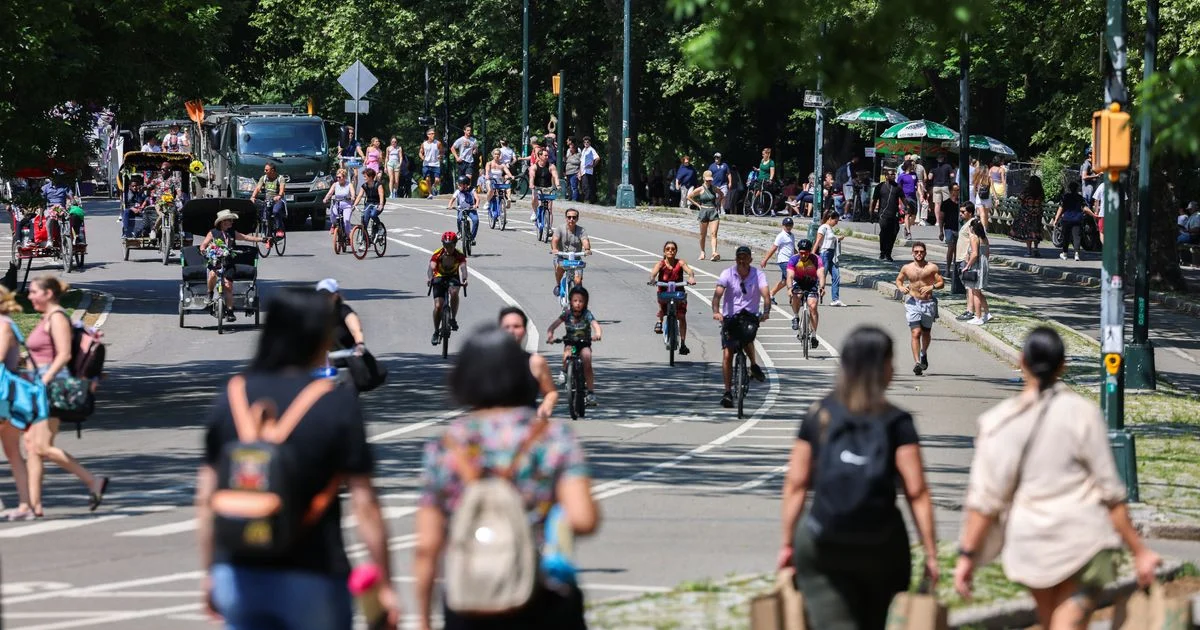
The six-mile roadway looping around the perimeter of Central Park has transformed from a peaceful nineteenth-century carriage path into a high-stakes, high-speed arterial channel where pedestrians, cyclists, e-bike couriers, and recreational users frequently collide. Originally engineered to accommodate leisurely horse-drawn carriages, Central Park Drive was later opened to commuter vehicles, temporarily freed from motorized traffic, and eventually claimed by a surging wave of micro-mobility devices. Today, the park’s asphalt loop acts as a microcosm of New York City’s broader post-pandemic transit crisis, highlighting the tension between rapid urban mobility and the preservation of public safety.
Recent tragedies on the Drive have intensified public scrutiny over roadway design, enforcement strategies, and the overall governance of public spaces. On September 23, Richie O’Brien, a steamfitter, was pushing his bicycle across East Drive at 84th Street when he was struck by another cyclist. He succumbed to his injuries four days later. Less than two weeks after that incident, a golden retriever bolted onto the roadway near the same location, causing a 71-year-old cyclist to brake violently, fly over the handlebars, and suffer fatal injuries. These fatal accidents follow a pattern of severe collisions, including the June 2025 death of Salvador Nico-Garcia, who was thrown from his e-bike after colliding with a pedestrian near 97th Street.
A Chronology of Conflict and Congestion
The evolution of Central Park Drive reflects shifting municipal priorities over more than a century. Conceived by landscape architects Frederick Law Olmsted and Calvert Vaux, the winding roads were designed to offer urban residents an immersive experience of pastoral serenity. For decades, private automobiles utilized the roadway during peak commuting hours, turning the park into an urban shortcut. Advocacy groups and park conservancies fought for decades to remove cars entirely, a goal finally realized when the park became permanently car-free under former Mayor Bill de Blasio.
However, the removal of automobiles did not restore tranquility. Instead, the vacuum was rapidly filled by a diverse, fast-moving array of alternative transit tools. Early mornings now see packs of road cyclists treating the 20-mph speed limit as a competitive training ground, weaving aggressively around slower riders and pedestrians. Simultaneously, delivery couriers operating throttled e-bikes and motorized scooters utilize the park’s straightaways and descents to maximize delivery efficiency. Families, tourists, joggers, and inline skaters occupy the same narrow bands of asphalt, creating a volatile mix of momentum and mass.
Regulatory Deadlocks and Inadequate Infrastructure
City agencies and the Central Park Conservancy have struggled to implement effective countermeasures. Following the release of a joint Safety and Circulation Study in 2024, the city deployed minor cosmetic adjustments, such as repainting crosswalks, laying down brighter lane markers, and stenciling caution alerts onto the pavement. More aggressive interventions, such as lowering the speed limit from 20 mph to 15 mph, have faced legal hurdles and stalled in local courts, leaving riders to maintain their previous velocity.
Enforcement efforts by the New York Police Department have similarly fallen short of community expectations. Critics note that police responses frequently rely on periodic ticket campaigns and verbal warnings rather than sustained structural deterrence. Meanwhile, proposals from park leadership—such as introducing bike lanes onto the narrow park transverses—face spatial limitations that threaten to compress already hazardous pathways further.
Comparative urban planning models suggest that systemic behavioral changes require physical infrastructure redesign rather than signage alone. Cities like London have successfully pacified speeding bicycle traffic in public parks by installing granite rumble strips, raised crosswalks, and meandering pathways that naturally disrupt momentum. Similarly, Amsterdam implemented targeted bans on heavy fat-tire bikes within high-density recreational zones like Vondelpark, yielding measurable drops in severe incidents.
The Broader Implications for Urban Mobility
The friction observed on Central Park Drive mirrors a citywide dilemma. Over the past two decades, New York’s Vision Zero initiative sought to reclaim public streets for pedestrians through wider sidewalks, protected bike lanes, and calmer traffic patterns. Yet, the explosive growth of app-based food delivery services has fundamentally altered street dynamics. Delivery workers, often operating under severe economic pressure and precarious employment conditions, frequently prioritize speed over safety, operating unlit vehicles on sidewalks and pedestrian paths.
Seniors and vulnerable populations bear the heaviest burden of this unregulated fluidity. According to municipal data, seniors accounted for less than 15 percent of New York City’s population in recent demographic assessments, yet they consistently represent nearly half of all pedestrian fatalities. The psychological toll is equally significant: as public thoroughfares grow increasingly hostile to the elderly, disabled, and young children, the foundational purpose of urban parks—to provide democratic, stress-free access to nature and community space—is undermined.
Urban planners and municipal officials face a critical juncture. Without a willingness to fundamentally alter the geometry of Central Park Drive—narrowing straightaways, introducing artificial curves, and placing strategic physical barriers to enforce slowness—the park risks becoming a casualty of its own accessibility. As advocates argue, public spaces cannot function effectively if users are too intimidated to occupy them.