As the 114th Congress returns to Washington following a transformative midterm election cycle, lawmakers are immediately confronting the staggering energy demands of the artificial intelligence boom. On Capitol Hill, the Senate is preparing for a pivotal procedural vote on comprehensive energy infrastructure legislation designed to streamline federal approvals for power projects while forcing hyperscale data center operators to internalize the true costs they impose on the regional electrical grids.
The bipartisan legislative package introduces critical regulatory oversight aimed at curbing the unchecked expansion of energy-intensive facilities. However, the bill has simultaneously triggered intense debate among lawmakers, with several legislators warning that certain provisions could inadvertently incentivize a new wave of data center construction. This looming legislative clash highlights the delicate balancing act facing federal policymakers as they attempt to reconcile aggressive technological innovation with the mounting infrastructure and economic strains felt by local communities nationwide.
The Political Awakening: Silicon Valley Meets a Changed Washington
The legislative urgency in Washington directly reflects the political shockwaves sent through the capital during last week’s midterm elections. Across the United States, voters did not merely elect a new class of federal and state officials; they delivered an unmistakable message to Big Tech and the artificial intelligence sector: the rapid, unchecked proliferation of warehouse-scale data centers has reached its limit.
Over the past two years, Silicon Valley has operated with unprecedented speed, prioritizing rapid deployment above all else. When major technology conglomerates sought to establish massive computing facilities, local governments frequently competed to offer lucrative tax exemptions, zoning variances, and utility subsidies, often assuring constituents that the developments would be environmentally benign and economically transformative.
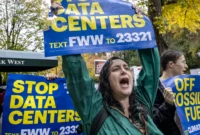
Today, that narrative is facing widespread public skepticism. Voters across dozens of states are pushing back against local zoning boards, demanding moratoriums, stricter environmental reviews, and permanent bans on new data center developments. The primary grievances focus on skyrocketing electricity rates, massive water consumption required for server cooling, and the visual and acoustic disruption of industrial-scale facilities placed near residential zones.
Consequently, newly elected Democrats find themselves navigating a complex political dilemma. Many campaigned heavily on promises to restrict data center proliferation in response to constituents anxious about utility bills and strained municipal resources. Now, these same lawmakers must evaluate federal legislation that attempts to reform the permitting process—a measure that some analysts and politicians fear could ultimately facilitate more construction rather than curtail it. If the bill passes and data center development accelerates, incoming members of Congress will be forced to defend an apparent about-face on campaign commitments.
The Anatomy of a Crisis: Grid Strain and Consumer Costs
To understand the friction between Capitol Hill and Silicon Valley, policymakers must look beyond the abstract concept of cloud computing and examine the physical realities of modern artificial intelligence. Every query processed by a large language model, every automated image generated, and every data-intensive computational task relies on rows of high-performance microprocessors housed within physical facilities that span hundreds of thousands of square feet.
These facilities demand an extraordinary, continuous supply of electricity. According to recent energy market analyses, a single hyperscale data center can consume as much electricity as a mid-sized American city. This unprecedented demand has severely strained regional transmission organizations (RTOs) and independent system operators (ISOs), forcing utilities to delay the retirement of fossil-fuel plants, restart dormant nuclear reactors, or construct new transmission lines at great expense.
The financial burden of these grid upgrades is increasingly falling on everyday ratepayers. As utility companies invest billions of dollars in infrastructure to support commercial tech expansion, residential and small business electricity bills have risen noticeably. This direct impact on household budgets has transformed artificial intelligence from a niche technological debate into a deeply personal economic grievance.
Proponents of local resistance argue that communities should not subsidize the infrastructure of multi-trillion-dollar corporations while local residents face escalating utility costs, inflation, and housing pressures. Conversely, industry advocates contend that data centers can serve as economic catalysts if structured correctly, providing substantial tax revenues that can fund local public schools, road repairs, and municipal services, while creating permanent, high-paying technical jobs.
Chronology of the AI Infrastructure Conflict
The current legislative showdown is the culmination of a multi-year trajectory characterized by rapid technological scaling, regulatory lag, and escalating public pushback:
- Late 2022 to 2023: The widespread public release of generative artificial intelligence triggers an unprecedented gold rush. Tech giants race to secure real estate, water rights, and power purchase agreements to fuel massive computing clusters.
- Throughout 2024: Local opposition begins to materialize nationwide. Communities in states such as Virginia, Ohio, Georgia, and Oregon organize grassroots movements against proposed data centers, citing grid reliability and environmental concerns. Internationally, regulatory bodies like the European Union implement strict compliance frameworks, prompting companies like Apple to delay feature rollouts due to regulatory uncertainty.
- November 2025: The U.S. midterm elections serve as a referendum on technology policy. Candidates across multiple jurisdictions successfully campaign on anti-data-center platforms, shifting the political calculus in Washington.
- Present (November 2026): Congress returns to session. The Senate prepares for a decisive procedural vote on bipartisan permitting reform legislation designed to simultaneously accelerate energy project approvals and impose stricter cost-sharing mandates on large-scale tech operators.
Economic Trade-Offs and the Risk of Innovation Bottlenecks
As Congress weighs its regulatory options, economic analysts warn of significant unintended consequences. Overly restrictive policies or punitive taxation could prompt technology companies to slow down infrastructure investment, resulting in a domestic bottleneck for computing capacity.
Industry stakeholders suggest that if regulatory hurdles become insurmountable, artificial intelligence deployment could decelerate, potentially delaying advancements in healthcare diagnostics, logistical optimization, and scientific research. Furthermore, tech firms may pass compliance costs directly to consumers through subscription fees for advanced features, altering the accessibility of consumer-facing AI tools.
Global precedents offer a cautionary tale. When the European Union enacted stringent digital market regulations in 2024, several major American technology firms withheld advanced software updates and artificial intelligence features from European consumers, citing legal ambiguity. This created a technological disparity between regions and demonstrated that regulatory friction can directly impact end-users.
Conclusion: Striking a Sustainable Balance
The legislative battle currently unfolding in the Senate represents a critical juncture for American technology policy. Lawmakers are tasked with establishing a framework that protects residential ratepayers, preserves grid reliability, and addresses local environmental concerns without stifling the economic and innovative potential of the artificial intelligence sector.
Achieving this balance will require rigorous oversight, transparent cost-allocation models, and a commitment from technology companies to invest meaningfully in the communities that host their infrastructure. Whether the incoming Congress can successfully navigate these competing pressures will shape the trajectory of American technological leadership and energy security for decades to come.