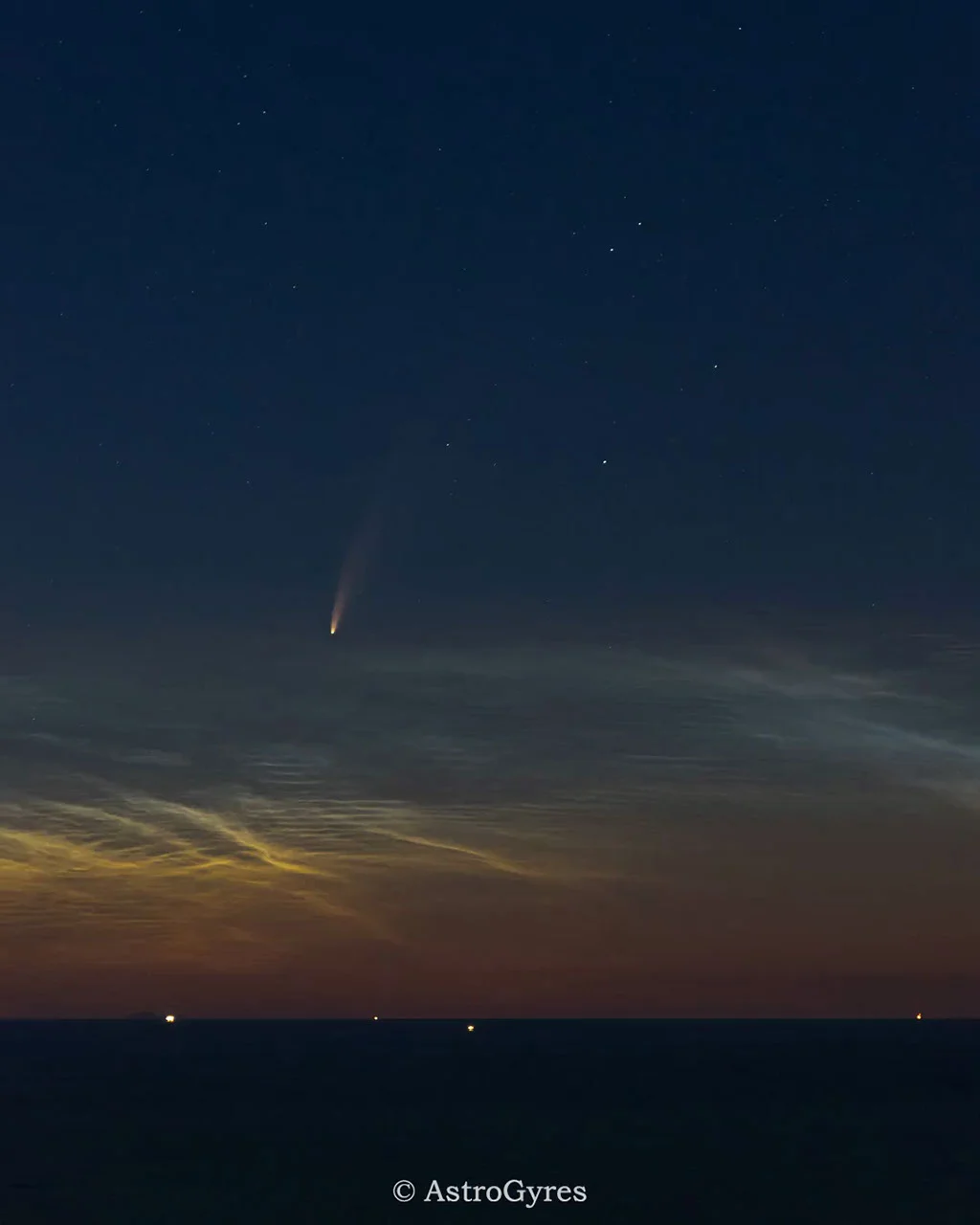
The celestial event that defined the summer of 2020 remains a landmark moment in modern amateur astronomy, serving as a rare opportunity for the general public to witness a Great Comet with the unaided eye. On July 8, 2020, photographer Paolo Girotti captured a stunning time-lapse sequence from the Italian coast, documenting Comet C/2020 F3 (NEOWISE) as it ascended above the Adriatic Sea. This footage, which synthesized over 240 individual exposures taken across a 30-minute window, has since become a definitive record of the comet’s passage through the inner solar system, highlighting its unique interaction with Earth’s upper atmosphere.
The Discovery and Characteristics of C/2020 F3
Comet NEOWISE was first detected on March 27, 2020, by NASA’s Near-Earth Object Wide-field Infrared Survey Explorer (NEOWISE) space telescope. At the time of its discovery, the object was approximately 170 million miles from the Sun. As it traveled closer to the solar center, it defied early expectations that it might disintegrate under the intense thermal radiation of the Sun. Instead, the comet maintained its structural integrity, largely due to its substantial nucleus, which measures approximately five kilometers in diameter.
The comet reached its perihelion—the point in its orbit closest to the Sun—on July 3, 2020. During this phase, the object survived temperatures that would typically vaporize smaller, less dense icy bodies. This resilience allowed it to develop two distinct tails: a faint, blue-tinted ion tail composed of ionized gases pushed away by the solar wind, and a broader, white-yellow dust tail reflecting sunlight. These features became prominently visible to observers across the Northern Hemisphere throughout July 2020, marking it as the brightest comet visible from Earth since the arrival of Comet Hale-Bopp in 1997.
Chronology of the 2020 Observation
The observational window for NEOWISE was defined by its rapid transition from a morning object to an evening object. For the first two weeks of July, it was best viewed in the pre-dawn hours, low on the northeastern horizon. Paolo Girotti’s time-lapse, recorded on the morning of July 8, captures this specific period.
The sequence shows the comet emerging through a foreground of noctilucent clouds—rare, high-altitude clouds that form in the mesosphere and become visible only when illuminated by sunlight from below the horizon. The juxtaposition of the glowing, undulating clouds against the stark, icy brilliance of the comet created a visual composition that drew significant interest from the international scientific and astronomical community. By mid-July, the comet shifted to the evening sky, becoming accessible to a wider audience, including urban residents who were able to spot it with minimal light pollution. By the end of July, the comet began its long-term departure from the inner solar system, gradually fading from naked-eye visibility as it headed toward the outer reaches of the Kuiper Belt.
Scientific Significance and Data Analysis
From an astrophysical perspective, Comet NEOWISE provided a wealth of data regarding the composition of long-period comets. Spectroscopic analysis conducted during its flyby revealed high concentrations of silicate dust and various volatile compounds. The comet’s trajectory indicated an orbital period of approximately 6,700 to 6,800 years, meaning the last time it visited the inner solar system was likely during the Neolithic era.
NASA researchers utilized the data gathered during the comet’s passage to refine models regarding cometary outgassing and the survival rates of ice-rich bodies near the Sun. The persistent brightness of NEOWISE allowed ground-based observatories to track its tail dynamics in unprecedented detail. These observations confirmed that the dust tail was a result of the Sun’s radiation pressure pushing debris away from the nucleus, while the ion tail was sculpted by the solar magnetic field. The survival of the five-kilometer nucleus was particularly instructive for planetary scientists studying the potential threat posed by Near-Earth Objects (NEOs).
Public Engagement and Cultural Impact
The visibility of Comet NEOWISE served as a major catalyst for public engagement in science. Because the comet was visible without the aid of telescopes or binoculars, it democratized the astronomical experience. Social media platforms were flooded with images and videos from amateur photographers, leading to a surge in interest regarding the NASA NEOWISE mission and the broader Space Activation programs.
The educational impact was bolstered by the Astronomy Picture of the Day (APOD) initiative, which provided daily explanations and historical context for the images captured by the public. By hosting these visuals alongside professional analyses by astronomers like Robert Nemiroff and Jerry Bonnell, the project bridged the gap between raw data collection and public scientific literacy. The movement of the APOD platform to the official science.nasa.gov domain reflects a broader institutional shift toward integrating citizen science and public outreach into core NASA communications.
Institutional Shifts and Future Outlook
As of September 2026, the legacy of Comet NEOWISE continues to inform the way space agencies present celestial phenomena. The transition of the APOD archives to the Science Activation portal is part of a larger initiative to centralize data and educational resources. This ensures that historical records—such as the Girotti footage of the Adriatic sunrise—remain accessible for future researchers and students.
The implications of the 2020 event are also shaping current planning for future comet interceptions. NASA’s focus on the Planetary Defense Coordination Office and the continued operation of the NEOWISE survey telescope (and its successors) underscores the importance of early detection systems. Understanding how a body like NEOWISE behaves as it approaches the Sun is critical for characterizing the risks associated with larger, potentially hazardous objects.
While Comet NEOWISE has long since left the vicinity of the inner solar system, its impact remains a subject of study. The combination of high-resolution digital imaging and widespread, real-time reporting allowed for a collaborative observational effort that is rarely matched. It demonstrated that even in an age of automated, robotic exploration, the human element of observation—the "delight of sky enthusiasts," as noted in contemporary reports—remains a vital component of the scientific process.
Looking forward, the scientific community continues to analyze the archival data from the 2020 flyby to improve the accuracy of orbital mechanics models. Every new image and video identified in the archives serves as a data point in the long-term history of the solar system. For astronomers and the public alike, the memory of NEOWISE rising over the Adriatic serves as a poignant reminder of the dynamism of our solar neighborhood and the importance of maintaining an active, global watch on the skies. As the mission to catalog these cosmic visitors evolves, the focus remains clear: to discover the cosmos, document the fleeting, and educate the next generation of observers.