The American housing market is currently undergoing a significant structural shift as homeowners increasingly prioritize property improvements over traditional relocation. According to a comprehensive study commissioned by Redfin and conducted by Ipsos in late 2025, the "stay put and improve" trend has become a dominant force in the real estate landscape. The survey, which polled 4,000 U.S. residents, reveals that more than two in five Americans (43%) have renovated their current residences within the last year, while another 33% are actively planning upgrades for the coming twelve months. This movement is not merely a hobbyist trend but a calculated response to a challenging macroeconomic environment characterized by high borrowing costs and a persistent shortage of available housing stock.
For a substantial majority of these homeowners, the decision to renovate is a direct alternative to entering the competitive and expensive home-buying market. The data indicates that 65% of those who recently completed renovations did so specifically to avoid moving. Looking ahead, this sentiment is even more pronounced among those planning future projects, with 71% of prospective renovators stating they intend to remodel rather than seek a new property. This shift suggests that the traditional "ladder" of real estate—where families move every few years to accommodate changing needs—is being replaced by a model of long-term stability and incremental investment in existing assets.
The Economic Drivers of the Renovation Boom
The primary catalyst for this trend is the "lock-in effect" created by the disparity between historical and current mortgage rates. A recent Redfin analysis highlights a stark reality: approximately 80% of current homeowners with a mortgage are tethered to interest rates well below the prevailing market levels. For these individuals, moving would not only mean purchasing a more expensive home but also abandoning a low-cost loan for one that could significantly increase their monthly debt service.
Beyond interest rates, the inventory of "move-in ready" homes remains historically low. While overall housing inventory has seen slight year-over-year increases in some regions, there remains a critical shortage of desirable, spacious homes suitable for growing families. The lack of supply has kept home prices elevated, making the financial hurdle of moving nearly insurmountable for many middle-class households. Consequently, the "fixer-upper" that a family already owns has become their most viable path to a more comfortable living situation.
Demographic Trends and Generational Shifts
The renovation trend is most visible among younger homeowners, specifically Gen Z and Millennials. The survey found that 77% of homeowners in these age groups opted for improvements over moving in the past year. This demographic is often at a stage in life where their families are expanding or their professional needs—such as the requirement for a dedicated home office—are evolving. Unlike older generations who may have more accumulated wealth to navigate a high-interest market, younger owners are utilizing renovations as a strategic tool to build equity while staying within their current financial means.
Families with children living at home are also significantly more likely to choose renovation over relocation. This is often driven by social and community factors. Staying in a current home allows families to maintain consistency in school districts and preserve established social networks. Chen Zhao, Redfin’s head of economics research, notes that these homeowners are "planting deeper roots." By reconfiguring existing spaces or adding square footage, they can adapt their homes to their children’s needs without the disruptive process of moving to a different neighborhood.
A Detailed Breakdown of Renovation Spending
While the term "renovation" can evoke images of massive structural overhauls, the majority of American homeowners are focusing on high-impact, mid-range projects. The Redfin-Ipsos data shows that most renovators are mindful of their budgets, seeking to maximize value without overextending their finances.
The spending patterns for recent renovations were distributed as follows:
- $10,000 to $20,000: This was the most common spending bracket, accounting for 23% of all projects.
- $1,000 to $5,000: Roughly 21% of renovators focused on smaller, cosmetic updates.
- $5,000 to $10,000: This mid-low tier was chosen by 20% of respondents.
- $20,000 to $50,000: A sizable 16% of homeowners invested in more significant upgrades, likely involving structural changes or high-end kitchen and bath remodels.
These figures suggest that the current wave of renovation is characterized by practicality. Homeowners are focusing on "meaningful improvements" that address specific functional deficiencies in their homes rather than indulging in luxury "gut-renovations" that may not provide a full return on investment in a stagnant market.
Popular Projects: From Aesthetics to Climate Resiliency
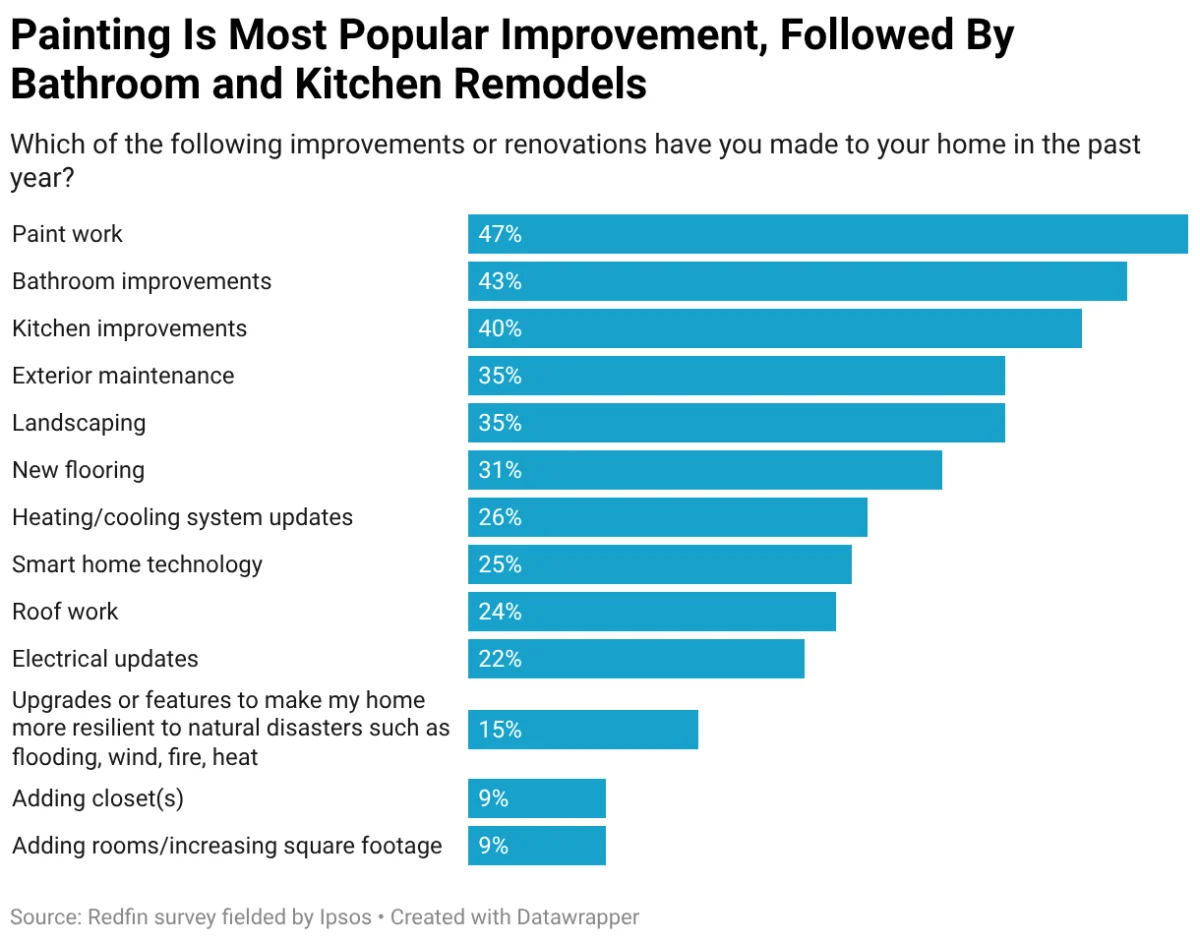
When it comes to the specific types of work being performed, aesthetic refreshes and essential room updates lead the way. Painting remains the most popular upgrade, with 47% of recent renovators applying a fresh coat to their interiors or exteriors. This is followed closely by bathroom improvements (43%) and kitchen upgrades (40%). These two areas are traditionally known to offer the highest return on investment and the most significant impact on daily quality of life.
External maintenance and landscaping also saw high engagement, with 35% of renovators focusing on curb appeal and outdoor functionality. However, a newer and increasingly important category of renovation is emerging: climate resiliency. Approximately 15% of homeowners reported adding features designed to protect their property from natural disasters, including flood defenses, wind-resistant roofing, and heat-mitigation technologies. As insurance premiums rise in response to climate risks, these types of upgrades are transitioning from optional luxuries to essential protective measures for home value.
Financing the Future: Equity and Investment
As homeowners decide to stay put, the question of how to fund these projects becomes central. One increasingly common method is the cash-out refinance, a financial product that allows owners to tap into the equity built up during the rapid home price appreciation of the early 2020s. By replacing their current mortgage with a larger loan, homeowners can receive the difference in cash to fund their upgrades.
However, real estate experts caution that while renovations improve livability, they should also be viewed through the lens of future marketability. Jo Chavez, a Redfin Premier agent based in Kansas City, MO, emphasizes that investing in a home’s appearance and functionality is a long-term play. "Updated homes tend to sell faster than fixer-uppers, and for more money," Chavez stated. Even in a market where homeowners plan to stay for five to ten years, making strategic choices now can prevent a home from becoming obsolete or "dated" when the market eventually shifts and relocation becomes more feasible.
Broader Implications for the U.S. Economy
The shift toward renovation has ripple effects across several sectors of the U.S. economy. The home improvement retail sector, including giants like Home Depot and Lowe’s, stands to benefit from the sustained demand for materials. Similarly, the labor market for skilled trades—plumbers, electricians, and carpenters—remains tight as the volume of residential work offsets any cooling in the new-construction sector.
From a housing policy perspective, this trend highlights the "clogged" nature of the current market. When homeowners do not move, the supply of "starter homes" for first-time buyers remains restricted. This creates a cycle where the only way for new buyers to enter the market is to purchase properties that require significant work, which they may not be able to afford after a down payment.
Conclusion and Future Outlook
The data from late 2025 suggests that the American "renovation nation" is here to stay for the foreseeable future. As long as mortgage rates remain significantly higher than the sub-4% rates of the past decade, the financial incentive to move will remain low for the vast majority of the population.
The renovation boom represents a maturation of the housing market. Instead of viewing homes as transient assets to be traded every few years, Americans are returning to a model of stewardship. By investing in climate resiliency, modernizing outdated spaces, and adapting layouts for multi-generational living, homeowners are ensuring that their current properties remain functional and valuable for the long haul. While this "stay put" mentality presents challenges for real estate inventory, it is fostering a new era of localized investment and community stability across the United States.
Methodology Note:
The survey results referenced in this report are derived from a study commissioned by Redfin and conducted by Ipsos in November 2025. The survey reached 4,000 U.S. residents and utilized a credibility interval of +/- 1.9 percentage points. The data reflects self-reported homeowner activities and intentions regarding property improvements and relocation preferences in the context of the 2025-2026 economic climate.