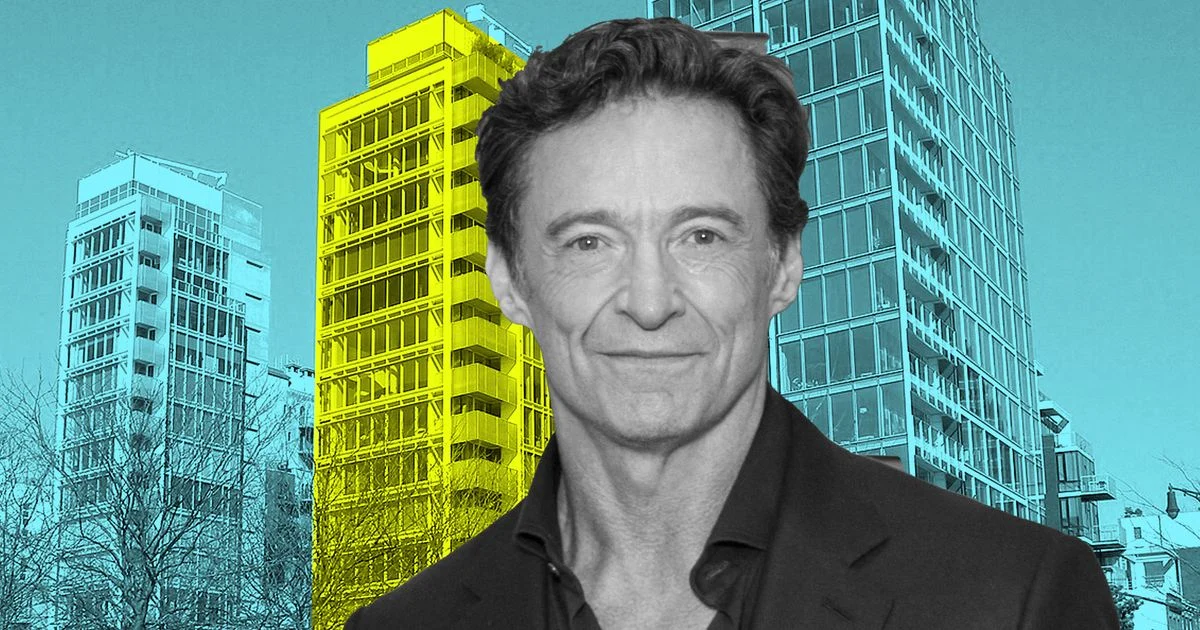
After lingering on the Manhattan luxury real estate market for four tumultuous years, award-winning actor Hugh Jackman has successfully found a buyer for his signature glass-and-steel triplex in New York City’s affluent West Village. According to data from the Olshan Report, the sprawling property—situated within the iconic, Richard Meier–designed towers at 173–176 Perry Street—has officially entered into contract. The transaction marks a definitive chapter’s end for the actor, whose personal and professional life has undergone significant structural shifts since the residence was first introduced to prospective buyers.
The journey to this eventual sale has been long, marked by shifting market dynamics, aggressive price reductions, a brief stint as an ultra-luxury rental, and a high-profile divorce. For real estate observers tracking the volatility of Manhattan’s high-end condo market, the transaction offers a fascinating case study in how celebrity-owned properties must eventually bend to the realities of supply, demand, and valuation when a swift exit becomes a priority.
Main Facts of the Transaction
While final sales figures are pending public registry completion following the closing of the contract, the home’s trajectory underscores the heavy leverage currently held by qualified buyers in the upper echelons of the New York housing market. The 11,000-square-foot architectural marvel occupies the eighth, ninth, and tenth floors of the West Side waterfront complex.
The residence boasts sweeping, unobstructed views of the Hudson River through double-height glass curtain walls, a sculptural staircase designed by Richard Meier, five bedrooms, and an array of luxury amenities. The entire tenth floor is dedicated to a primary suite featuring multiple dressing areas, an exercise spa, a dedicated bath, and a private sauna. Additional perks of the building include standard fitness facilities and white-glove dining service directly from the renowned Jean-Georges restaurant, Perry St, located on the premises.
Despite these high-end attributes, the property struggled to secure a buyer at its initial price point. The ultimate agreement signals that the listing brokerage, Corcoran—led by veteran broker Deborah Grubman—successfully bridged the gap between lingering seller aspirations and the more conservative valuations demanded by current ultra-high-net-worth purchasers.
A Timeline of the Listing and Personal Upheavals
The prolonged marketing period of the Perry Street triplex closely mirrors a transformative era in Jackman’s personal life. The timeline of the listing, separation, and subsequent restructuring of assets highlights the intersection of celebrity real estate and major life events:
- 2008: Hugh Jackman and his then-wife, Deborra-Lee Furness, purchase the Perry Street triplex for $21 million, establishing it as one of their primary residential anchors in New York City.
- June 2022: Following years of enjoying the space, the couple lists the 11,000-square-foot triplex for an ambitious $39 million, setting a high watermark for the building’s valuation.
- Late 2022 to Mid-2023: As the property sits on the market without a serious buyer, the listing price is incrementally reduced.
- September 2023: Jackman and Furness publicly announce their separation after nearly three decades of marriage. Around this same period, the former couple pivots strategies, pulling the home from the sales market and listing it as a luxury rental asking $125,000 per month.
- March 2024: The property returns to the sales market under the representation of Corcoran’s Deborah Grubman. The asking price is aggressively slashed to $29 million, signaling an urgent desire by the co-owners to divest from the shared asset.
- 2025: Deborra-Lee Furness files for divorce. Days later, she reportedly buys Jackman out of another shared Manhattan property—a penthouse located at 100 11th Avenue—utilizing an LLC named Phoenix Rising I. Legal ownership of the couple’s Hamptons beach house is similarly consolidated under an entity titled Phoenix Rising II.
- Late 2026: Four years after its initial debut, the Perry Street triplex officially secures a buyer, entering into contract.
Supporting Data and Architectural Pedigree
The Perry Street towers hold an important place in modern Manhattan architectural history. Designed by Richard Meier—the celebrated modernist starchitect behind the Getty Center in Los Angeles—the twin glass structures helped ignite a massive wave of high-end residential development along the West Side waterfront in the early 2000s. The buildings redefined luxury living by introducing minimalist, light-drenched glass boxes that maximized river views and prioritized transparency over traditional brick-and-mortar masonry.
However, the buildings’ association with their creator has experienced complicated public perception. In 2018, Meier stepped down from his firm following allegations of sexual harassment made by multiple former employees. Despite the architectural patriarch falling from institutional favor, the buildings at 173–176 Perry Street continue to be marketed and colloquially referred to on real estate platforms like StreetEasy as the "Meier Towers," a testament to the enduring consumer appeal of the design philosophy itself.

From a spatial perspective, the Jackman-Furness triplex represents a rare amalgamation of scale in a city where sprawling single-family footprints are fiercely guarded. Spanning three full floors, the residence successfully separates entertaining zones from private quarters. The ninth floor serves as the central hub, anchored by a double-height living room featuring dramatic floor-to-ceiling windows framing the Hudson River. The eighth floor traditionally functioned as guest or children’s quarters, housing four auxiliary bedrooms. The tenth floor provided an exclusive sanctuary for the primary inhabitants, complete with customized wellness and spa facilities.
Financial Implications and Divorce Asset Restructuring
The sale of the Perry Street triplex is the final major real estate domino to fall in the dismantling of the joint property portfolio accumulated by Jackman and Furness during their 27-year marriage. High-net-worth divorces frequently necessitate the strategic liquidation or buyout of trophy assets, a process that can occasionally put downward pressure on pricing if market conditions are unfavorable.
When the property was first listed at $39 million in 2022, the Manhattan luxury market was still riding a post-pandemic rebound characterized by robust buyer demand and historically low interest rates. By the time the price was cut to $29 million in early 2024, macroeconomic conditions had shifted dramatically. Elevated interest rates, tighter credit markets for jumbo loans, and an oversupply of ultra-luxury inventory had collectively shifted power away from sellers.
By opting to drop the price by $10 million from its peak ask—and previously attempting to generate rental income at $125,000 monthly—the former couple demonstrated a pragmatic approach to asset management. Serving as co-landlords or holding onto a stagnant, high-carrying-cost property alongside an estranged spouse is rarely tenable, making a finalized contract at a market-clearing price a welcome relief, even if the final transaction value falls significantly short of the original 2022 ambition.
Broader Impact on the Manhattan Luxury Market
The eventual contract signing of the Perry Street triplex offers valuable insights into the current state of downtown Manhattan’s high-end condominium sector. Trophy properties—defined as those asking upwards of $20 million—are increasingly subject to extended days on market unless they are priced precisely in alignment with contemporary buyer expectations.
While architectural pedigree and celebrity provenance can initially generate headlines and foot traffic through open houses, they ultimately cannot override fundamental valuation metrics. Buyers in the multi-million-dollar tier are sophisticated, highly selective, and acutely aware of carrying costs, such as monthly common charges and real estate taxes, which can easily run into the thousands of dollars for properties of this scale.
Furthermore, the transaction highlights the enduring appeal of the West Village waterfront. Despite shifting luxury hot spots in neighborhoods like Tribeca and Billionaires’ Row, the West Side highway corridor pioneered by Meier’s glass towers remains a coveted address for figures in entertainment, finance, and technology seeking privacy, security, and unobstructed water views.
As Jackman transitions into his next chapter—having spent recent months deeply engaged in theatrical productions in New York City, including back-to-back runs at the Minetta Lane Theatre—the successful clearance of his former marital home removes a significant lingering financial tie. For the undisclosed buyer, the acquisition secures a monumental piece of Manhattan residential architecture at a historically corrected price point, closing out one of the most closely watched celebrity real estate sagas of the decade.