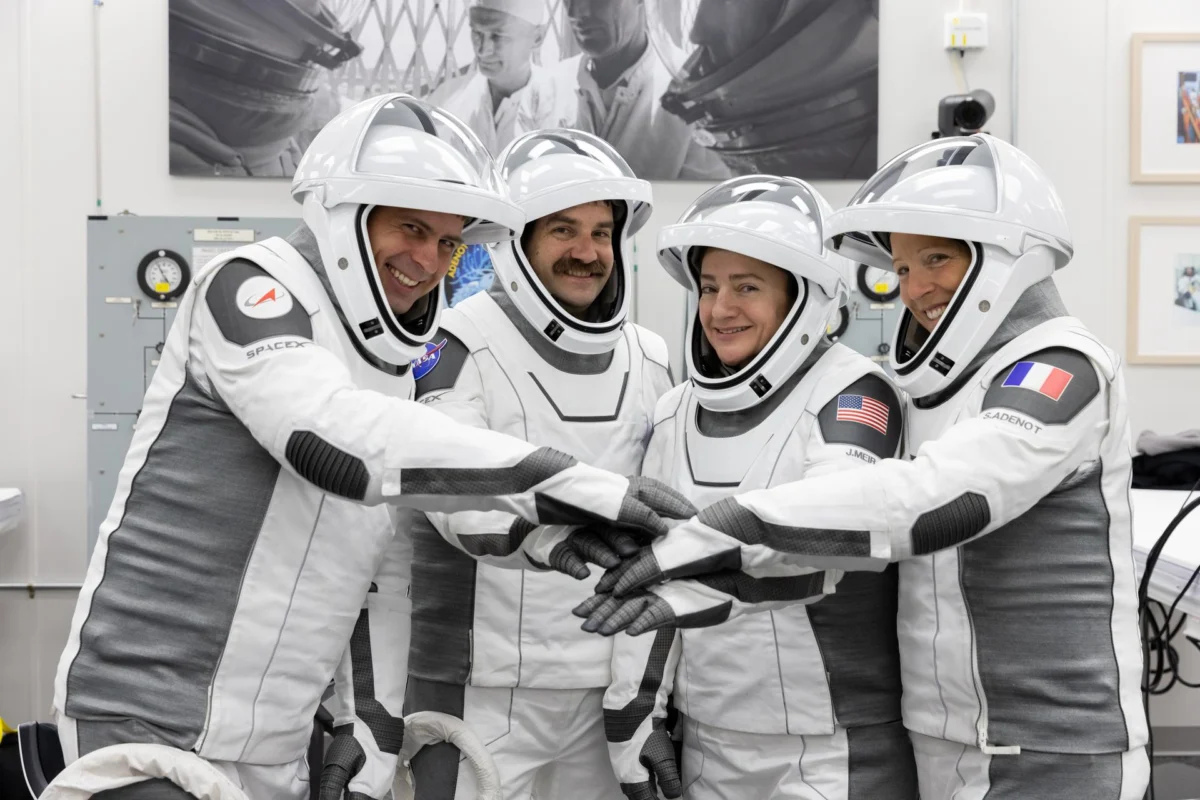
The International Space Station remains the preeminent laboratory for scientific advancement in low Earth orbit, and as the SpaceX Crew-12 mission nears its conclusion, the orbiting crew is preparing to share insights from their tenure in space. NASA has invited global media to participate in a news conference on Wednesday, September 16, at 2:45 p.m. EDT. This briefing will feature NASA astronauts Jessica Meir and Jack Hathaway, ESA (European Space Agency) astronaut Sophie Adenot, and Roscosmos cosmonaut Andrey Fedyaev, who will provide a firsthand account of their mission objectives, the complexities of life in microgravity, and their preparations for a safe return to Earth.
Media Participation and Briefing Details
The upcoming news conference serves as a critical bridge between the mission’s operational phase and its conclusion. Media organizations intending to cover the event must coordinate directly with the newsroom at NASA’s Johnson Space Center in Houston. Accreditation and participation requests must be finalized no later than 5:00 p.m. on Tuesday, September 15. Interested parties may reach out via telephone at 281-483-5111 or via email at [email protected].
For those approved to participate, strict adherence to the briefing protocol is required. Participants must dial into the news conference line at least 10 minutes prior to the scheduled start time to ensure connectivity. The event will be broadcast live for the public at https://www.nasa.gov/live, allowing a global audience to witness the reflections of these spacefarers as they conclude their rotation aboard the orbital outpost. All media representatives are encouraged to review the official NASA agency-wide media accreditation policy to ensure compliance with federal reporting standards.
Mission Chronology and Scientific Contributions
The Crew-12 mission has been characterized by a high volume of scientific output. Upon joining the Expedition 74/75 crew members, the team integrated seamlessly into the station’s ongoing research cycle. Their work has been pivotal in advancing the agency’s goals for deep-space exploration, specifically by targeting physiological and technological hurdles that must be overcome before human crews can venture beyond the Moon and toward Mars.
Throughout their stay, the crew conducted hundreds of experiments, many of which have immediate applications for both space travelers and patients on Earth. Notable among these investigations is a study focused on pneumonia-causing bacteria. By analyzing how these microorganisms behave in microgravity, researchers aim to develop more effective cardiovascular treatments and antibiotics that could revolutionize modern medicine.
Furthermore, the crew has been deeply involved in the development of on-demand intravenous fluid generation. For future long-duration missions—such as those planned under the Artemis program—the ability to produce medical-grade fluids locally, rather than relying on heavy, finite supplies from Earth, is a prerequisite for survival. The team also conducted extensive research into the fluid dynamics of the human body, specifically analyzing how physical characteristics influence blood flow during prolonged exposure to spaceflight. These data points are essential for mitigating the risks of circulatory issues during multi-year deep-space transit.
The Transition: Crew-13 and Splashdown Logistics
The departure of Crew-12 is not merely a logistical end-point but the final stage of a carefully choreographed handover. The transition will commence following the arrival of the SpaceX Crew-13 mission. This overlap period is critical for maintaining operational continuity, allowing the incoming crew to be fully briefed on the specific nuances of the station’s current configuration, ongoing experiments, and maintenance requirements.
Once the handover is complete, the Crew-12 team will prepare their spacecraft for undocking. Mission control at Johnson Space Center will work in tandem with meteorologists to monitor the atmospheric conditions at potential splashdown sites off the coast of California. A departure date will be finalized only after a rigorous review of weather patterns, including wave height, wind speed, and visibility, to ensure a safe and stable return to the Pacific Ocean.
The Legacy of the International Space Station
For more than 25 years, the International Space Station has served as a permanent human presence in space, fundamentally altering the trajectory of global scientific research. It represents an unprecedented collaboration between international space agencies and private commercial partners. The facility has provided a unique environment where the laws of physics can be tested in ways impossible within the constraints of Earth’s gravity.
The station’s impact is threefold: it acts as a testbed for the technologies required for human exploration of the Moon and Mars; it facilitates the expansion of a robust commercial space economy in low Earth orbit; and it serves as a beacon of international cooperation. The research conducted by Crew-12 is the latest chapter in this ongoing saga, building upon decades of accumulated knowledge that has yielded breakthroughs in material science, biology, and human health.
Strategic Implications for Human Exploration
The implications of the Crew-12 mission extend far beyond the station’s hull. As NASA shifts its focus toward the Artemis program, the data gathered by astronauts Meir, Hathaway, Adenot, and Fedyaev will inform the design of future lunar habitats and transport vehicles. Understanding how the human body adapts to long-term exposure to space is the primary barrier to the next era of discovery.
The success of commercial partners like SpaceX in providing reliable transport to the station has also been a defining feature of this era. By outsourcing routine crew rotation to the private sector, NASA has been able to focus its internal resources on the high-level engineering challenges of deep-space navigation and lunar surface operations. The professional integration of European and Russian partners alongside American astronauts underscores the station’s role as a diplomatic and scientific hub.
Future Outlook and Research Trajectory
As the mission draws to a close, the scientific community is already looking toward the next set of objectives. The ongoing study of human adaptation remains the highest priority. Research into blood flow and intravenous fluid synthesis, in particular, will continue to be refined by subsequent crews as they test new hardware and diagnostic tools designed for the harsh realities of interplanetary travel.
The International Space Station’s continued operation is a testament to the durability of international alliances and the ingenuity of mission planners. The upcoming press conference provides a vital opportunity to gain insight into the human element of these technological feats. As these four astronauts prepare to return to their families and the gravity of Earth, they bring with them a wealth of information that will undoubtedly shape the future of human space exploration for generations to come.
For those seeking to delve deeper into the specific investigations conducted by Crew-12, or to learn more about the ongoing status of the International Space Station, NASA provides a comprehensive repository of mission data, research papers, and crew updates. Readers and media professionals are invited to visit the official portal at https://www.nasa.gov/station for a complete overview of the facility’s current mission parameters and its role as a foundation for humanity’s future in the cosmos.
The conclusion of this mission serves as a reminder of the inherent risks and profound rewards of space exploration. As the world watches the splashdown of Crew-12, the focus remains on the synthesis of international expertise and the relentless pursuit of knowledge. The legacy of the space station continues to grow, and with each returning crew, humanity moves one step closer to making the stars a destination rather than a mystery.