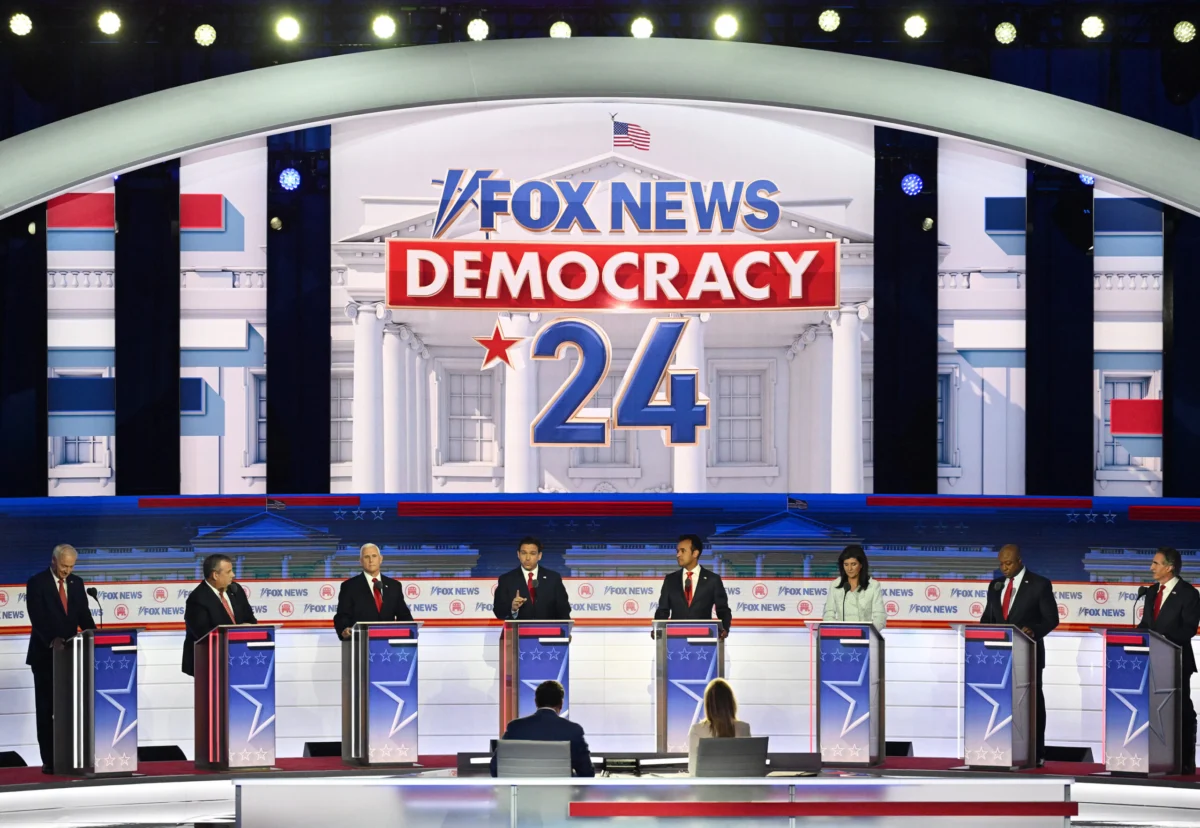
The second Republican presidential primary debate, scheduled for September 27 at the Ronald Reagan Presidential Library in Simi Valley, California, is fast approaching, intensifying the race against the clock for GOP hopefuls to meet the Republican National Committee’s (RNC) increasingly stringent qualification criteria. As the September 25 deadline looms, the political landscape suggests a notably smaller lineup compared to the eight candidates who participated in the initial August debate in Milwaukee. This evolving dynamic underscores the RNC’s strategic intent to winnow the field and elevate serious contenders, while also highlighting the enduring, almost gravitational, pull of former President Donald Trump, whose likely absence continues to reshape the primary contest.
RNC’s Elevated Hurdles: A Bid for Seriousness
The RNC, in its capacity as the organizing body for the primary debates, has progressively raised the bar for participation, aiming to showcase candidates with demonstrable grassroots support and polling viability. For the second debate, candidates must satisfy three key requirements, each more demanding than those for the first encounter:
-
Polling Threshold: Candidates need to achieve at least 3 percent support in two qualifying national polls, or 3 percent in one national survey combined with 3 percent in polls from two different early voting states. These states include Iowa, New Hampshire, Nevada, and South Carolina, recognized for their pivotal roles in the primary calendar. All qualifying polls must have been conducted since August 1 and must be recognized by the RNC as legitimate, typically meaning they are from independent, reputable pollsters and not affiliated with any candidate’s campaign or a political action committee (PAC). This increased polling threshold from the initial 1 percent for the first debate is a significant leap, designed to filter out candidates lacking broad appeal. The RNC’s strict interpretation of these rules, including a disinclination to round decimal poll results and a prohibition on polls conducted by partisan-affiliated organizations, further tightens the field.
-
Unique Donor Requirement: A candidate must provide verifiable evidence of having attracted at least 50,000 unique donors to their campaign. Furthermore, this support must be geographically diverse, requiring a minimum of 200 unique donors from at least 20 different states or territories. This criterion, up from 40,000 unique donors for the first debate, serves as a crucial indicator of a campaign’s fundraising prowess and grassroots enthusiasm. It mitigates the ability of self-funded candidates to simply buy their way onto the stage without demonstrating a wider base of support, ensuring a broader base of small-dollar support.
-
The Loyalty Pledge: Mirroring the first debate, all participants must sign a pledge committing to support the eventual Republican nominee for the 2024 presidential election. This pledge, a point of contention for some candidates, is a mechanism for the RNC to enforce party unity and prevent potential spoilers in the general election, a lesson perhaps learned from past contentious primaries. It aims to foster a united front against the Democratic challenger in the general election.
As of the current assessment, six of the original eight debate participants appear poised to clear these higher thresholds: Florida Governor Ron DeSantis, entrepreneur Vivek Ramaswamy, former U.N. Ambassador Nikki Haley, former Vice President Mike Pence, former New Jersey Governor Chris Christie, and South Carolina Senator Tim Scott. Each of these candidates had already signed the RNC’s pledge for the inaugural debate, indicating their continued willingness to adhere to party rules. Their campaigns have also demonstrated the necessary fundraising infrastructure and maintained sufficient polling averages to meet the new criteria. For instance, FiveThirtyEight’s analysis found that DeSantis and Ramaswamy consistently registered at least 3 percent support in virtually all qualifying surveys since August 1. Haley, Pence, and Christie achieved this mark in nearly every poll, while Scott secured it in approximately three-quarters of the eligible surveys. Even Pence’s campaign, which initially faced challenges in donor acquisition, announced in mid-August that it had successfully reached the 50,000 unique contributor mark, underscoring the relentless effort required to stay competitive in a high-stakes environment.
The Precarious Position of Burgum and Hutchinson
The elevated qualification standards pose a significant challenge for North Dakota Governor Doug Burgum and former Arkansas Governor Asa Hutchinson, both of whom participated in the first debate but now face an uphill battle for the second. Their struggles highlight the difficulty for candidates with lower national profiles to gain the necessary traction.
Governor Burgum, a self-funded candidate, notably announced in late July that he had already secured 50,000 unique donors, a testament to his campaign’s aggressive, and at times unconventional, donor acquisition strategies, which included offering $20 gift cards in exchange for small contributions. However, his struggle lies primarily with the polling threshold. FiveThirtyEight’s analysis indicates he has only unequivocally reached 3 percent in one qualifying statewide survey: a mid-August Iowa poll by Trafalgar Group, where he registered exactly 3 percent. His campaign might contend that he also cleared the 3 percent mark in New Hampshire, citing a 2.5 percent showing in another mid-August Trafalgar poll or a 4 percent result in an early-August co/efficient poll for the New Hampshire Journal. However, the RNC has historically shown reluctance to round decimal-point poll results, making the 2.5 percent figure unlikely to count. Furthermore, the co/efficient poll is problematic due to its affiliation with the Trump campaign during this cycle, which automatically disqualifies it under RNC rules designed to ensure poll impartiality and independence.
Burgum’s national polling figures are even more concerning. Despite his supporting super PAC, Best of America PAC, reserving a substantial $4 million for advertising between August 30 and September 24, there is little tangible evidence of a significant boost in his national standing. Morning Consult, one of the most prolific national pollsters, released data from seven nationwide surveys since August 1, yet Burgum surpassed 0 percent in only one instance, reaching 1 percent in a mid-August poll—before the super PAC’s major ad buy. He has only managed to hit 2 percent in a single national poll sampling at least 800 likely Republican voters since August 1, a Kaplan Strategies survey conducted immediately following the first debate. These figures suggest that while Burgum has invested heavily, translating that investment into measurable increases in voter support remains a formidable obstacle, indicating that financial power alone is insufficient without a compelling narrative or broader public recognition.
Asa Hutchinson faces an even more daunting path, needing to bolster both his polling numbers and donor count. While a campaign spokesperson indicated last week that he is "very close" to the 50,000 donor requirement, and he did experience a last-minute surge of contributors to qualify for the first debate (reportedly utilizing a "text-for-pay" campaign to rapidly accumulate small donations), this suggests a continuous struggle rather than a comfortable margin. On the polling front, Hutchinson has one national poll showing 3 percent or better, a Kaplan Strategies survey conducted prior to the first debate. However, he has failed to exceed 1 percent in any potentially eligible nationwide poll conducted since the first debate, indicating a lack of post-debate momentum. His performance in early state surveys has been similarly weak, making it highly improbable he will secure qualifying polls from two different states to pair with his single national survey, a necessary alternative route to meet the RNC’s polling criteria. Hutchinson’s campaign, positioned as a more traditional, anti-Trump conservative voice, has struggled to gain traction in a primary dominated by populist sentiment and a crowded field seeking to appeal to the former president’s base.

The Unlikely Outsiders and the Pledge Barrier
Beyond Burgum and Hutchinson, the prospect of any other Republican candidate qualifying for the September debate appears exceedingly remote. Former Texas Representative Will Hurd, for example, has one qualifying poll from New Hampshire—a mid-August Echelon Insights/Republican Main Street Partnership survey. However, much like Burgum and Hutchinson, Hurd has consistently struggled to register above 1 percent in most other surveys. While his campaign might theoretically reach the 50,000 donor mark, his public and unequivocal refusal to sign the RNC’s loyalty pledge effectively guarantees his exclusion from the debate stage. Hurd has been a vocal critic of former President Trump, and his principled stance against pledging support to a candidate he views as unfit for office, while consistent with his campaign message, directly conflicts with the RNC’s non-negotiable requirement for participation. This stance, while admirable to some, places him squarely outside the RNC’s parameters.
Other fringe candidates, such as businessman Perry Johnson and radio host Larry Elder, who both narrowly missed qualifying for the first debate and subsequently threatened legal action against the RNC, face similar, if not greater, hurdles. While Johnson claimed to have reached 50,000 donors in mid-August, neither he nor Elder possesses any qualifying polls under the RNC’s current stringent criteria. Their legal challenges, alleging unfair exclusion, underscore the frustration among candidates who feel the RNC’s rules are arbitrary or designed to favor specific contenders, yet these challenges have not altered the fundamental requirements for debate participation. The RNC has maintained that its rules are clear and applied uniformly, regardless of campaign complaints.
The Indomitable Shadow of Donald Trump
The defining characteristic of the 2024 Republican primary debate process remains the towering and largely absent figure of former President Donald Trump. Polling consistently above 50 percent in FiveThirtyEight’s national average, Trump is the undisputed frontrunner and a clear favorite to secure the GOP nomination, a prediction further bolstered by historical data on the predictive power of early primary polls. Despite easily meeting all RNC polling and donor criteria, Trump deliberately chose to skip the first debate, opting instead for counter-programming—a pre-taped interview with former Fox News host Tucker Carlson that aired concurrently with the debate. This strategy proved remarkably effective; while his average support dipped slightly immediately after the first debate, it quickly rebounded to its pre-debate levels, demonstrating that voters did not penalize him for his absence.
Given this outcome, it comes as no surprise that Trump appears intent on eschewing the second debate as well, reportedly planning further counter-programming to maintain control of his narrative and deny his rivals a direct forum for confrontation. His strategy is clear: he sees little upside in sharing a stage with lower-polling candidates, preferring to position himself as the incumbent-in-waiting, above the fray of a traditional primary contest. His absence transforms the debates from a contest among all contenders into a contest for the leading alternative to Trump, essentially creating a two-tiered primary. This approach minimizes his exposure to direct attacks from rivals and allows him to bypass the RNC’s pledge requirement, which he has publicly criticized.
Implications for the Primary Race and Beyond
The likely reduction in the number of candidates on the debate stage carries significant implications for the Republican primary race, affecting not only the campaigns themselves but also the broader trajectory of the party.
For the Participating Candidates: For those who do qualify, the debate represents a critical, high-stakes opportunity. With Trump’s absence, the spotlight falls squarely on the remaining contenders, providing them an invaluable platform to articulate their visions, differentiate themselves, and attempt to ignite momentum. A strong performance can capture media attention, attract new donors, and potentially shift public perception, as seen, to some extent, with Vivek Ramaswamy’s initial surge after the first debate, even if that surge has since stabilized. Conversely, a poor showing or failure to stand out could severely damage a campaign’s viability, potentially leading to a drying up of donor funds and a loss of media interest. For campaigns like Pence, Christie, and Scott, who are vying for a more traditional conservative lane, this stage is crucial to demonstrate leadership and appeal to a segment of the party that may be seeking an alternative to Trump’s populism. For DeSantis and Ramaswamy, it’s an opportunity to consolidate their positions as the primary challengers and further distinguish themselves from each other, attempting to be the singular viable alternative to the former president.
For the Republican Party: The RNC’s stricter criteria reflect a desire for a more focused and serious primary process. A smaller stage can lead to more substantive policy discussions, allowing voters to better evaluate the candidates’ platforms without the cacophony of too many voices. This could potentially foster a clearer vision for the party’s future. However, it also risks alienating candidates and their supporters who feel unfairly excluded, potentially fostering resentment and disunity within the party. The overarching challenge for the RNC is to navigate the primary in a way that ultimately strengthens the party’s position for the general election, an objective complicated by Trump’s unique relationship with the institution and his willingness to disregard its traditional frameworks. The goal is to produce a strong nominee who can unite the party, but the process itself is a delicate balancing act.
For the 2024 Nomination: While the debates offer a vital platform for the non-Trump candidates, the fundamental dynamic of the race remains largely unchanged. Trump’s commanding lead in national and early state polls suggests that the debates, while important for individual campaigns, are unlikely to fundamentally alter the trajectory of the nomination contest unless one candidate delivers an exceptionally groundbreaking performance that dramatically shifts voter sentiment and consolidates the anti-Trump vote. The debates are, in essence, an audition for the role of Trump’s principal challenger, rather than a direct contest for the nomination itself. The real battle for the party’s future, therefore, continues to play out not just on the debate stage, but in the broader landscape of fundraising, grassroots organizing, and media narratives, all against the backdrop of an unprecedented frontrunner who chooses to operate outside the traditional primary framework. The ability of any candidate to leverage this opportunity into a sustained challenge remains the central question of the Republican primary.
The second debate in Simi Valley is thus set to be a crucial test for the Republican hopefuls, a moment where the campaigns either prove their enduring viability or signal their approaching end. With the qualification window closing rapidly, the political world watches to see who will seize this opportunity and who will fade from the national spotlight. The stakes are undeniably high, not just for the individual candidates, but for the future direction of the Republican Party in the lead-up to the 2024 presidential election.