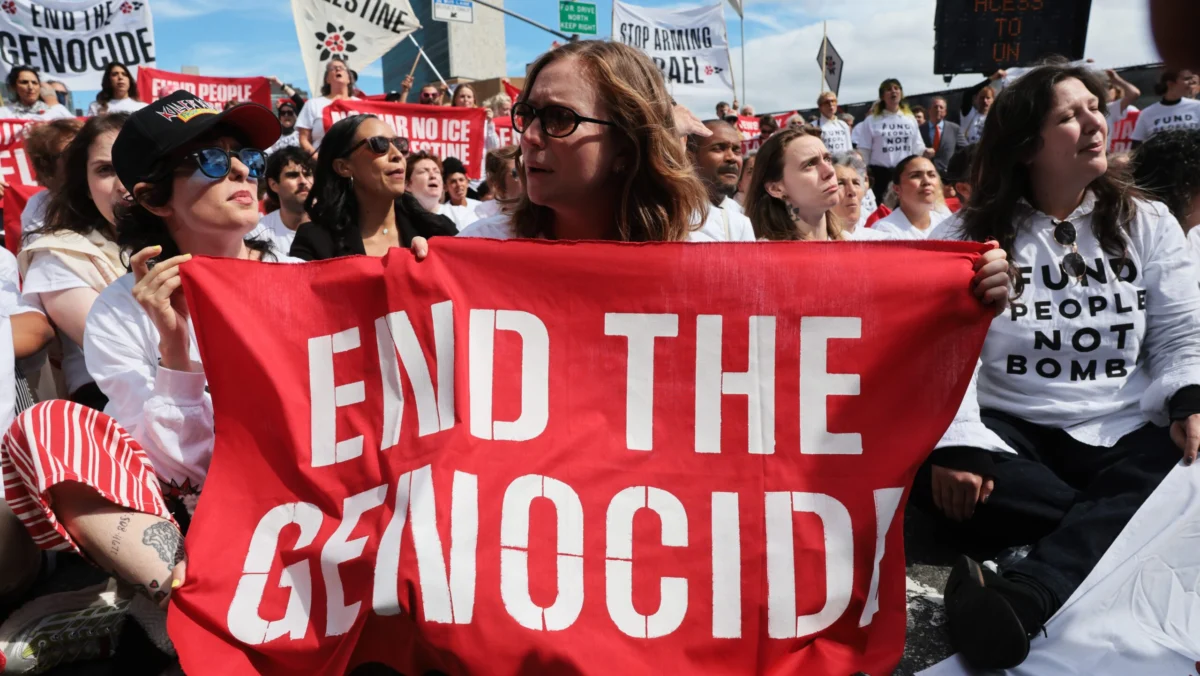
The intersection of high-profile activism and international diplomacy reached a flashpoint on Thursday in New York City, as actress and comedian Hannah Einbinder, best known for her breakout role in the critically acclaimed series Hacks, was taken into police custody during a demonstration protesting the presence of Israeli Prime Minister Benjamin Netanyahu. The protest, which occurred ahead of Netanyahu’s address to the United Nations General Assembly, saw a cohort of celebrities and activists detained by the New York City Police Department after blocking a major thoroughfare in Manhattan.
Einbinder was joined in the demonstration by other notable figures in the entertainment industry, including Academy Award-winning actress Susan Sarandon, comedian Caleb Hearon, and Saturday Night Live cast member Sarah Sherman. The protest, which saw approximately 100 participants, was organized to voice opposition to the ongoing military campaign in Gaza and the perceived complicity of the United States government in the humanitarian crisis.
A Chronology of the Demonstration
The events of Thursday unfolded as international dignitaries gathered in New York for the annual UN General Assembly, a period typically characterized by heightened security measures and significant protest activity. According to reports from the New York City Police Department, the demonstration began as an unscheduled gathering, quickly escalating as protesters moved to occupy a key intersection near the United Nations headquarters.
As the crowd swelled, law enforcement officers from the NYPD’s Community Affairs Bureau were deployed to manage the disruption. According to a spokesperson for the NYPD, officers issued multiple verbal warnings to the participants, explicitly advising them that their presence in the roadway was unauthorized and that they were required to disperse to avoid arrest. Despite these warnings, a significant portion of the group, including Einbinder, Sarandon, and Hearon, remained in the intersection. Following their refusal to comply with dispersal orders, officers proceeded to take the individuals into custody on charges related to disorderly conduct and obstructing vehicular traffic.
Einbinder’s Public Statement and Advocacy
In the hours following her release, Hannah Einbinder took to social media to provide a formal statement, framing her arrest not as a singular event, but as a deliberate act of civil disobedience intended to amplify the urgency of the humanitarian crisis in Gaza and Southern Lebanon.
"If the pictures of my friends and me getting arrested in protest of Netanyahu’s shameful visit to New York draw attention to anything, let it be to the devastating genocidal war Israel is waging against people of Palestine and Southern Lebanon," Einbinder wrote on her Instagram Story. She emphasized the human cost of the conflict, specifically citing settler violence, the demolition of civilian homes, and the ongoing aerial bombardments that have displaced millions.
Einbinder’s statement also sought to challenge the political status quo in Washington. "The US government has the power to bring an end to all of this killing, pillaging, and land theft, yet instead it chooses to welcome the butcher of Gaza with open arms," she continued. She argued that the geopolitical support provided to Israel by both Republican and Democratic administrations renders them complicit in the humanitarian catastrophe. Her call to action concluded with a link to Pal Humanity, an organization focused on humanitarian relief efforts for Palestinians.
Historical Context and Previous Activism
This incident is not the first time Einbinder has used her public platform to advocate for Palestinian rights. Her arrest on Thursday follows a pattern of outspokenness that has characterized her career trajectory over the past year. Notably, during her acceptance speech for Outstanding Supporting Actress in a Comedy Series at the 2025 Emmy Awards, Einbinder delivered a pointed conclusion to her remarks: "I just wanna say, finally, go birds, fuck ICE and free Palestine."
The involvement of figures like Susan Sarandon—who has been a consistent presence at various demonstrations regarding the Israel-Hamas conflict—and the participation of current SNL cast members reflects a growing trend of intersectional activism within Hollywood. For many of these participants, the goal is to bridge the gap between popular culture and international politics, leveraging their social capital to force public discourse on issues they feel are underrepresented by mainstream media outlets.
Data and Humanitarian Implications
The protests in New York occurred against a backdrop of escalating tensions in the Middle East. Since the outbreak of hostilities in October 2023, the death toll in Gaza has reached levels described by the United Nations as "catastrophic." Reports from the UN Office for the Coordination of Humanitarian Affairs (OCHA) indicate that more than 80% of the population in Gaza has been displaced, with a significant percentage of residential infrastructure rendered uninhabitable.
Furthermore, international organizations have warned of a looming famine and the collapse of the healthcare system in the region. The criticism leveled by protesters against the United States stems from the fact that the U.S. remains the largest supplier of military aid to Israel. Critics argue that this aid, which continues despite intense international pressure for a ceasefire, effectively grants the Israeli government impunity to continue its military operations.
Official Responses and Legal Framework
The NYPD’s response to the protest adheres to standard operating procedures for demonstrations that impede public safety. The "unscheduled" nature of the march meant that participants had not secured the necessary permits to close down city streets, a prerequisite for organized protests in New York City. The police spokesperson noted that the arrests were a direct consequence of the failure to comply with lawful orders, rather than the content of the protest itself.
While the legal fallout for those arrested remains to be seen—typically resulting in summonses for disorderly conduct—the broader implications of the event are likely to persist. The arrest of high-profile actors serves to keep the issue of the humanitarian crisis in the news cycle, potentially placing increased pressure on elected officials to re-evaluate their foreign policy stances.
Broader Impact and Political Implications
The arrest of Einbinder and her colleagues occurs at a critical juncture for both U.S. domestic politics and international diplomacy. With the UN General Assembly acting as a global stage, the visibility of these protests serves as a counter-narrative to the formal diplomatic engagements taking place inside the assembly hall.
For the entertainment industry, the incident highlights a widening generational and ideological divide. As younger artists increasingly view their professional success as a mandate for social and political advocacy, the industry faces ongoing debates regarding the role of celebrities in public policy. While some argue that such advocacy brings necessary attention to ignored issues, others contend that it risks oversimplifying complex geopolitical conflicts.
Ultimately, the demonstration on Thursday serves as a microcosm of the intense polarization surrounding the Israeli-Palestinian conflict. By choosing to prioritize the visibility of the humanitarian crisis over their personal freedom, individuals like Einbinder are signaling a commitment to a cause that shows no signs of waning. Whether these actions will yield tangible changes in foreign policy remains a subject of intense debate, but the integration of celebrity protest into the machinery of international diplomacy ensures that the conversation will continue to be held in the public square, rather than exclusively behind closed doors.
As of the publication of this article, representatives for Einbinder have not provided additional comments regarding potential future legal actions or further demonstrations. The ongoing dialogue, however, remains fixed on the intersection of individual conscience and the collective responsibility of global powers in the face of what many activists define as an urgent humanitarian crisis. The protests in New York are expected to continue throughout the remainder of the UN General Assembly session, signaling that the tension between official state rhetoric and grassroots activism will remain a defining feature of the current geopolitical landscape.