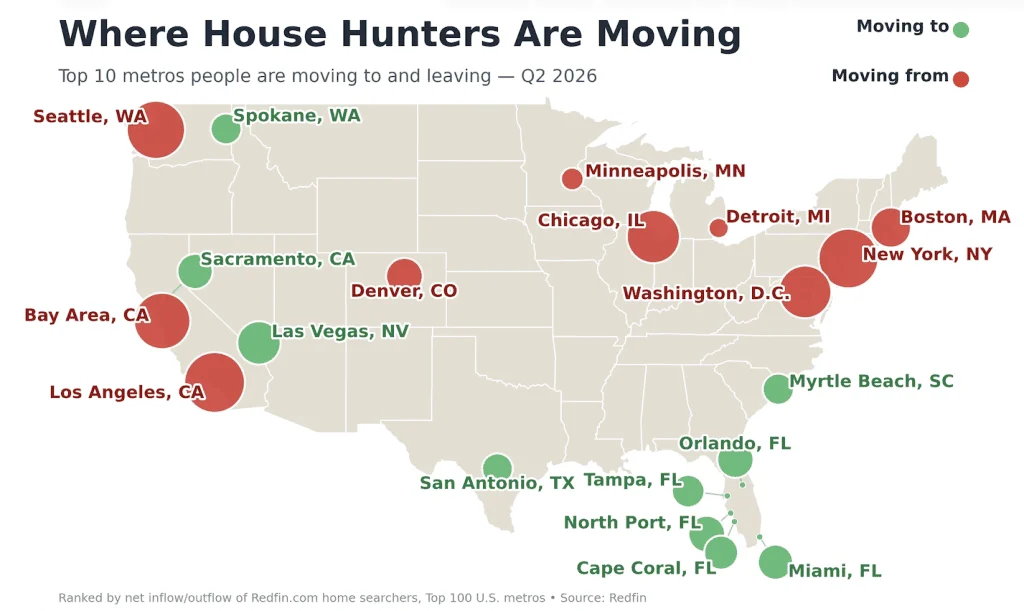
The American housing landscape is undergoing a profound structural shift as record numbers of prospective buyers prioritize affordability and climate over the traditional allure of coastal economic centers. Data from the second quarter of 2026 reveals that Las Vegas, Nevada, has emerged as the nation’s most sought-after destination for house hunters, while major coastal metros—specifically Los Angeles, New York, and Seattle—are experiencing significant net outflows. This migration pattern, tracked through the digital footprints of millions of homebuyers and renters on Redfin, underscores a growing national trend: the pursuit of the "Sun Belt" dream driven by a relentless search for lower entry-point pricing and the flexibility of the modern remote workforce.
The Shift Toward Sun Belt Affordability
The second quarter of 2026 solidified a trend that has been simmering for years. Nine of the ten most popular destinations for prospective homebuyers are located within the Sun Belt region, a geographic area stretching across the southern tier of the United States known for its warmer climate and relatively lower cost of living. Following Las Vegas, which claimed the top spot with a net inflow of 9,581 house hunters, Florida dominates the top ten list. North Port, Orlando, Miami, and Cape Coral occupy four of the top six positions, signaling that the Sunshine State remains the premier landing pad for domestic migrants.
The primary driver of this movement is the stark disparity in real estate valuation. In Las Vegas, the median home price currently hovers around $447,000. For a resident living in Los Angeles—the primary source of incoming migrants to Las Vegas—that price represents a dramatic reduction from the $922,000 median price point commonly found in the Southern California market. This price delta acts as a powerful economic lever, compelling families and individuals to trade proximity to coastal job hubs for larger, more affordable properties in the desert and the Southeast.
The Exodus from Coastal Economic Powerhouses
While the Sun Belt thrives on net growth, the traditional economic engines of the United States are grappling with a significant loss of population. Los Angeles, New York, and Seattle are currently losing more prospective buyers than any other metro area in the country. This trend is not merely a result of rising interest rates or general market volatility; it is a fundamental re-evaluation of what households are willing to pay for urban amenities.
For example, a typical home in New York City is valued at approximately $832,000. When residents look to relocate, they are increasingly drawn to more budget-friendly alternatives like Philadelphia, where the median home price is $309,000. This pattern is repeated across the country: San Jose residents are looking toward Sacramento, and Seattleites are turning their sights toward Portland. These departures suggest that the "prestige tax" of living in major coastal hubs is no longer sustainable for a significant segment of the population, particularly as high-income earners seek to maximize their purchasing power in emerging regional markets.
Chronology of a Shifting Market
The current wave of migration is the culmination of a multi-year trajectory that began in earnest during the 2021 pandemic recovery. In early 2021, the widespread adoption of remote work protocols allowed a segment of the workforce to decouple their residence from their office location. By 2023, this temporary behavior evolved into a permanent preference for many, leading to a sustained migration pattern.
By the second quarter of 2026, the share of house hunters looking to move to a different metro area reached 18.7%. While this represents only a slight increase from the 18.1% observed in the second quarter of 2025, it marks the highest level of geographic mobility for a second quarter since record-keeping began in 2021. The timeline indicates that while the initial urgency of pandemic-era relocation has stabilized, the preference for secondary, more affordable cities has become a normalized aspect of the American housing market.
Statistical Deep Dive: A Tale of Two Realities
The state-level data provides an even broader perspective on this realignment. Florida leads the nation in total net inflow, welcoming 38,922 new prospective residents in the second quarter of 2026. This figure is staggering, as it eclipses the combined net inflow of Arizona, South Carolina, and Tennessee—the next three most popular states.

Conversely, California remains the epicenter of the outflow crisis. With a net loss of 56,548 house hunters, California’s exodus is nearly double that of New York, which ranks second in net departures. The severity of these numbers highlights a critical challenge for urban planners in the West and Northeast: maintaining a tax base and labor force in an era where the workforce is increasingly mobile. The northern industrial states, including Illinois, Washington, and Massachusetts, are also facing sustained pressure as residents look to diversify their living situations.
The Role of Remote Work and Lifestyle Choices
Economists often point to the "Zoom Town" phenomenon as the catalyst for these shifts, but the reality is more complex. While remote work provides the technical means to relocate, the desire for a better quality of life—defined by lower density, better weather, and higher housing inventory—is the primary catalyst.
However, it is vital to contextualize these findings. While the share of house hunters looking to relocate is at an all-time high, the overall volume of homebuying activity remains sluggish compared to the frenzy of 2021 and 2022. Because the total pool of buyers has shrunk due to broader macroeconomic pressures, the total number of people actually moving may be lower than in previous years, even if the percentage of those looking to move out of their home region remains elevated. This suggests that the current housing market is characterized by a "wait and see" approach, where only those who have a strong incentive to move—such as those seeking immediate affordability—are actively engaging in the market.
Implications for Future Urban Development
The implications of this mass migration are significant for both the receiving and origin cities. For Sun Belt metros like Las Vegas, San Antonio, and Orlando, the rapid influx of residents brings a host of logistical challenges, including the need for expanded infrastructure, water management, and public services to accommodate the population growth. These cities are transitioning from regional hubs into major national centers of commerce, which necessitates a shift in urban planning and policy.
For the origin cities, the departure of tax-paying residents and skilled labor forces creates a fiscal squeeze. As these cities lose residents, they must reconcile their high costs of living with a shrinking demand for housing in certain tiers. This may lead to a period of correction in urban real estate, potentially lowering entry barriers for future residents, or it may necessitate a pivot toward attracting different types of industries that do not rely on a massive, local-resident labor pool.
Methodology and Data Reliability
It is important to note that this analysis is based on active search patterns on Redfin.com, capturing both homebuyers and renters. A user is defined as a potential migrant only if they view at least 20 for-sale or for-rent properties in a destination metro area within a single month. This threshold ensures that the data captures serious intent rather than casual browsing.
The analysis utilizes the Combined Statistical Area (CSA) level to define metros, providing a comprehensive view of how people move between large geographic regions. While this data is a robust indicator of intent, it should be read with the understanding that it includes individuals searching for secondary, vacation, or investment properties, which may inflate the numbers in tourist-heavy destinations like Myrtle Beach or Miami.
Conclusion
The second quarter of 2026 has provided clear evidence that the American housing market is in a period of geographic rebalancing. The era of the "coastal-only" economic model is being tested by the reality of affordability constraints and the modern desire for flexibility. As households continue to vote with their feet, the Sun Belt will likely continue to absorb the growth that coastal cities can no longer sustain. For policymakers and industry stakeholders, the data serves as a definitive roadmap of where the next generation of American homeowners is planting their roots, and why they are leaving the traditional power centers behind.