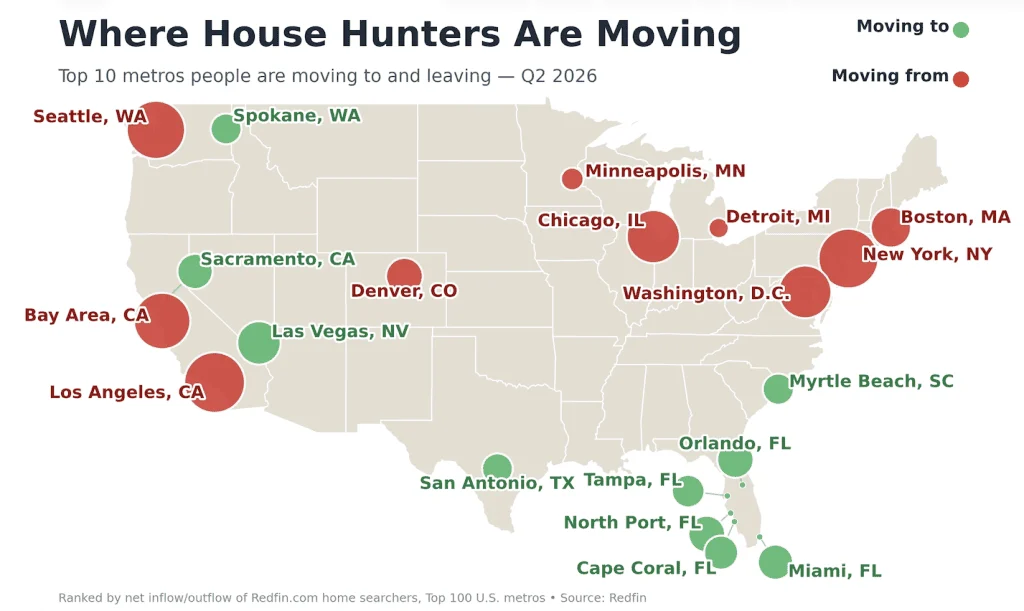
The landscape of American residential mobility is undergoing a profound transformation as the second quarter of 2026 reveals a decisive exodus from the nation’s most expensive coastal hubs toward the more budget-friendly corridors of the Sun Belt. According to recent data from Redfin, a growing number of prospective homebuyers and renters are actively prioritizing affordability, signaling a sustained shift in where Americans choose to live, work, and build wealth. Las Vegas has emerged as the most sought-after destination in the United States, outpacing traditional migration hotspots in Florida and the South.
This migration pattern, characterized by a net inflow of residents into regions with lower cost-of-living indices, highlights a broader socioeconomic realignment. As housing inventory remains tight and interest rates continue to shape affordability, the appeal of cities like Las Vegas, North Port, and Orlando has surged. Conversely, high-density, high-cost metropolitan areas including Los Angeles, New York, and Seattle are experiencing record-breaking levels of outbound interest, as residents look for a reprieve from the aggressive pricing models that have defined those markets for decades.
A Chronology of the Shift: From Pandemic Pulse to Sustained Trend
The current migration trend is not an overnight phenomenon but rather the culmination of years of changing lifestyle preferences that were catalyzed by the COVID-19 pandemic in 2020. Between 2021 and 2023, the sudden shift toward remote and hybrid work models fundamentally broke the tether between employment and geography for millions of workers.
By 2024, the "search for space" began to evolve into a "search for value." As inflation impacted household budgets across the country, the disparity in median home prices became a primary driver for relocation. Throughout 2025, real estate analysts noted a cooling in the migration intensity, but by the second quarter of 2026, the data confirmed that the desire for more affordable housing had not dissipated. It had, instead, become a permanent feature of the modern real estate market. The current data, covering the period through June 2026, suggests that the geographic reorganization of the American workforce is now firmly rooted in the pursuit of long-term financial stability.
The Economics of Relocation: Price Arbitrage as the New Norm
The driving force behind this mass movement is simple economic arithmetic. When a household decides to leave a city like Los Angeles, where the median home price sits at approximately $922,000, and moves to Las Vegas, where the median price is roughly $447,000, they are engaging in a form of geographic price arbitrage. This move allows a family to drastically reduce their mortgage-to-income ratio or, in many cases, purchase a larger, more modern home for half the cost of their previous residence.
This phenomenon is replicated across the country. In the Northeast, for example, the move from New York City to Philadelphia is often motivated by the fact that the median home price in the Big Apple is nearly triple that of the City of Brotherly Love. This delta is too significant for many families to ignore, particularly those planning for long-term savings or preparing for retirement.
Regional Winners: The Sun Belt Dominance
Florida remains the undisputed titan of the current migration wave. The state’s ability to attract residents is nearly unparalleled, with North Port, Orlando, and Miami occupying three of the top four spots on the national list for net inflow. The allure of Florida is multifaceted, combining a lack of state income tax with a warmer climate and a robust inventory of newer, single-family homes that cater to the suburban-seeking demographic.
Beyond Florida, the Sun Belt continues to thrive as a collective region. Nine out of the top ten most popular destinations for house hunters in Q2 2026 are located in the Sun Belt, including:

- Las Vegas, NV: Leading the nation with a net inflow of 9,581 users.
- North Port, FL: Serving as a major draw for families originating from the Midwest.
- Orlando, FL: A top destination for those exiting the New York metropolitan area.
- Miami, FL: Continuing its trend as a global hub attracting both domestic and international capital.
- Sacramento, CA: Acting as a localized "relief valve" for the prohibitively expensive Bay Area.
- Cape Coral, FL: A growing favorite for retirees and remote workers alike.
- Tampa, FL: Benefitting from a diversified economy and proximity to the Gulf Coast.
- Myrtle Beach, SC: A rising destination for those seeking coastal living at a fraction of the cost of California or New England.
- Spokane, WA: Drawing residents from the Pacific Northwest who are priced out of Seattle.
- San Antonio, TX: Capitalizing on the broader economic growth of the Texas Triangle.
The Coastal Exodus: Why Major Hubs Are Losing Their Grip
While the Sun Belt gains, the traditional centers of gravity—Los Angeles, New York, Seattle, and the Bay Area—are seeing significant net outflows. This is not necessarily a sign of economic decline for these cities, but rather a correction in their demographic composition. These metros have long acted as "incubator" cities, where young professionals go to launch their careers, only to find that the cost of homeownership becomes unsustainable as they approach their 30s and 40s.
The net outflow statistics are striking. Los Angeles saw a net loss of 28,652 prospective buyers in the second quarter, while New York followed closely with a loss of 27,143. These departures represent a loss of human capital that could have long-term implications for the tax bases and public infrastructure of these regions. Urban planners are now grappling with how to incentivize long-term residency in these cities when the "entry-level" cost of a home remains so high.
Statistical Context and Migration Methodology
To understand these figures, one must look at how Redfin tracks this data. The analysis focuses on "net inflow" and "net outflow"—metrics that track the difference between those searching to move into a metro area versus those looking to move out. A user is categorized as a "migrant" if they view at least 20 for-sale or for-rent properties in a destination metro area within a single month.
It is important to note that this data reflects search intent rather than finalized real estate transactions. However, historically, these search patterns act as a leading indicator for actual relocation. While the overall volume of homebuying remains lower than the peak years of 2021 and 2022 due to higher interest rates and a smaller pool of active buyers, the proportion of those buyers who are looking to relocate is at its highest point since records began in 2021. Nearly 18.7% of all house hunters in the second quarter were searching for a home in a different metro area than their current residence.
Broader Implications for the American Housing Market
The current trend toward migration has several far-reaching implications for the national economy:
- Infrastructure Stress: Cities like Las Vegas, Orlando, and San Antonio are experiencing rapid population growth that places immense pressure on local infrastructure, from road networks to water supply and school capacity. Local governments in these areas are being forced to accelerate urban planning and zoning reforms to accommodate the influx.
- Economic Diversification: As remote workers relocate to secondary and tertiary cities, they bring higher-than-average salaries with them. This "remote work premium" can stimulate local businesses and service industries but can also inadvertently drive up local housing costs, potentially pricing out long-time residents of these smaller metros.
- The Future of the Office: The fact that migration is still trending upward suggests that the return-to-office mandates issued by some major corporations have not yet been enough to reverse the geographic diversification of the American workforce. Employees continue to prioritize the flexibility of location over proximity to traditional corporate headquarters.
Official Perspectives and Market Outlook
While no single official body has released a formal statement regarding these specific Q2 2026 figures, economic analysts observe that this trend is a rational market response to the persistent mismatch between housing supply and demand in the coastal U.S.
"The migration we are seeing is essentially a search for equilibrium," notes one industry analyst. "People are voting with their feet. When a household can move from a $900,000 market to a $450,000 market and experience a comparable quality of life—or sometimes better—the decision becomes inevitable. The challenge for the next decade will be for those popular destination cities to manage their growth sustainably so they don’t eventually become as expensive as the cities people are fleeing."
As we move into the second half of 2026, the trajectory of this migration appears set to continue. Unless there is a massive shift in housing policy, a significant correction in coastal home prices, or a complete reversal of remote work adoption, the flow of Americans from the expensive coastlines to the interior Sun Belt will remain the defining story of the domestic real estate market. The geographic map of the United States is being redrawn, one household at a time, based on the pursuit of a more accessible version of the American Dream.