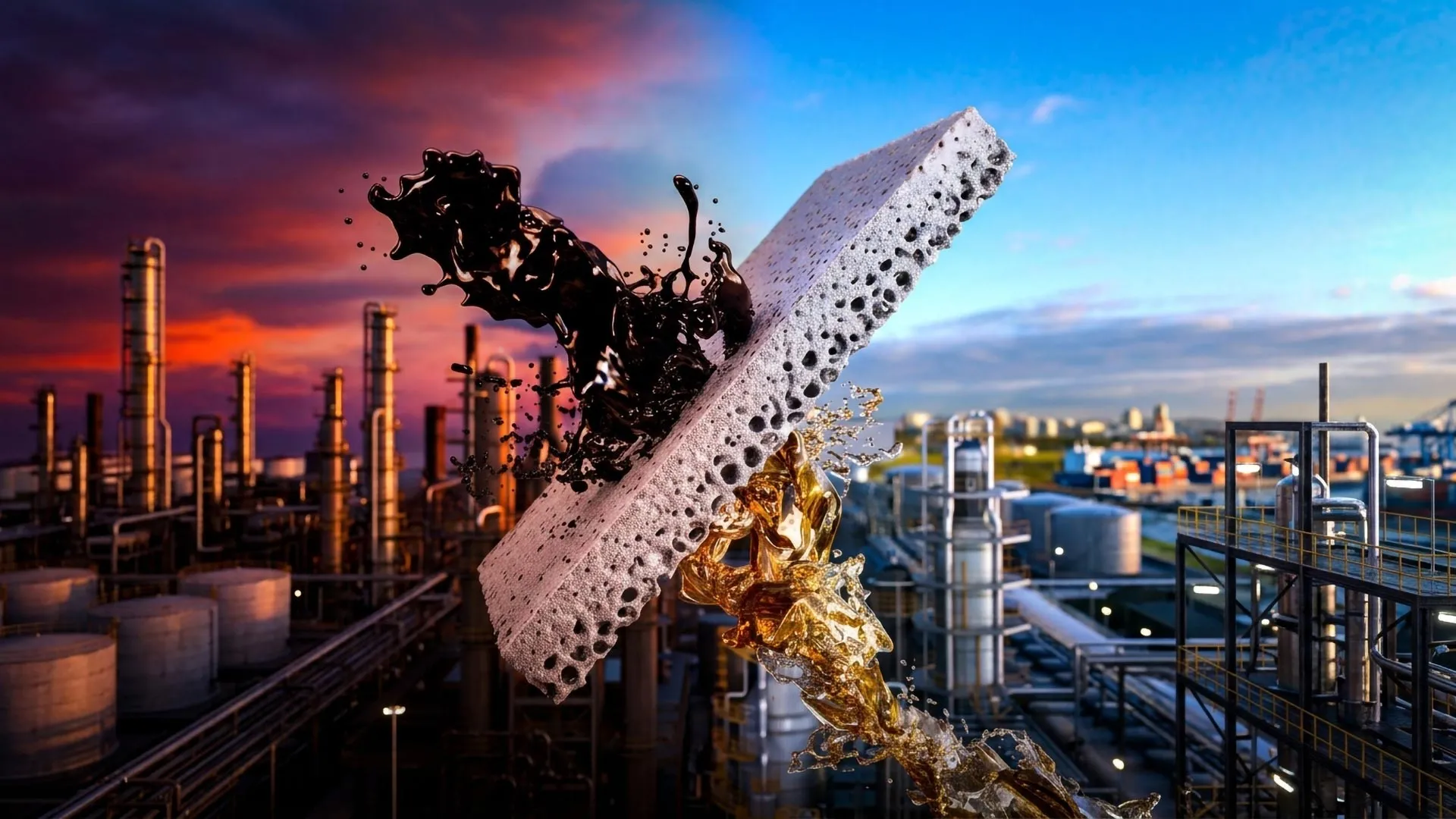
For over a century, the global petrochemical industry has operated on a foundational, energy-intensive premise: to separate crude oil into its usable components, one must subject it to intense heat. This process, known as thermal distillation, involves heating crude oil to temperatures exceeding 350°C, a practice that has remained the backbone of modern industrial civilization despite its immense carbon footprint. However, a landmark study published in the journal Nature has unveiled a disruptive alternative. An international team of researchers, led by Professor Dong-Yeun Koh of the Korea Advanced Institute of Science and Technology (KAIST) and Professor Ryan Lively of the Georgia Institute of Technology, has successfully demonstrated a method to separate crude oil at room temperature using an inexpensive, self-assembling membrane. This innovation promises to slash energy consumption, reduce operational costs, and significantly lower the greenhouse gas emissions associated with the production of everything from gasoline to the raw materials used in plastics and textiles.
The Problem with Thermal Distillation
To understand the significance of this discovery, one must first appreciate the scale of the process it aims to replace. Crude oil distillation is a massive, global energy sink. Annually, the process consumes approximately 1,100 terawatt-hours (TWh) of energy. To contextualize this figure, the energy required for distillation globally is equivalent to the total annual electricity generation of roughly 130 nuclear power plants, each operating at a capacity of one gigawatt.
This extreme reliance on thermal energy is not merely a financial burden; it is a critical environmental challenge. The refining industry is responsible for a significant share of global industrial carbon dioxide emissions, largely due to the furnaces required to boil crude oil. As economic pressures mount and global climate policies shift toward net-zero targets, the petrochemical sector has faced urgent calls to innovate. For years, membrane-based separation was touted as the "holy grail" of refinery efficiency, promising to replace boiling with physical filtration. However, the technology was previously hindered by high costs, the need for complex, thin-film coatings, and the propensity for these coatings to develop defects at an industrial scale.
A Paradigm Shift: Turning Fouling into Function
The research team’s breakthrough stems from a counterintuitive approach. Conventional membrane design typically strives to prevent "fouling"—the process where material accumulates inside a membrane’s pores and clogs it. In standard filtration, fouling is viewed as a failure, necessitating frequent cleaning or membrane replacement.
The KAIST and Georgia Tech team, however, intentionally utilized a bare, uncoated membrane made from porous polyacrylonitrile (PAN). PAN is a chemically stable, inexpensive polymer commonly used in industrial filtration as a support material. When the team introduced crude oil to this seemingly simple filter, they observed an unexpected phenomenon. As the oil permeated the membrane, heavier hydrocarbon molecules began to accumulate along the internal walls of the pores.
Rather than rendering the membrane useless, this accumulation served a constructive purpose: it constricted the pores, shrinking them into extremely narrow, microscopic channels measuring less than 2 nanometers in width. In effect, the crude oil acted as its own architect, spontaneously constructing the precise filtration channels required to separate its own molecular components. The result was a membrane that allowed lighter, high-value fractions—such as naphtha, gasoline, and kerosene—to pass through with high flux, while effectively rejecting heavier components.
Performance Metrics and Industrial Viability
The empirical results of this self-assembling mechanism were striking. The uncoated PAN membrane achieved crude oil permeation rates approximately 23 times higher than those documented in previous literature for specialized, coated membranes. Furthermore, the system demonstrated remarkable durability, maintaining stable performance for 28 consecutive days of continuous operation.
Professor Ryan Lively of Georgia Tech noted the implications for the industry: "One of the key challenges facing membrane systems for crude oil separation was the low productivity of the membrane units. The PAN membranes, with their surprising separation mechanism, dramatically increase the productivity of the membrane unit, to the point where industry should seriously consider adopting the technology."
By validating the technology using actual crude oil supplied by HD Hyundai Oilbank, the research team ensured that their findings were grounded in industrial reality. This distinguishes their work from many laboratory-scale experiments that rely on simplified synthetic mixtures that fail to account for the complex, "dirty" chemistry of raw industrial feedstocks.
Economic and Environmental Projections
The potential impact of this technology is multifaceted. Because the membrane can be integrated as a modular filtration system preceding existing distillation infrastructure, refineries would not need to undergo a complete, prohibitively expensive overhaul of their facilities. Instead, the membrane could perform initial separations, significantly reducing the heat load required in downstream distillation columns.
Computer simulations conducted by the research team indicate that the full-scale adoption of this technology could result in a 31.6% reduction in energy consumption and a 37.6% decrease in CO2 emissions. Beyond energy, the cooling water consumption of a refinery could drop by 20.7%, and overall operating costs could see a 36% decline.
The environmental scale of these findings is vast. Estimates suggest that if this system were implemented throughout the refining and petrochemical industries in Korea alone, it could prevent approximately 10 million tonnes of greenhouse gas emissions annually—a volume roughly equivalent to the emissions produced by four million internal combustion engine vehicles. While these are currently projected figures, the data provides a compelling economic and environmental roadmap for the industry’s transition to lower-carbon operations.
Beyond Oil: A New Platform for Chemical Processing
While the initial focus has been on crude oil, the researchers suggest the underlying principle—spontaneous pore constriction via complex mixtures—could be applied to a variety of other sectors. One of the most promising applications is the processing of pyrolysis oil derived from recycled waste plastics. As the world struggles to manage plastic waste, the ability to refine pyrolysis oil into high-quality chemical feedstocks at lower energy costs is essential for the success of a circular economy.
The technology also holds potential for the pharmaceutical industry, particularly in the purification of complex compounds, and in the production of biofuels, which currently face similar energy-intensity challenges as petroleum refining. Additionally, the recovery of solvents in high-tech battery manufacturing represents a massive, untapped market for such robust, inexpensive membrane systems.
Future Outlook and Next Steps
Despite the success of the initial demonstrations, the path to commercialization involves clear engineering milestones. The researchers are now turning their attention to scaling up the manufacturing of these membranes and further testing their long-term reliability under even more extreme, real-world refinery conditions.
Professor Jae W. Lee of KAIST, a co-corresponding author, emphasized the necessity of this next phase: "By advancing large-area membrane modularization and long-term operational reliability, we hope to broaden the adoption of membrane-based processes throughout the refining and petrochemical industries."
The team’s co-first authors, Dr. Jihoon Choi and Dr. Hyeokjun Seo, added that their goal is to gain precise control over the pore-constriction phenomenon to create a versatile platform. "We aim to expand the technology to plastic recycling, biofuel purification, and other sustainable chemical processes that support carbon neutrality," they stated.
The research was funded by Korea’s Ministry of Science and ICT through the Basic Research Program for Outstanding Early-Career Researchers and the Engineering Research Center (ERC) Program. As the industry grapples with the transition away from fossil fuels, the ability to make existing processes significantly more efficient represents a vital bridge. By turning the traditional problem of "fouling" into a sophisticated tool for separation, the KAIST and Georgia Tech researchers have demonstrated that sometimes, the most effective solution is not to add complexity, but to find a way to let the process refine itself.