
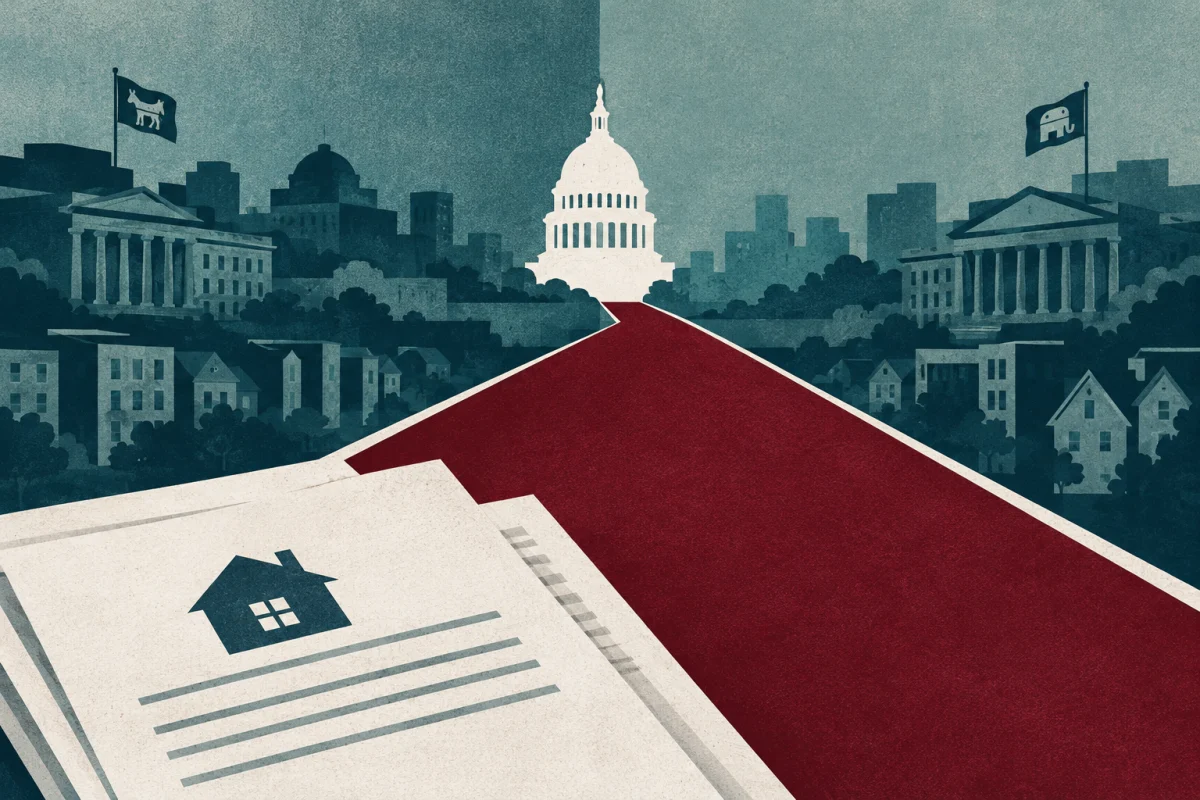
The American political landscape shifted significantly following Tuesday’s election results, creating a unique governing dynamic that will define the trajectory of national housing policy for the next two years. With the Democratic Party securing control of both the House of Representatives and the Senate, while a Republican-led administration prepares to occupy the White House, the stage is set for a period of high-stakes legislative negotiation. Housing industry stakeholders, including lenders, economists, and trade groups, are now assessing how this divided government will influence mortgage affordability, regulatory oversight, and the broader real estate market.
The central challenge facing policymakers is the persistent affordability crisis that has defined the post-pandemic housing market. Despite the political friction inherent in a split-branch government, industry leaders suggest that housing remains one of the few areas where bipartisan consensus is not only possible but likely necessary to meet voter demands.
The Legislative Landscape and the ROAD to Housing 2.0
As the new Congress prepares to convene in January, the focus is shifting toward practical, incremental policy improvements. Isaac Boltansky, head of public policy at Pennymac, noted that voters have signaled a clear frustration with the current state of the housing market, identifying it as the primary line item in their household budgets.
The industry is looking to build upon the momentum of the ROAD to Housing Act, which previously provided a framework for addressing supply-side constraints. Proponents are now calling for a “ROAD to Housing 2.0” package. Key components of this proposed legislation include addressing the "lock-in effect"—whereby homeowners are discouraged from selling due to high capital gains taxes or the disparity between current interest rates and the rates locked in on their existing mortgages—and expanding the Neighborhood Homes Investment Act. By incentivizing the rehabilitation of older homes and the development of new housing stock in distressed areas, lawmakers hope to alleviate the inventory shortage that has kept home prices elevated despite cooling demand.
Chronology of the Policy Shift
The transition toward this new legislative era follows a series of significant economic and political milestones:
- October 2024: The Mortgage Bankers Association (MBA) released a comprehensive policy road map aimed at reducing closing costs and expanding credit access, setting the stage for post-election advocacy.
- November 2024 (Election Night): Voters returned control of the House and Senate to the Democratic Party, while the Republican presidential candidate secured the White House.
- January 2025 (Upcoming): The new Congress will be sworn in, marking the commencement of committee assignments and the initiation of oversight hearings.
- 2027 (Anticipated): Economists and policy analysts expect a significant confrontation over the national debt ceiling, which will likely dominate the fiscal agenda and exert pressure on bond markets, directly influencing mortgage rates.
Data-Driven Perspectives on Market Volatility
The economic backdrop remains complex. Jake Krimmel, a senior economist at Realtor.com, emphasizes that while Democrats have a mandate to address pocketbook issues, the translation of that mandate into actionable legislation remains an open question. One of the primary variables remains the geopolitical climate, specifically the ongoing conflicts in the Middle East.
Historical data indicates that housing demand is highly sensitive to inflation, which is often exacerbated by energy costs. Should a resolution in the Middle East improve global oil supply, inflation could decelerate, potentially providing the Federal Reserve with the room needed to stabilize or lower mortgage rates. However, as Krimmel notes, the distance between desiring a peaceful resolution and achieving terms acceptable to all stakeholders is vast.
Furthermore, the bond market—the primary driver of mortgage interest rates—remains wary of the nation’s fiscal trajectory. Boltansky points out that the impending debt ceiling negotiations in 2027 will be a critical focal point for investors. Any signs of fiscal discipline or a clear plan to manage the national debt would likely be viewed favorably by the bond market, potentially easing the upward pressure on long-term borrowing costs.
Official Responses and Industry Priorities
Trade associations are already positioning themselves to engage with both the incoming administration and the new congressional leadership. The Mortgage Bankers Association has explicitly stated its intent to work across the aisle to advance common-sense proposals. Their current priorities include:
- Easing Credit Reporting: Reducing the reliance on tri-merge credit reports to streamline the mortgage application process.
- LLPA Alignment: Standardizing Loan-Level Price Adjustments to ensure greater transparency and fairness in pricing.
- FHA Premium Adjustments: Lowering the annual mortgage insurance premium for Federal Housing Administration (FHA) loans to reduce the monthly burden on first-time and low-to-moderate-income homebuyers.
Conversely, the American Land Title Association (ALTA) is urging lawmakers to ensure that, in the pursuit of affordability, consumer protection remains a non-negotiable priority. ALTA has highlighted the rise of sophisticated fraud schemes that threaten property rights, arguing that the security of title is as critical to a healthy market as the affordability of the underlying loan.
Executive Authority vs. Legislative Oversight
A critical nuance in the current political environment is the distinction between legislative agenda-setting and executive regulatory control. Tim Rood, CEO of Impact Capitol, warns that observers should not expect an "overnight rewrite of the rules."
While the Democratic-controlled committees in the House and Senate will wield significant power—including the ability to initiate investigations, conduct hearings, and withhold confirmation of executive nominees—the regulatory agencies themselves remain under the influence of the executive branch. Trump’s administration will continue to control the leadership of major regulatory bodies.
This creates a dynamic of "contested implementation." Policy analysts anticipate that the coming months will be defined by a tug-of-war over which existing regulations are funded and defended. For example, the nomination of Brian Johnson to lead the Consumer Financial Protection Bureau (CFPB) has already become a point of contention. Democrats may use their control of the Senate confirmation process to demand broader concessions on financial agency appointments, effectively using the confirmation process as leverage for other legislative goals.
The Unfinished Regulatory Agenda
Several key issues remain in a state of regulatory limbo. The industry is closely watching for updates on the loan originator compensation rule, which has been under review. Lenders are seeking changes that would allow for more flexibility in clawing back compensation in specific scenarios, arguing that such reforms would increase credit availability for borrowers. Currently, however, these adjustments remain stalled as the industry waits for a signal from the regulatory agencies.
As Scott Norman, CEO of the Texas Mortgage Bankers Association, aptly observed, the political process is designed for change, and the current shift in power should be viewed as an opportunity for a fresh assessment of policy. "In much of the world, a change in power signals a crisis," Norman said. "Here, it simply means new leadership and a fresh look at policy."
Broader Implications and Outlook
The next two years will be a test of whether a divided Washington can prioritize the economic stability of the American housing market over partisan objectives. The convergence of interest rates, supply chain constraints, and regulatory reform represents a complex puzzle that will require cooperation from the White House, the Treasury, and Congress.
While the legislative branch may move to pass measures like the "ROAD to Housing 2.0," the effectiveness of these policies will ultimately depend on their implementation within the executive agencies. If the legislative and executive branches can find common ground on even a subset of these priorities—such as lowering FHA premiums or reforming capital gains structures—the potential for incremental improvement in market accessibility is significant.
Ultimately, the housing sector remains at the intersection of macroeconomic health and individual opportunity. As lawmakers and regulators navigate the complexities of this new political reality, the industry will continue to advocate for policies that prioritize transparency, efficiency, and the long-term sustainability of the American dream of homeownership. The road ahead is unlikely to be smooth, but the consensus among industry leaders is that the current political environment, while challenging, provides a necessary platform for a renewed focus on the housing issues that matter most to the American public.